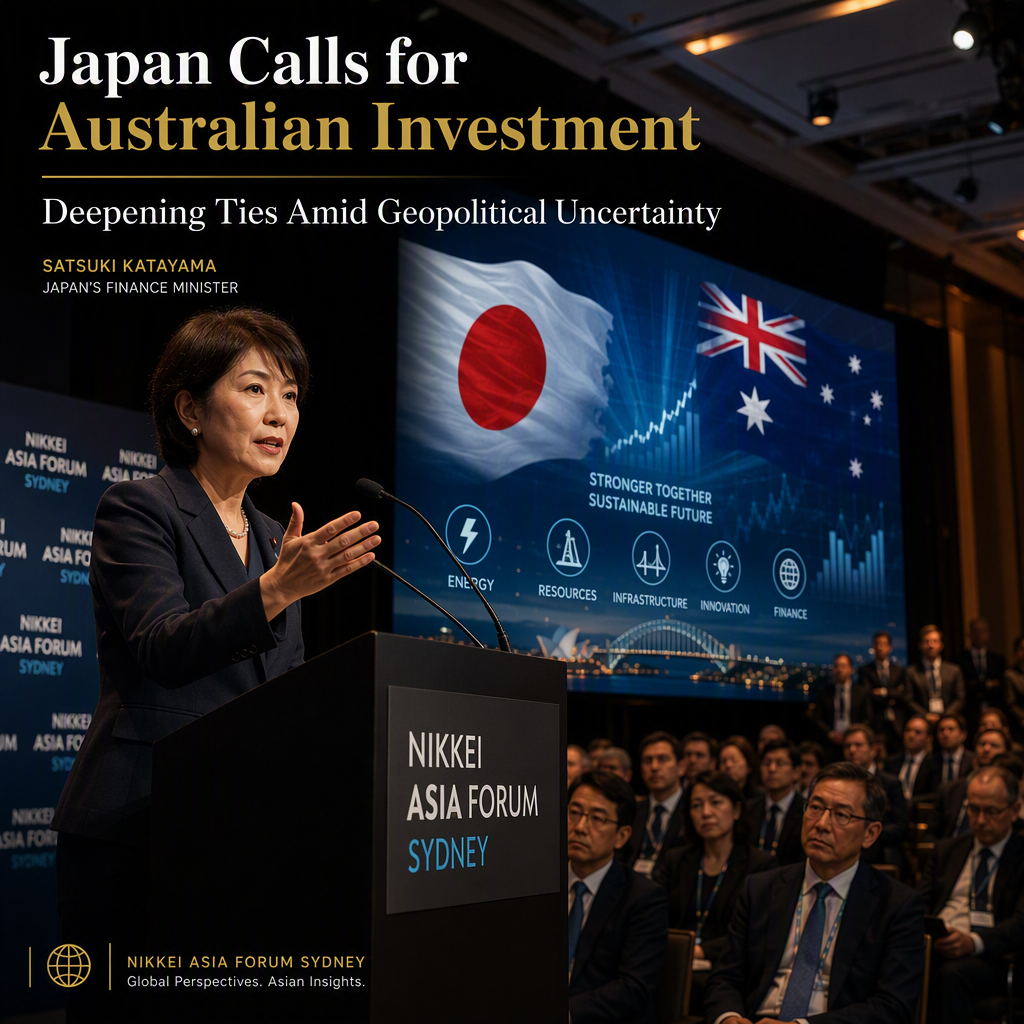
Japan's Minister of Finance, Satsuki Katayama, has called for increased investment from Australia, specifically targeting financial services firms and a broader range of investments. This appeal was made during her address at the Nikkei Asia Forum Sydney, where she highlighted the significance of Australia-Japan relations in the context of rising geopolitical tensions and regional fragmentation [1]. Katayama emphasized Australia's 'indispensable' role as a supplier of energy and minerals to Japan, describing the bilateral relationship as a 'stabilizing power in the region' [1].
Katayama noted that Japanese reforms aimed at facilitating the entry of overseas firms have resulted in more than 50 foreign financial institutions, including some from Australia, establishing operations in Japan over the past five years [1]. She underscored the importance of finance in supporting investment and capital flows, stating, 'As we deepen cooperation in the real economy, the role of finance in supporting investment and capital flows becomes ever more important' [1].
The minister expressed hope that ongoing reforms would drive sustainable growth and long-term value creation, ultimately strengthening economic and financial cooperation between Japan and Australia. She concluded her remarks by stating, 'Through continued reform, we will pursue sustainable growth and long-term value creation. I hope these efforts will deepen economic and financial cooperation between Japan and Australia and contribute to our shared prosperity' [1].
The Nikkei Asia Forum Sydney, now in its fourth iteration in Australia, focused on the future of Australia-Japan relations amid a volatile global environment shaped by the presidency of U.S. President Donald Trump and China's continued rise [1].
CONCLUSION
Japan is actively seeking to attract Australian investment, particularly in financial services, as part of broader reforms to facilitate overseas firms. The minister's statements signal a positive outlook for deepening economic ties and sustainable growth between the two countries. Market participants may view this as a medium-impact development, given the emphasis on reforms and cross-border cooperation.