
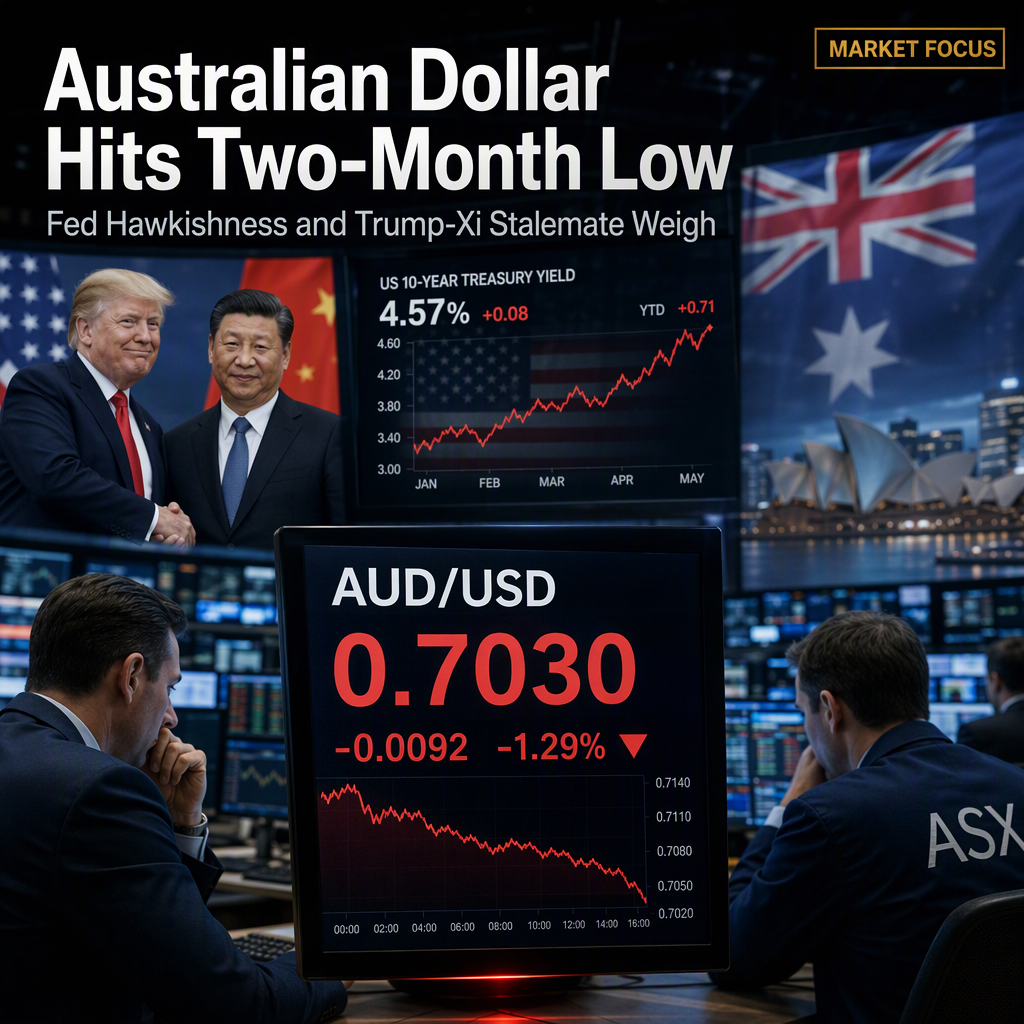
The Australian Dollar (AUD) edged higher against the US Dollar (USD) on Friday but remained on track for a 1.3% weekly decline, marking its third consecutive week of losses. The AUD/USD pair traded near 0.7030, its lowest level in almost two months, after briefly testing the key 0.7000 psychological threshold earlier in the day [1].
The lack of any significant outcome from the summit between US President Donald Trump and Chinese President Xi Jinping contributed to the subdued sentiment. While both leaders praised each other and emphasized the need for 'win-win' cooperation during their meetings, no relevant agreements were reached, and contentious issues such as Taiwan and the Middle East conflict were left unaddressed. This underscored the ongoing mistrust between the two global powers [1].
Meanwhile, the US Dollar was bolstered by a hawkish repricing of the Federal Reserve's outlook and surging US Treasury yields. Strong US business activity data, rising wages, and higher energy prices reinforced expectations that the Fed may need to hike interest rates further to prevent economic overheating. Philadelphia Fed President Anna Paulson indicated that 'modest' rate increases might be necessary to bring inflation to target, while New York Fed President John Williams stated it is 'sensible to expect another rate increase by year-end' [1].
Strategists at OCBC highlighted that resilient US economic data, elevated energy prices, and persistent inflation concerns are driving Treasury yields higher, supporting the USD and pressuring rate-sensitive and carry-oriented assets like the AUD. They cautioned that a stronger-than-expected US employment report could further reinforce market expectations for Fed tightening, keeping US yields elevated and providing additional support for the USD [1].
CONCLUSION
The Australian Dollar remains under pressure amid a lack of progress at the Trump-Xi summit and a hawkish shift in US monetary policy. With the Fed signaling potential further rate hikes and US yields climbing, the AUD is likely to face continued headwinds in the near term.