
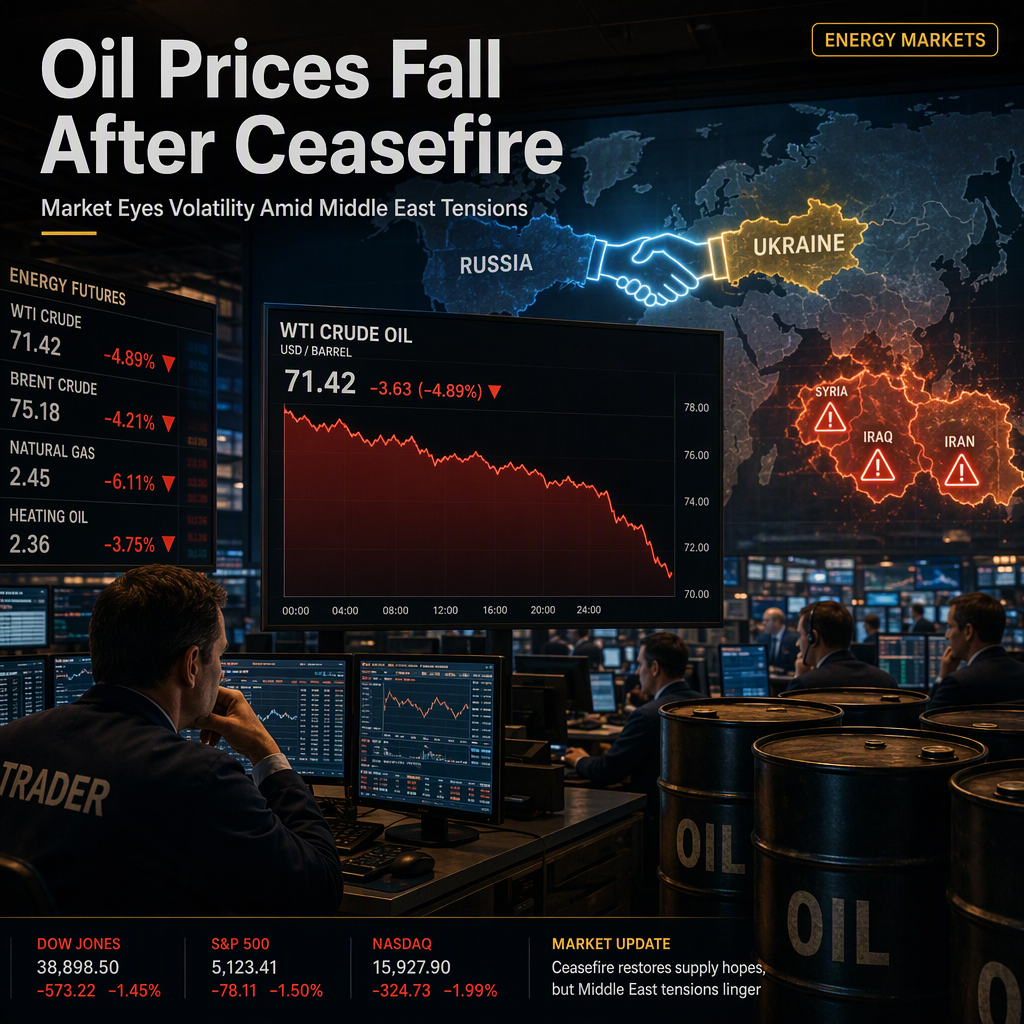
Oil prices declined on Monday following President Donald Trump's announcement of an 'energy ceasefire' between Russia and Ukraine, stating that both countries have agreed not to target each other's energy facilities [1]. Trump declared, 'Effective immediately, there is an ENERGY CEASEFIRE in the War between Russia and Ukraine. Both parties have agreed. Do not break it!' via social media [1]. Ukrainian President Volodymyr Zelenskyy confirmed Ukraine's support for the ceasefire and emphasized the importance of Russia's commitment [1].
In response to the news, Brent crude futures for December delivery fell 1.65% to $102.99 a barrel, while U.S. West Texas Intermediate (WTI) futures for November dropped 1.92% to $90.09 per barrel [1]. The market also reacted to Trump's statement that Russia will supply more than 4 million tons of diesel to the global market under a deal he struck with President Putin during a phone call [1].
Meanwhile, geopolitical tensions in the Middle East continued to influence market sentiment. Iran's Minister of Foreign Affairs, Abbas Araghchi, reached out to Saudi Arabia's Foreign Minister, Faisal bin Farhan bin Abdullah, to discuss recent regional escalations and efforts to address them. Araghchi indicated Iran's readiness to assist in initiating dialogue between Saudi Arabia and Yemen's Houthis, following Houthi missile strikes on Riyadh airport that killed 12 and injured over 300 people [1].
Analysts at UOB noted that oil prices are expected to remain volatile in the near term due to ongoing U.S.-Iran tensions and the impact of Hurricane Isaias, which has strengthened to Category 3 and forced U.S. energy producers to curtail offshore output [1]. UOB also highlighted that the recent Houthi attacks have materially elevated Middle East risk premia [1].
CONCLUSION
The announcement of an energy ceasefire between Russia and Ukraine led to a decline in oil prices, but ongoing Middle East tensions and weather-related supply disruptions are expected to keep markets volatile. Analysts warn that risk premia remain elevated, and near-term price movements will likely reflect both geopolitical developments and supply-side uncertainties.