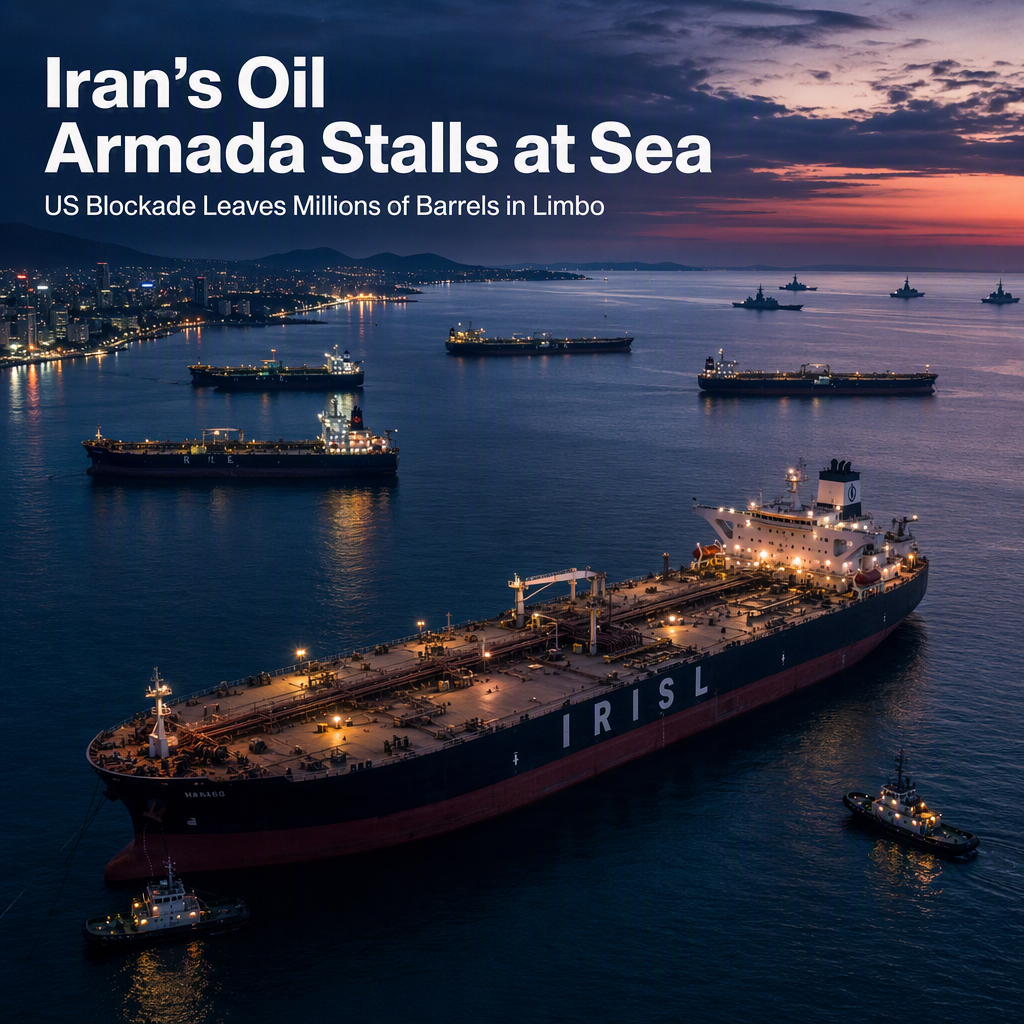
The United States has intensified its blockade on Iranian oil exports, with 46 Iranian oil ships currently trapped by US naval forces, and Iran's oil storage tanks now 77% full [1]. Despite these efforts, nearly 40 million barrels of Iranian crude—equivalent to about 20 very large crude carriers—are sitting aboard tankers in waters near Malaysia, east of Singapore, outside the immediate reach of the blockade [1]. This floating stockpile represents a significant challenge for the Trump administration, which has shifted from military action to a financial 'endgame' against Tehran, as described by Treasury Secretary Scott Bessent, who announced Operation Economic Outcast and a 'zero-leakage approach' to cut off Iran's remaining oil revenue [1].
The blockade has already impacted Iran's oil exports, with China's imports of Iranian crude dropping to an estimated 534,000 barrels per day so far this month, down from approximately 823,000 barrels per day in July, according to provisional Kpler data reported by Reuters [1]. However, an estimated 80 million barrels of Iranian crude remain in floating storage, with about half of that volume aboard vessels near Malaysia [1]. This oil, which moved beyond the blockade line before enforcement tightened, could still be monetized by Iran through ship-to-ship transfers, a tactic used to obscure the oil's origin before it reaches buyers, often independent Chinese refineries [1].
Max Meizlish, a former Treasury official and current senior fellow at the Foundation for Defense of Democracies, noted that the current enforcement of the blockade is not fully stopping the flow of Iranian oil that has already passed the blockade line [1]. The ability of Iran to sell this oil could provide the regime with funds to pay for imports and potentially finance military rebuilding, undermining the US goal of 'total isolation' [1]. The tankers near Malaysia thus represent an early test of whether the administration can achieve its stated objectives [1].
CONCLUSION
The US blockade has significantly reduced Iran's new oil exports, but a large volume of Iranian crude remains outside the blockade's reach and could still be sold through ship-to-ship transfers. This situation poses a critical challenge to the US strategy of total economic isolation, as Iran may continue to generate revenue from oil already beyond the blockade line.