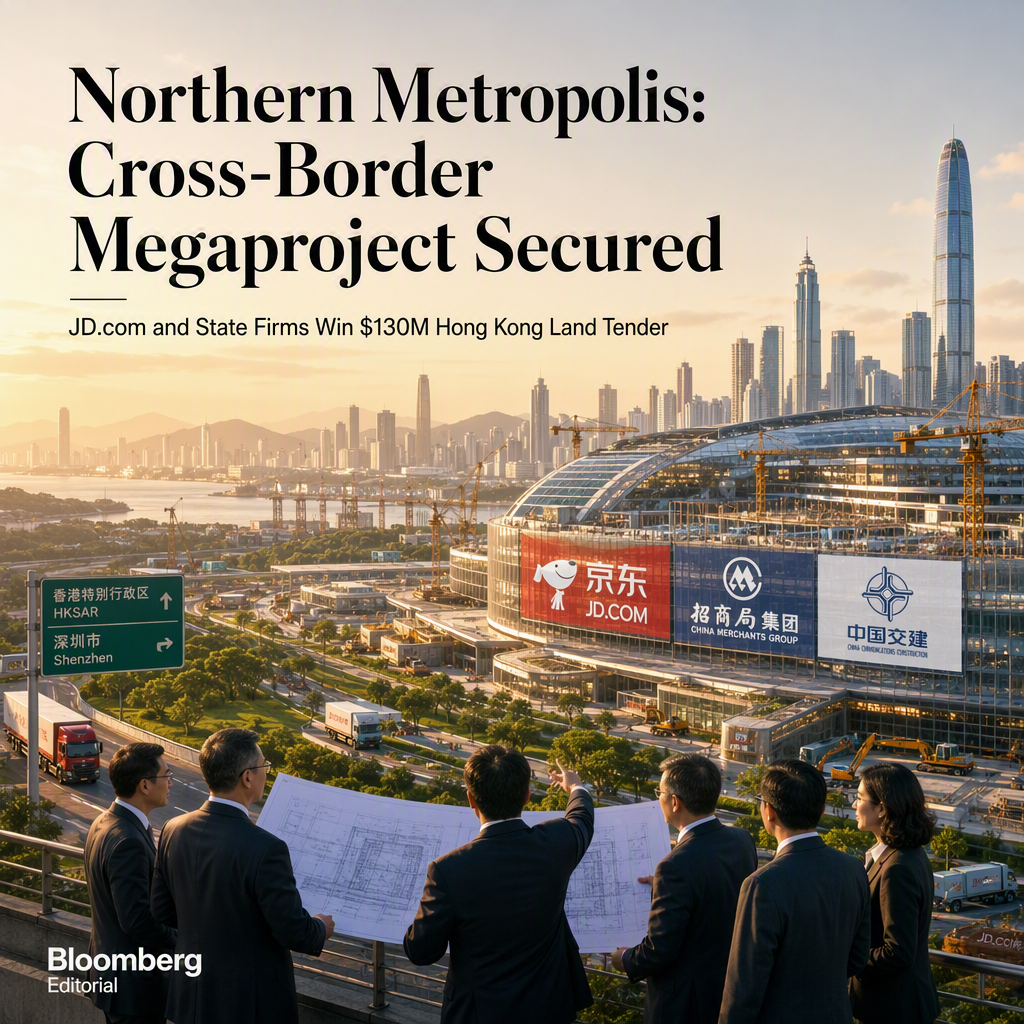
A consortium of six companies, including e-commerce giant JD.com and several Chinese state-owned enterprises, has won the first government land sale in Hong Kong's Northern Metropolis for $130 million, marking a significant milestone in the city's strategic development plan near the border with mainland China [1]. This tender underscores the growing influence of mainland Chinese capital in Hong Kong's real estate sector and is seen as a pivotal step in boosting economic integration with the Greater Bay Area, as well as expanding both residential and commercial capacity in the region [1].
The Northern Metropolis project is designed to transform the area into a new economic engine for Hong Kong, leveraging a development model that combines private sector innovation with state-backed financial resources [1]. Market participants are closely monitoring the impact of mainland involvement on pricing, demand, and the pace of development, with analysts highlighting this tender as a bellwether for future collaboration between Hong Kong and mainland developers, especially as the city seeks to revitalize its property market amid broader economic uncertainties [1].
A senior property analyst at a major brokerage stated, "The successful bid by the consortium sends a strong signal about the continued appetite for cross-border investment and the strategic importance of the Northern Metropolis" [1]. The government is expected to announce additional land sales in the area, with global developers and investors watching closely for technical requirements and financial performance of these pioneering projects [1]. The integration of advanced logistics, technology infrastructure, and sustainable design is anticipated to set new benchmarks for Hong Kong's property sector [1].
CONCLUSION
The successful $130 million land tender by a JD.com-led consortium highlights robust cross-border investment interest and the strategic significance of Hong Kong's Northern Metropolis. Market participants view this as a key indicator for future collaboration models and property market revitalization, with further land sales and innovative development standards expected.