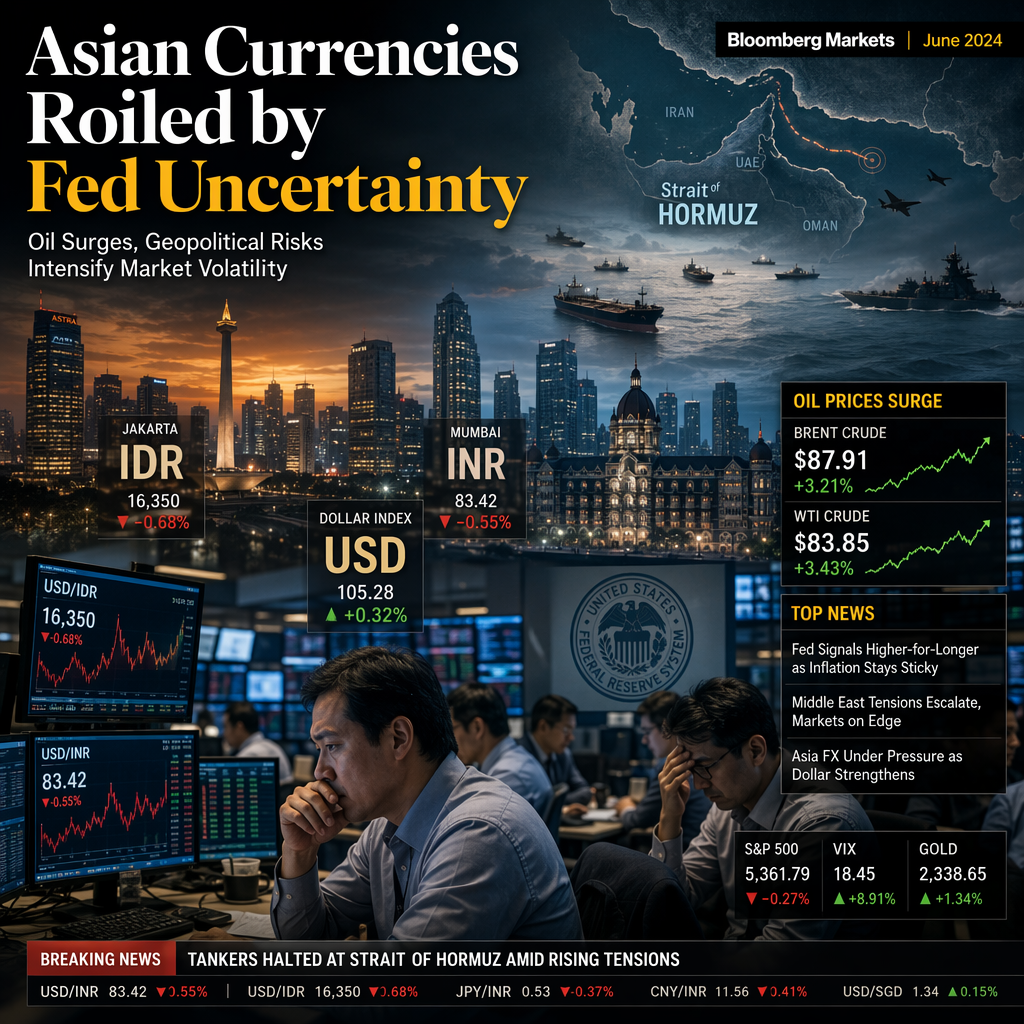
The Indonesian Rupiah (IDR) and Indian Rupee (INR) both experienced notable volatility against the US Dollar (USD) on Wednesday, driven by uncertainty surrounding the Federal Reserve's upcoming policy decision and heightened geopolitical risks in the Middle East. The USD/IDR pair depreciated after two days of gains, trading around 18,120 during Asian hours, as the US Dollar struggled ahead of the Fed's announcement. Traders are pricing in a 30.5% chance of an immediate rate hike, with a 76.6% probability of a rate increase in September, suggesting expectations for elevated global borrowing costs to persist [1]. Meanwhile, the USD/INR pair rebounded to near 95.85, as oil prices surged 4.3% to Rs. 7,930 in the MCX Crude Oil contract expiring August 19, following renewed geopolitical tensions. India, which imports 85% of its energy needs, faces increased foreign outflows from reserves due to higher oil prices [2].
The geopolitical backdrop intensified after US Central Command (CENTCOM) and Saudi Arabia conducted precision strikes in Iraq targeting Iran-backed groups, raising fears of a prolonged closure of the Strait of Hormuz—a critical passage for nearly 20% of global energy supply. The Iranian Islamic Revolutionary Guard Corps (IRGC) reported that three oil tankers were 'struck and stopped' in the Hormuz, indicating ongoing disruptions to energy transport and a continued squeeze on global oil supply [2].
In Indonesia, the surprise resignation of Bank Indonesia Governor Perry Warjiyo on Monday added to market uncertainty, raising concerns about the central bank's institutional independence. This event weighed heavily on Indonesian assets, compounding the impact of falling approval ratings for President Prabowo Subianto, which dropped to 51.1% in a recent SMRC survey, down from 81.2% in November last year and 66.4% in March [1].
Ahead of the Fed's policy announcement, the US Dollar Index (DXY) traded 0.13% lower near 101.25. The CME FedWatch tool indicated a 69.5% chance that the Fed will leave rates unchanged at 3.50%-3.75%, marking the fifth consecutive meeting with no change. Chairman Kevin Warsh previously stated that 'so-called forward guidance is not well-suited in the current policy juncture,' suggesting limited monetary policy guidance from the Fed [2].
Additionally, a sharp decline in South Korea's KOSPI stock market, driven by falling shares of SK Hynix, is expected to redirect global investor flows back to Indian equities, potentially strengthening the INR in the near term [2].
CONCLUSION
Asian currencies are facing heightened volatility due to Fed policy uncertainty and geopolitical risks impacting oil prices and investor sentiment. The Indonesian Rupiah is pressured by domestic political developments, while the Indian Rupee is vulnerable to rising energy costs but may benefit from shifting global equity flows. Overall, market sentiment remains cautious as traders await the Fed's decision and monitor ongoing geopolitical developments.