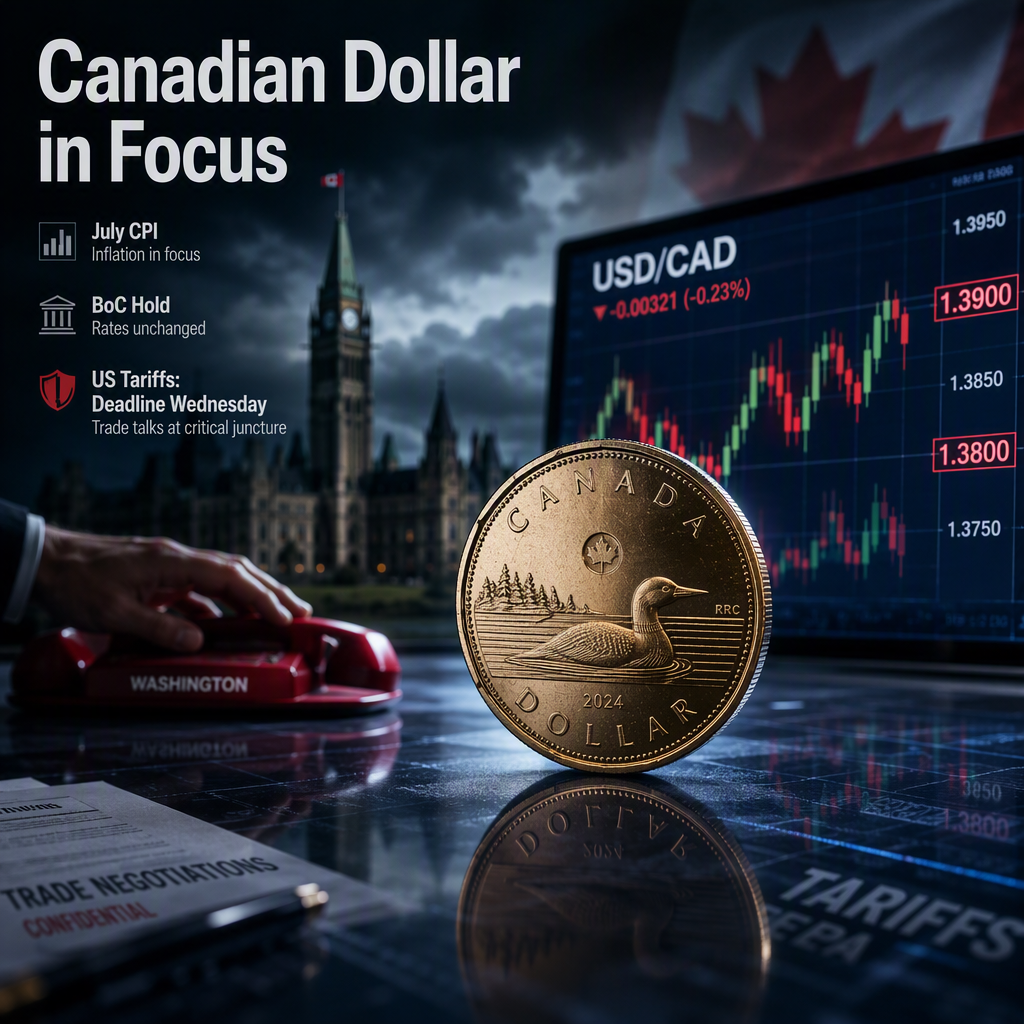
The Canadian Dollar (CAD) is under the spotlight as markets await the release of July Consumer Price Index (CPI) data and monitor the potential imposition of US Section 338 tariffs on Canadian exports. Economists expect headline CPI to rise by 2.9% year-over-year in July, up from June’s 2.8%, with core inflation projected at 2.2% or slightly lower at 1.85% according to TD Securities, and a monthly increase of 0.4% driven by food and energy prices [4][8]. The Bank of Canada (BoC) kept its policy rate steady at 2.25% at its July 15 meeting, and is widely expected to maintain this rate through 2026, with gradual hikes anticipated in 2027 [4][8].
The BoC’s preferred inflation gauges—CPI-Common, Trimmed Mean, and Median—receded in June to 2.6%, 1.8%, and 1.9%, respectively [4]. While inflation lost some momentum in June, there is skepticism about whether this trend will continue into July, especially given ongoing oil price volatility and the potential impact of US tariffs [4][8]. TD Securities notes that Canadian officials have been negotiating with US counterparts to avert a 50% tariff on $20 billion of CAD exports, with a Wednesday deadline looming [8].
Retail sales are expected to remain flat in June, with stronger motor vehicle sales offset by weaker gasoline prices, and the ex-autos measure forecast to decline by 0.2% month-over-month [8]. Market participants expect just over 18 basis points of tightening by year-end, but the consensus is for the BoC to remain on hold in the near term [4][8].
The USD/CAD pair has been in a steady downtrend since late July, breaking below the 1.3900 support level for the first time since early June, largely tracking developments in Middle East conflicts and their impact on the US Dollar [4]. Technical analysis suggests further losses could bring the pair toward the 200-day SMA in the mid-1.3800s, while a rebound could target the 55-day SMA at 1.4060 [4].
Analysts highlight that if July’s inflation data reverses the recent decline, bets on further BoC rate hikes could increase, providing support for the Canadian Dollar [4]. However, the combination of persistent inflationary pressures, geopolitical volatility, and tariff risks continues to shape the near-term outlook for CAD [4][8].
CONCLUSION
Markets are closely watching Canada’s July CPI release and the outcome of US tariff negotiations, both of which could influence the Canadian Dollar’s trajectory. While the BoC is expected to hold rates steady in the near term, any upside surprise in inflation or escalation in trade tensions could prompt a reassessment of policy expectations and market positioning.