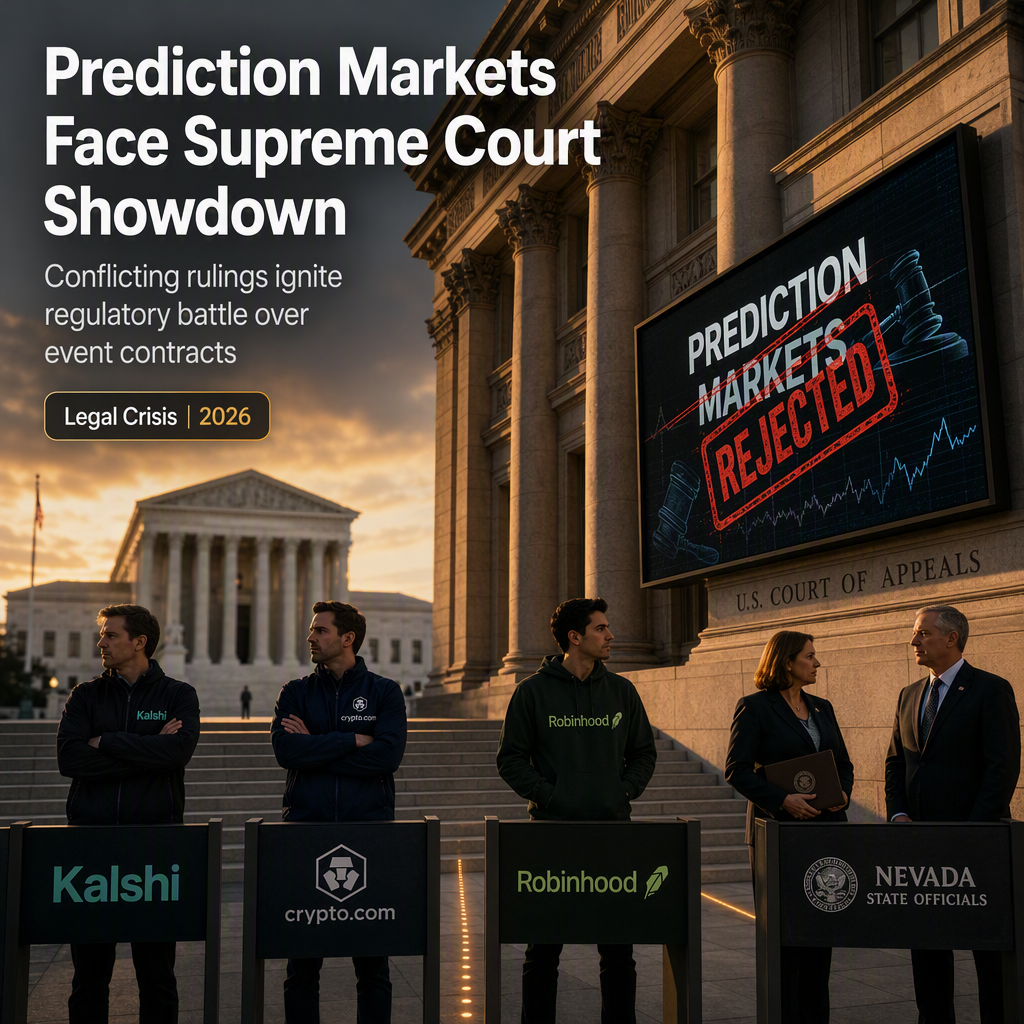
On August 28, 2026, the 9th U.S. Circuit Court of Appeals ruled against prediction market platforms in a significant legal battle concerning the classification of sports-related event contracts. The court determined that these contracts are not 'swaps,' rejecting the argument made by platforms such as Kalshi, Crypto.com, and Robinhood, as well as the Commodity Futures Trading Commission (CFTC), that all event contracts are derivatives regulated at the federal level [1]. This decision stands in direct contradiction to an earlier ruling by the 3rd U.S. Circuit Court of Appeals in April, which found that all event contracts are swaps and thus fall under CFTC regulation, setting the stage for a likely Supreme Court resolution [1].
The 9th Circuit specifically denied requests for injunctive relief from Kalshi, Crypto.com, and Robinhood, allowing Nevada to continue halting their operations on the grounds that these offerings constitute gambling outside the state's gaming control framework [1]. The court's opinion stated, 'The sports event contracts were not 'swaps' because they were sports bets,' reinforcing the position held by 44 states that such contracts are equivalent to sports betting [1].
The Nevada Attorney General's office hailed the ruling as a major victory, with deputy communications director Alcinia Whiters stating that the decision affirmed Nevada's authority to regulate sports betting and prevented companies from bypassing state gaming laws by labeling their products as federally regulated financial instruments [1].
In response, a CFTC spokesperson maintained that swaps are exclusively regulated by the commission and expressed disagreement with the court's interpretation that sports-related event contracts do not fall under the definition of swaps [1]. The CFTC has also initiated lawsuits against nine states to assert its regulatory authority over prediction markets [1].
The conflicting appellate court decisions have created significant legal uncertainty for prediction market platforms and their regulatory oversight, with the Supreme Court now expected to provide a definitive ruling on the matter [1].
CONCLUSION
The 9th Circuit's ruling against prediction market platforms marks a pivotal moment in the ongoing regulatory battle over event contracts, directly contradicting a previous appellate court decision. With both state and federal authorities asserting jurisdiction, the Supreme Court is now poised to resolve this high-stakes dispute, which could have far-reaching implications for the future of prediction markets in the United States.