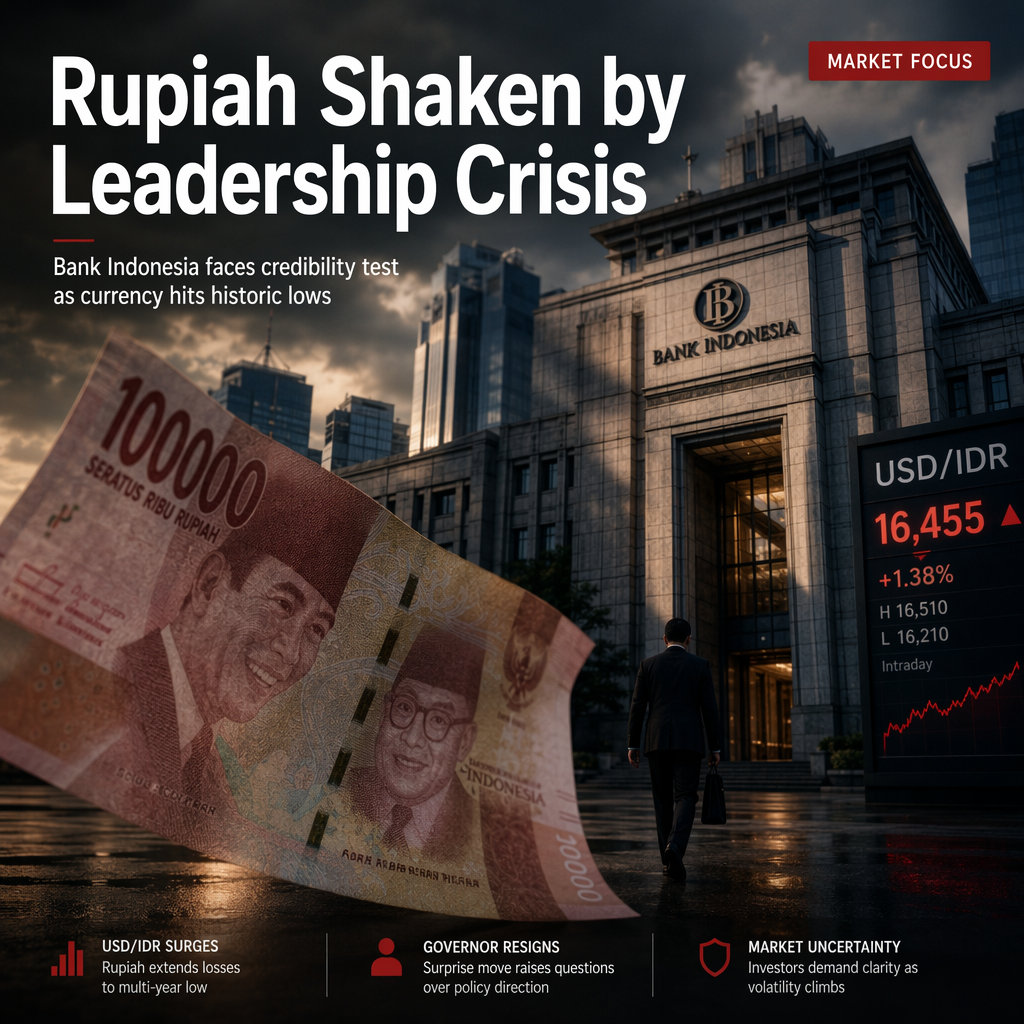
Bank Indonesia (BI) Governor Perry Warjiyo unexpectedly resigned yesterday, intensifying concerns over policy continuity and institutional credibility as the Indonesian Rupiah (IDR) trades near historic lows against the US Dollar (USD) [1]. Warjiyo, who had served as governor since 2018, cited personal reasons for his departure and will be temporarily replaced by Senior Deputy Governor Destry Damayanti [1]. This leadership change follows the earlier exit of former Finance Minister Sri Mulyani in 2025, who was widely seen as a pillar of fiscal discipline, further raising questions about the stability of Indonesia's economic policy direction [1].
The IDR has faced renewed depreciation pressure, with the USD/IDR exchange rate rising above 18,200 earlier this year—surpassing levels seen during the Asian Financial Crisis in 1997 [1]. The currency's weakness has been attributed to several factors, including a spike in global oil prices, doubts about BI's independence and policy credibility, the risk of Indonesia being downgraded to frontier-market status by MSCI, and concerns that increased fuel subsidy costs could push the fiscal deficit above the statutory ceiling of 3% of GDP [1].
Market participants are now closely watching the selection process for Warjiyo's permanent successor, as the choice is seen as critical for restoring confidence. The appointment of Senior Deputy Governor Damayanti is viewed as likely to reassure investors and provide policy continuity, while the potential selection of Deputy Governor Thomas Djiwandono, who is President Prabowo's nephew, could heighten concerns about central bank independence [1]. In the near term, the USD/IDR is expected to remain supported, limiting the potential for a sustained IDR recovery [1].
CONCLUSION
The surprise resignation of Bank Indonesia Governor Perry Warjiyo has heightened market concerns about policy continuity and institutional credibility, keeping the Indonesian Rupiah under pressure. The choice of his successor will be closely watched, with market sentiment likely to hinge on whether the new appointment reassures investors about central bank independence and policy direction.