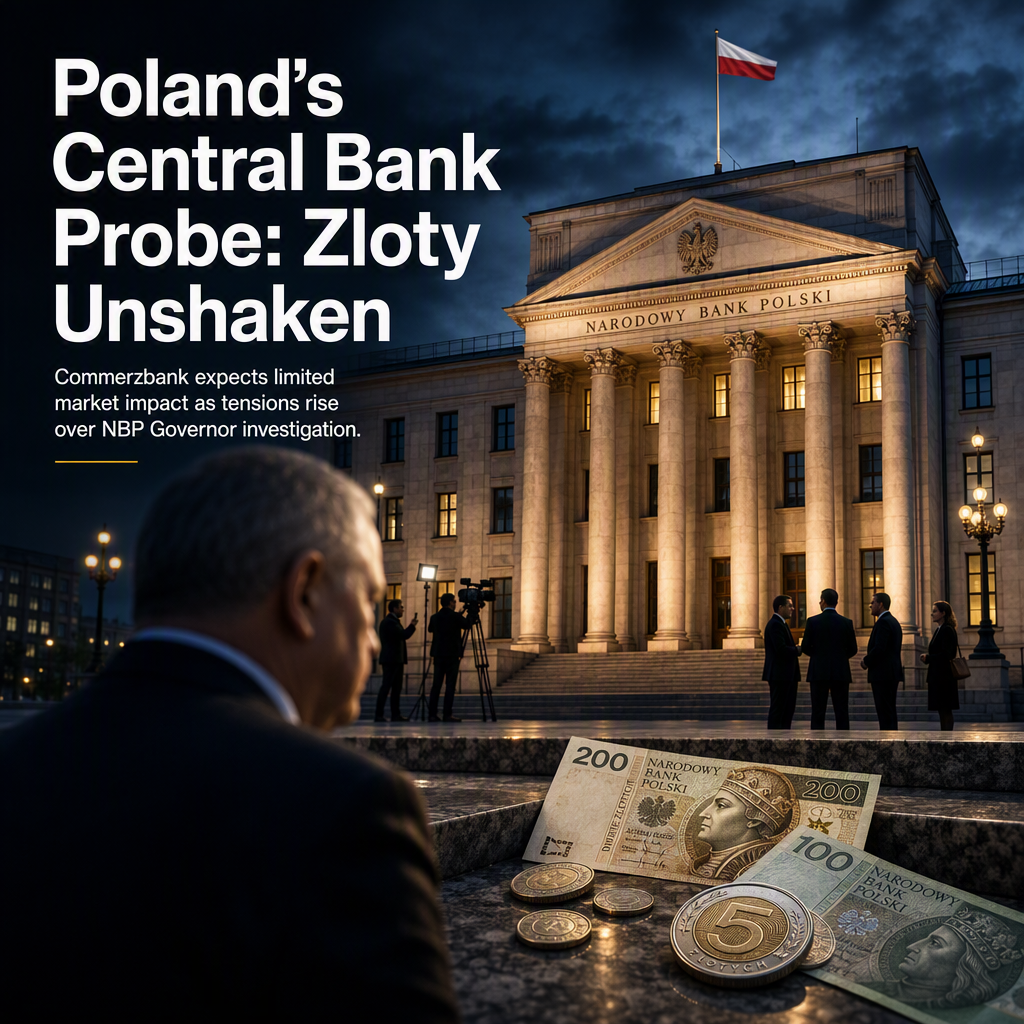
Commerzbank’s Tatha Ghose reports that Poland’s Sejm Constitutional Accountability Committee is accelerating efforts to hold National Bank of Poland (NBP) Governor Adam Glapinski accountable before the State Tribunal, amid allegations of politicising the central bank [1]. The committee, led by Zdzislaw Gawlik, aims to present its report before the end of the current parliamentary term in autumn 2027, having started its work in May 2024 by calling witnesses and examining claims against Glapinski [1].
Despite the renewed political tensions, including disputes over EU legislation and presidential vetoes, Ghose asserts that the process is unlikely to significantly affect monetary policy or the Polish Zloty (PLN) at this stage [1]. Glapinski has dismissed the proceedings, referencing the Constitutional Tribunal’s previous involvement and arguing that an absolute majority is insufficient for prosecution, which adds to the legal uncertainty and potential for further institutional disputes [1].
The situation is further complicated by political divisions, such as the split within the PiS party and ongoing presidential veto politics, which could turn the process into another political battleground. However, Commerzbank maintains that, as a base case, there is little expected impact on the zloty or monetary policy for now [1]. Speculation that the coalition had dropped the matter was reignited by Glapinski’s role in supporting President Karol Nawrocki’s veto of the EU’s SAFE bill [1].
CONCLUSION
Commerzbank sees the ongoing probe into NBP Governor Glapinski as having limited immediate impact on the Polish Zloty or monetary policy. While political risks remain, the market reaction is expected to be muted unless the situation escalates further.