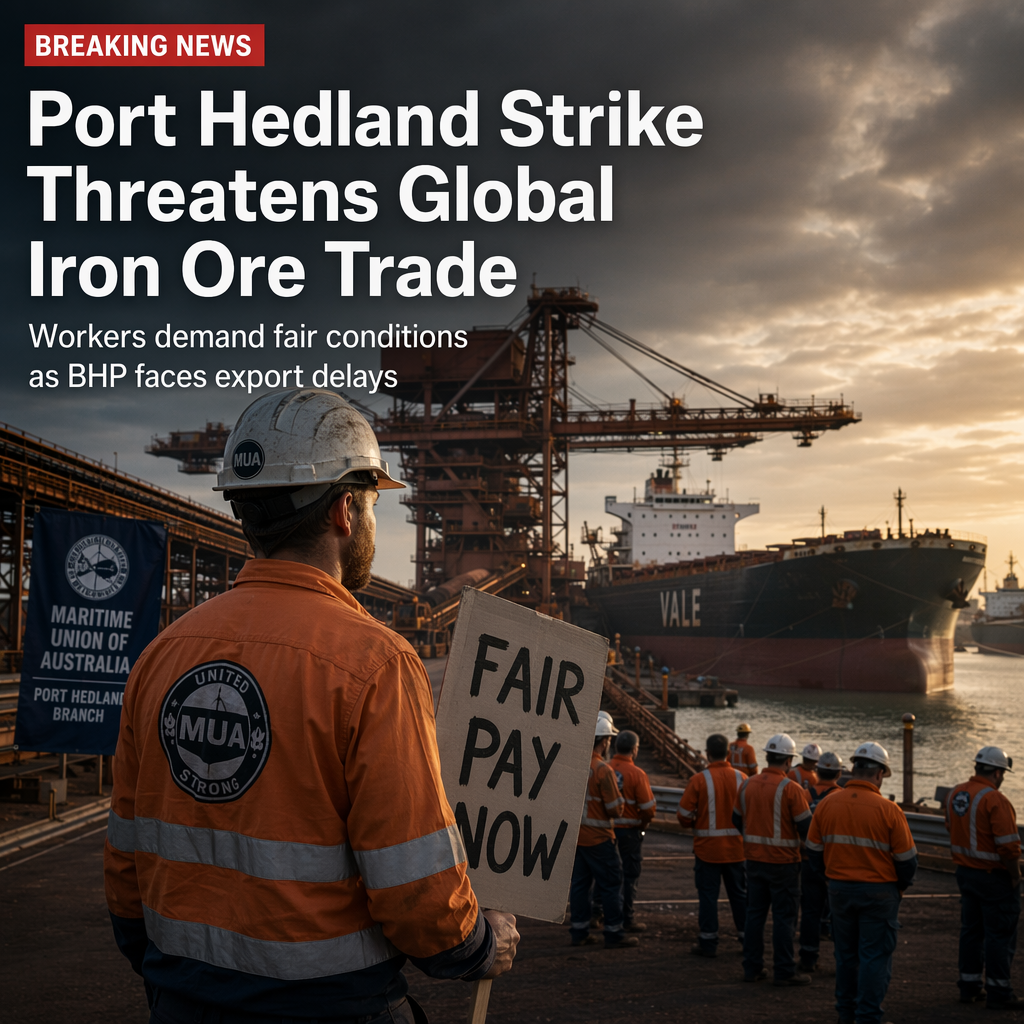
Unions representing workers at Port Hedland, the world's largest iron ore bulk export port in Australia, have announced plans for an 8-hour strike as negotiations with BHP over pay and working conditions continue [1]. The unions have not disclosed the exact timing of the walkout but have warned that the industrial action could cost BHP, one of the world’s largest mining companies, tens of millions of dollars and delay iron ore exports to steel mills in China, Japan, and South Korea [1].
A union representative stated that a one-day strike at Port Hedland could result in tens of millions of dollars in lost revenue due to delayed shipments [1]. Market analysts highlight that even a brief disruption at this key Pilbara region port can have a significant impact on global iron ore supply chains and commodity prices, given Port Hedland's critical role in supplying Asian steel mills [1].
The situation is being closely monitored by market analysts, as iron ore prices have demonstrated sensitivity to supply risks in Western Australia [1]. While the current strike is planned for 8 hours, analysts caution that a prolonged disruption could drive iron ore prices higher, with traders remaining vigilant for any escalation in the dispute [1].
CONCLUSION
The threatened strike at Port Hedland poses a significant risk to global iron ore supply chains and could have substantial financial consequences for BHP. Market participants are closely watching the situation, as any escalation or prolonged disruption may lead to increased iron ore prices and broader market volatility.