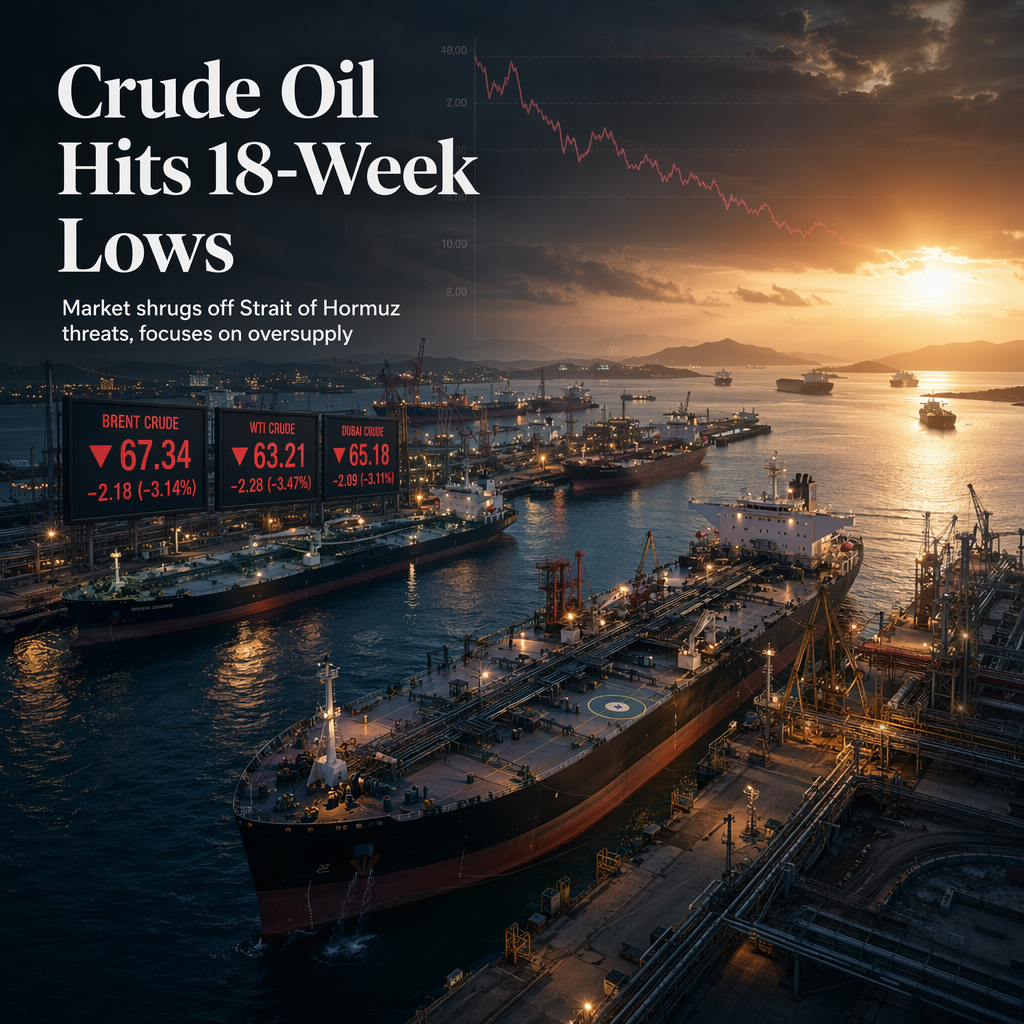
Crude Oil prices ended Thursday at their lowest level in 18 weeks, signaling that the risk premium built up during this year's conflict has fully dissipated, returning prices to pre-war levels [1]. The previous spike, which saw Crude Oil rise above $110 per barrel at the height of the conflict, has completely reversed, with the benchmark now trading below its 50-period Exponential Moving Average (EMA) near $83 and its 200-period EMA close to $78 [1]. The market is now characterized by oversupply, with increased production from the US, Guyana, and Brazil pushing inventories to near multi-year peaks, a surplus that was previously masked by geopolitical fears [1].
Despite ongoing threats between Tehran and Washington over the imposition of a toll in the Strait of Hormuz, the market has largely shrugged off the potential impact. Tehran, with Oman as its coastal partner, is insisting on the right to charge for passage once the current toll-free window ends, describing the levy as a service fee rather than a toll, while Washington is attempting to prevent this by offering approximately $100 billion in frozen Iranian funds, so far without success [1]. The market appears to have distinguished between a toll, which marginally increases delivered costs, and a blockade, which would remove barrels from the market; as a result, prices have not reacted strongly to the headlines [1].
The rationale is that a toll only generates revenue if shipping traffic continues, giving Tehran an incentive to keep the waterway open rather than disrupt flows, which would yield no income [1]. This perspective has led the market to respond to supply-risk headlines with calm and even lower closes, though the possibility remains that a toll regime rejected by Washington could still lead to disruption [1].
Falling Crude Oil prices are also contributing to lower headline inflation, providing the Federal Reserve with justification to maintain current interest rates rather than hike, especially in light of recent soft US jobs data [1]. Cheaper oil is seen as supporting the Fed's disinflationary goals, with prices in the high $60s offering a continued tailwind [1].
CONCLUSION
Crude Oil's decline to 18-week lows reflects the market's focus on oversupply and its dismissal of current geopolitical threats as non-disruptive. The easing in oil prices is also seen as beneficial for US inflation and Federal Reserve policy, reinforcing a stable outlook unless the situation in the Strait of Hormuz escalates.