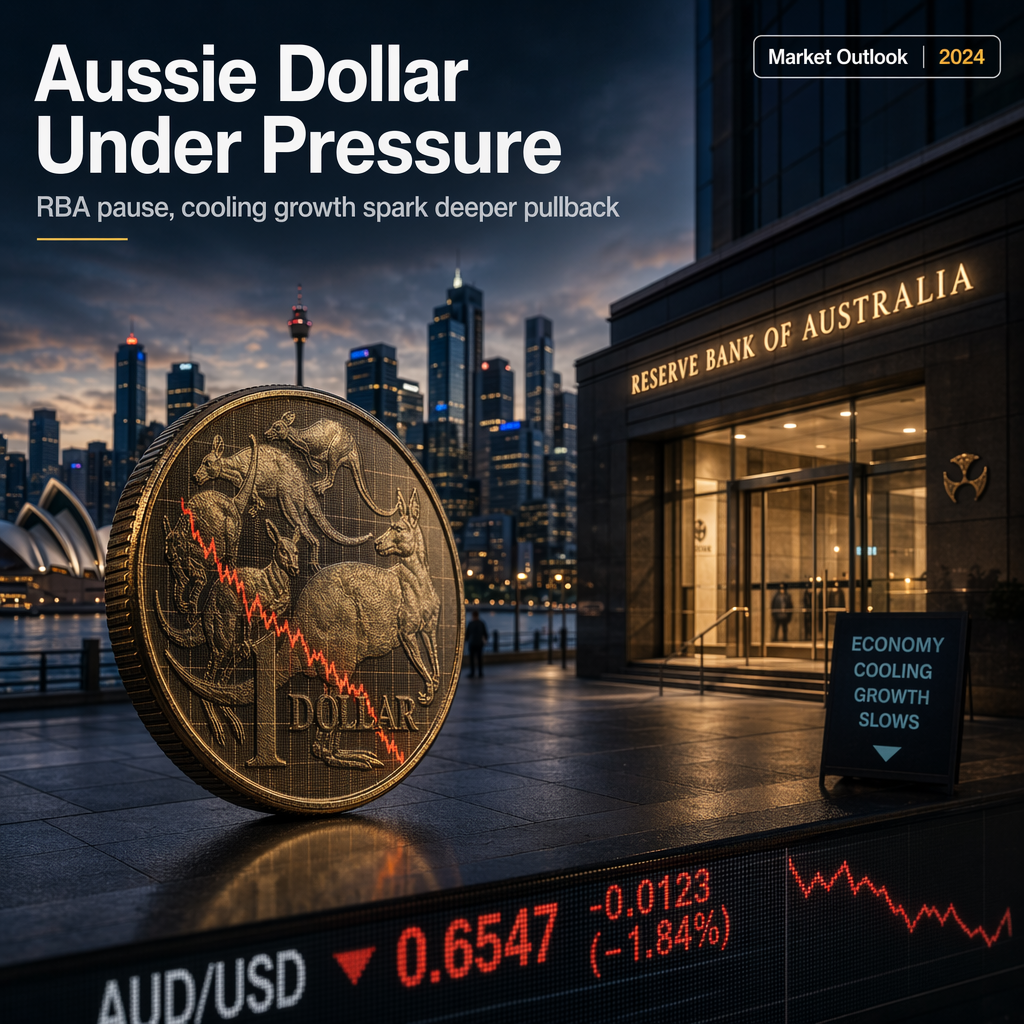
The Australian Dollar (AUD) has entered a corrective phase, surrendering part of its recent gains against the US Dollar after the Reserve Bank of Australia (RBA) decided to pause its rate hike cycle and hold the benchmark cash rate at 4.35% [1]. This follows three consecutive 25-basis-point increases earlier in the year, with policymakers now opting for a data-dependent pause to assess the delayed effects of their restrictive monetary policy [1].
Analysts at Brown Brothers Harriman (BBH) highlight that the AUD is losing momentum, particularly as the initial market optimism from a US-Iran peace agreement fades. They note that unfavorable interest rate differentials between Australia and the United States are likely to drive a deeper near-term pullback for the currency, with Australia-US 2-year bond yield spreads suggesting that AUD/USD could fall below the 0.7000 level [1].
MUFG analysts add that the RBA's unanimous decision to hold rates reflects signs that previous tightening measures are cooling the domestic economy. Slowing consumer spending, a softening housing market, and declining global energy prices are easing inflationary pressures, leading to a reduction in aggressive rate hike expectations that previously supported the AUD [1]. The correction in commodity prices and the paring of rate hike bets are currently contributing to the Australian Dollar's retreat from its earlier strong gains [1].
Both BBH and MUFG project a downward-biased trajectory for the AUD, with BBH warning of vulnerability to breaking below the 0.7000 threshold and MUFG forecasting a period of underperformance and near-term consolidation. As the RBA remains comfortable holding rates to monitor cooling growth and softer global commodity markets, analysts expect the Aussie to continue giving back its year-to-date gains [1].
CONCLUSION
The RBA's pause on rate hikes and signs of a cooling economy have triggered a bearish outlook for the Australian Dollar, with analysts warning of further downside risk. Unfavorable yield differentials and easing commodity prices are expected to keep the AUD under pressure in the near term. Market participants should anticipate continued underperformance and potential breaks below key support levels.