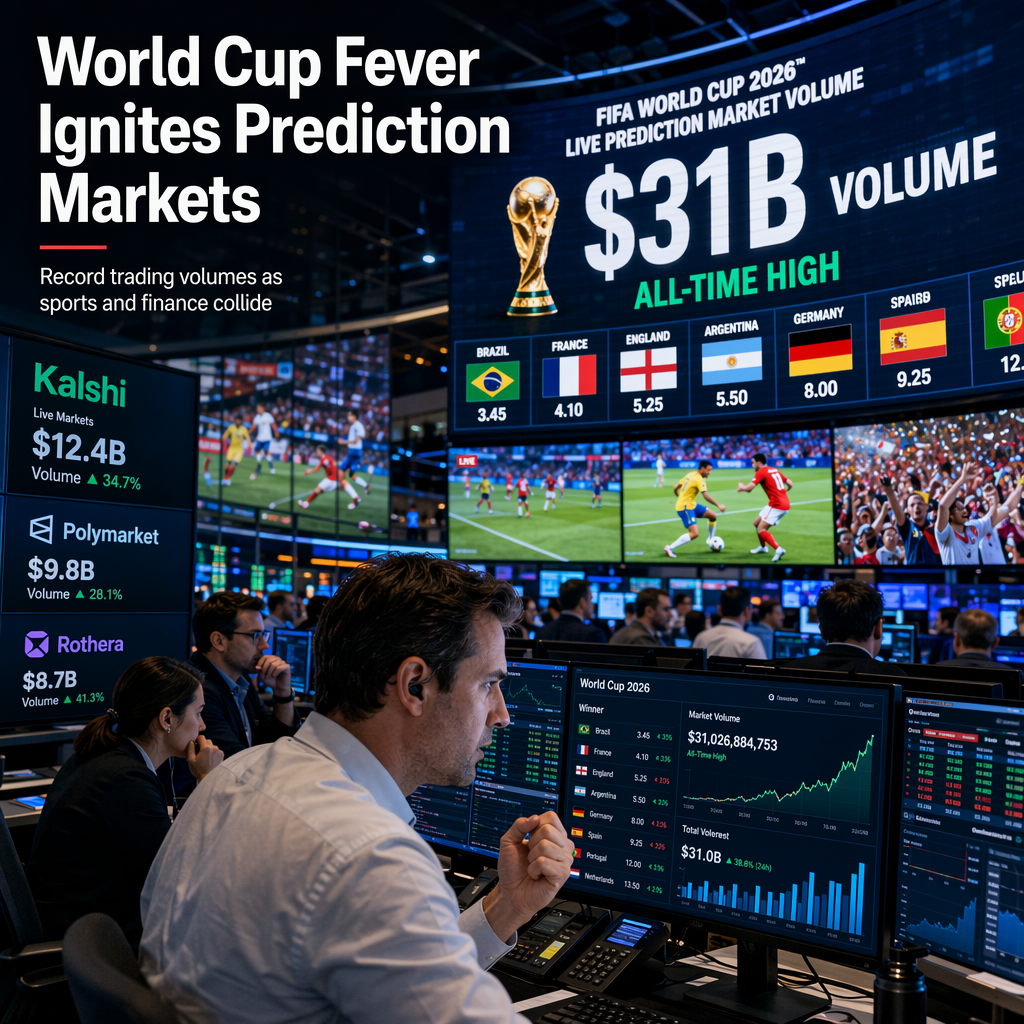
The 2026 FIFA World Cup has propelled prediction market platforms to unprecedented trading volumes in June. Kalshi, a leading prediction market platform, reported more than $31 billion in notional trading volume for the month, marking a more than 70% increase from May's $17.9 billion, according to user-collected data on Dune Analytics. Since the tournament began on June 11, Kalshi has consistently managed over $1 billion in daily volume. Polymarket, another major player, set a new record with $10.8 billion in monthly notional trading volume, reversing a previous downtrend seen in April and May. Its U.S. platform alone saw over $3.5 billion in June, up from $1.77 billion in May. Rothera, a new event contract exchange launched in June as a joint venture between Susquehanna International Group and Robinhood, saw $2 billion in notional trading volume and now accounts for 7% of U.S. prediction market volume, according to Bank of America [1].
The World Cup's influence extended to specific betting markets, with more than $64 million on Kalshi and $122 million on Polymarket traded on the outcome of Team USA's chances to win the tournament. However, the odds for a U.S. victory remain low, at 4.3% on Kalshi and 3% on Polymarket. To further capitalize on the surge in interest, Polymarket launched a competition offering up to $2 million for a perfect World Cup knockout round bracket, while Kalshi promoted World Cup trading prominently on the Apple app store [1].
Open interest, representing the total number of active, unsettled contracts, also surged. Kalshi's open interest surpassed $1 billion, while Polymarket's stood just under $400 million, maintaining elevated levels. The platforms' ability to handle the massive influx of sports-related contracts is seen as a potential indicator of their capacity to manage other event-driven markets in the future. Asaf Meir, CEO of Solidus Labs, which partners with Kalshi, emphasized that the World Cup represents a pivotal moment for prediction markets, as both regulators and institutions are closely monitoring their performance [1].
CONCLUSION
The 2026 FIFA World Cup has significantly boosted trading volumes and open interest across major prediction market platforms, setting new records and attracting institutional attention. The platforms' robust handling of this surge may influence their future role in broader event-driven markets. Market sentiment is strongly positive, reflecting heightened engagement and growth potential in the sector.