
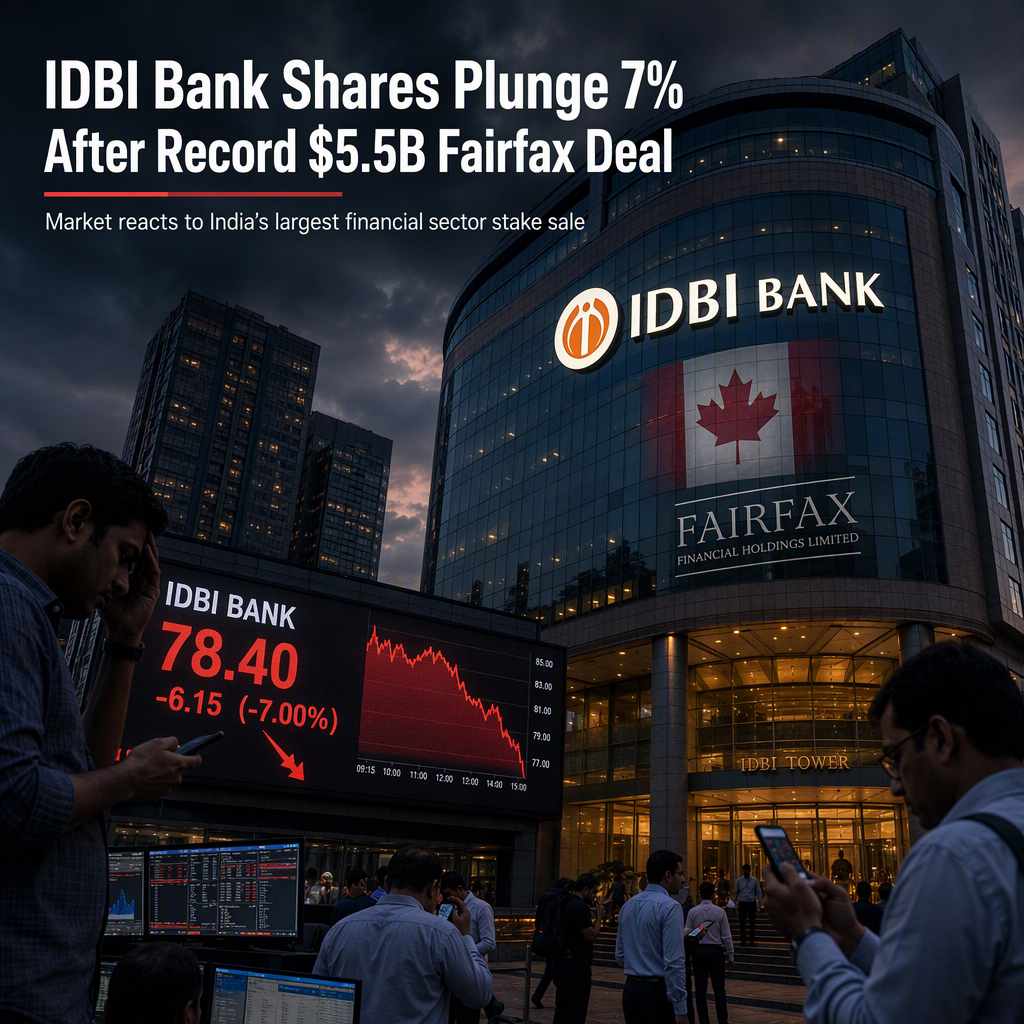
India's government has announced the sale of a 60.7% stake in IDBI Bank to Canadian firm Fairfax Financial Holdings for over 529 billion rupees ($5.5 billion), marking the largest foreign direct investment transaction in India's financial sector to date [1]. Fairfax's winning bid offered a price of 81 rupees per share, which is above the government's average fair value of 75.99 rupees but below IDBI's closing price of 90.39 rupees on Wednesday [1]. Following the announcement, shares of IDBI Bank fell more than 7% on Thursday, reflecting investor concerns about the deal pricing and its implications [1].
The Ministry of Finance stated that IDBI Bank had required repeated capital infusions due to its poor financial health, and after a brief recovery, the government decided to sell a majority stake to a strategic buyer [1]. Fairfax will need to present its credentials to the Reserve Bank of India for a "fit and proper assessment" before the deal can be finalized [1]. Finance Minister Nirmala Sitharaman emphasized that the investment would enable IDBI Bank's next phase of growth and highlighted the government's commitment to reform, stating that Fairfax's investment reinforces India's strong growth story and resilient economy [1].
This stake sale is part of a broader government divestment strategy, which has included sales in companies such as Cochin Shipyard, Indian Railways Finance Corp, NHPC, and Coal India earlier in the year [1]. In August, the government raised $3.3 billion by selling a 6.5% stake in Life Insurance Corporation of India [1]. The divestment push aims to sustain India's growth amid fiscal pressures [1].
Market reaction to the IDBI deal was negative, as evidenced by the sharp decline in IDBI Bank's share price. The deal's pricing below the market value and concerns about the bank's financial health contributed to the sell-off [1].
CONCLUSION
The Indian government's sale of a majority stake in IDBI Bank to Fairfax marks a record-setting FDI deal but triggered a sharp 7% drop in IDBI shares, reflecting investor unease about the deal's pricing and the bank's financial outlook. While officials tout the move as a sign of India's economic resilience and reform commitment, the immediate market response was negative, underscoring uncertainty about the bank's future trajectory.