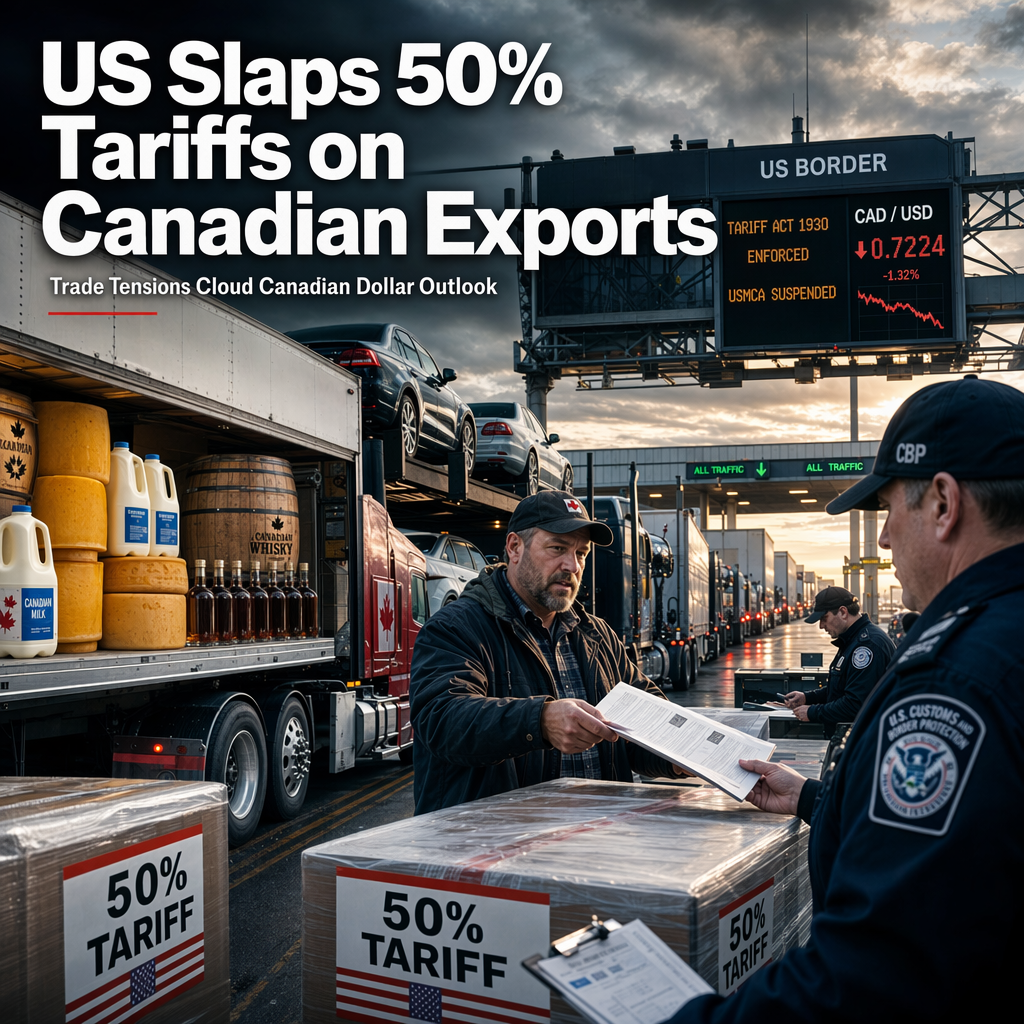
The United States has imposed new tariffs of 50% on selected Canadian dairy, alcohol, and automobile products, citing Section 338 of the Tariff Act of 1930. These tariffs remove the United States-Mexico-Canada Agreement (USMCA) exemptions for the affected products, following accusations that Canada unfairly discriminates against US products in these sectors. The US government has issued three separate notices covering dairy, alcohol, and automobiles, each listing products now subject to the new tariffs [1].
According to Volkmar Baur at Commerzbank, the Canadian dollar (CAD) showed only a muted initial reaction to the announcement. The loonie did lose some ground on the day of the announcement, but this movement may also have been influenced by June's overall inflation rate, which came in slightly lower than analysts' median expectations [1].
Baur notes that, given the numerous threats made by Donald Trump in recent months—many of which have not been enacted—the market's subdued response is understandable. However, he emphasizes that this trade dispute is expected to dominate Canadian dollar news in the coming weeks. The loss of USMCA free trade benefits for these products is seen as a significant factor likely to weigh on Canadian exports [1].
CONCLUSION
The imposition of 50% US tariffs on key Canadian exports marks a significant escalation in trade tensions, with the loss of USMCA exemptions expected to negatively impact Canadian exports. While the Canadian dollar's initial reaction was limited, analysts anticipate that this issue will remain a central focus and could exert further pressure on the currency in the near term.