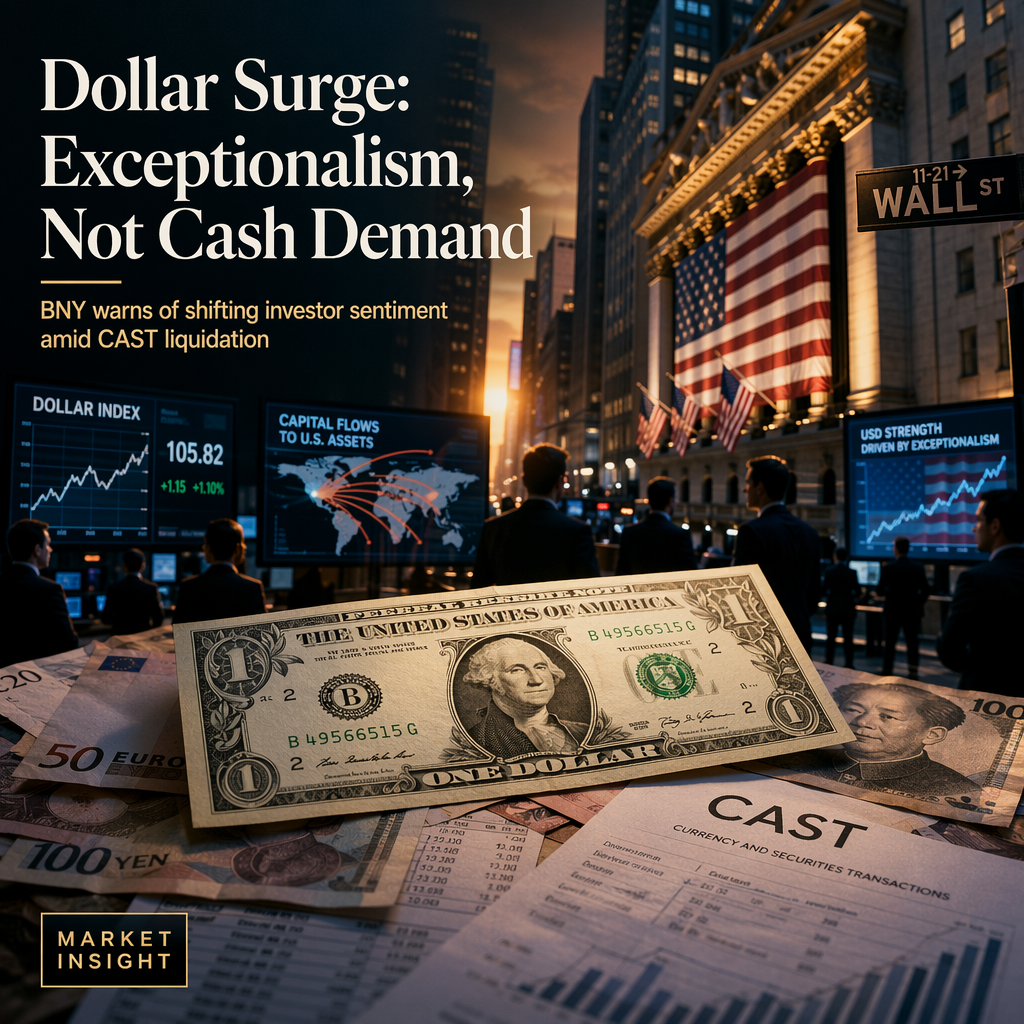
According to BNY’s Geoff Yu, the recent strength of the US Dollar (USD) is attributed to renewed perceptions of US exceptionalism rather than fresh cross-border buying activity. Yu notes that cross-border investors have already reduced their underweight positions in the dollar, with data showing a shift from roughly 10% above the rolling 12-month average (holdings score -1.10) to around 20% below (holdings score -0.80) by the end of last week [1].
Despite higher US yields, there has not been a corresponding increase in demand for cash and short-term instruments, specifically Corporate Asset-Backed Securitization Trust (CAST). Instead, cross-border investors are selling CAST at the fastest pace seen this year. Yu attributes this ongoing liquidation to conflict-related funding needs and highlights that this trend persists even though CAST typically benefits from rising rates and market stress, as investors usually seek to raise cash in such environments [1].
Aggregate flows in the market remain stable, which suggests that domestic demand is offsetting the foreign selling of CAST. Yu warns that a reversal in CAST outflows would be significant, as it could indicate waning enthusiasm for current investment themes and a shift in investor preference towards rebuilding cash reserves rather than deploying additional capital [1].
No specific market reactions, analyst forecasts, or forward-looking statements beyond Yu’s observations and warnings are provided in the article [1].
CONCLUSION
BNY’s analysis suggests that the US Dollar’s recent strength is not driven by new cross-border cash demand, but rather by perceptions of US economic exceptionalism. The ongoing liquidation of CAST by foreign investors, despite higher yields, signals potential caution and could foreshadow a shift in market sentiment if outflows reverse.