Rabobank analysts Mauricio Une and Renan Alves highlight that the Brazilian Real (BRL) is facing increased downside risks due to a combination of domestic and international factors. Externally, softer-than-expected U.S. core CPI and PPI readings for July, along with signs of a cooling U.S. labor market, have given the Federal Reserve more time to assess its policy stance, reducing immediate pressure for further rate hikes in the United States [1]. Domestically, minutes from the Central Bank of Brazil's (BCB) monetary policy committee (Copom) indicate that restrictive monetary policy is gradually impacting economic activity. However, inflation expectations in Brazil remain unanchored, necessitating higher interest rates for a longer period and close monitoring of potential second-round effects [1].
Rabobank notes that the Brazilian Real ended the previous week at BRL 5.2228 per U.S. dollar, marking a 2.8% depreciation against the dollar over the week. This performance was the weakest among 24 emerging-market currencies tracked by the analysts [1]. The outlook is further complicated by a fragile domestic fiscal situation and expectations of a narrower interest rate differential between Brazil and advanced economies through 2026. Additionally, the potential for a global recovery of the U.S. dollar and ongoing election-year fiscal uncertainty in Brazil are seen as contributing to further weakness in the Real [1].
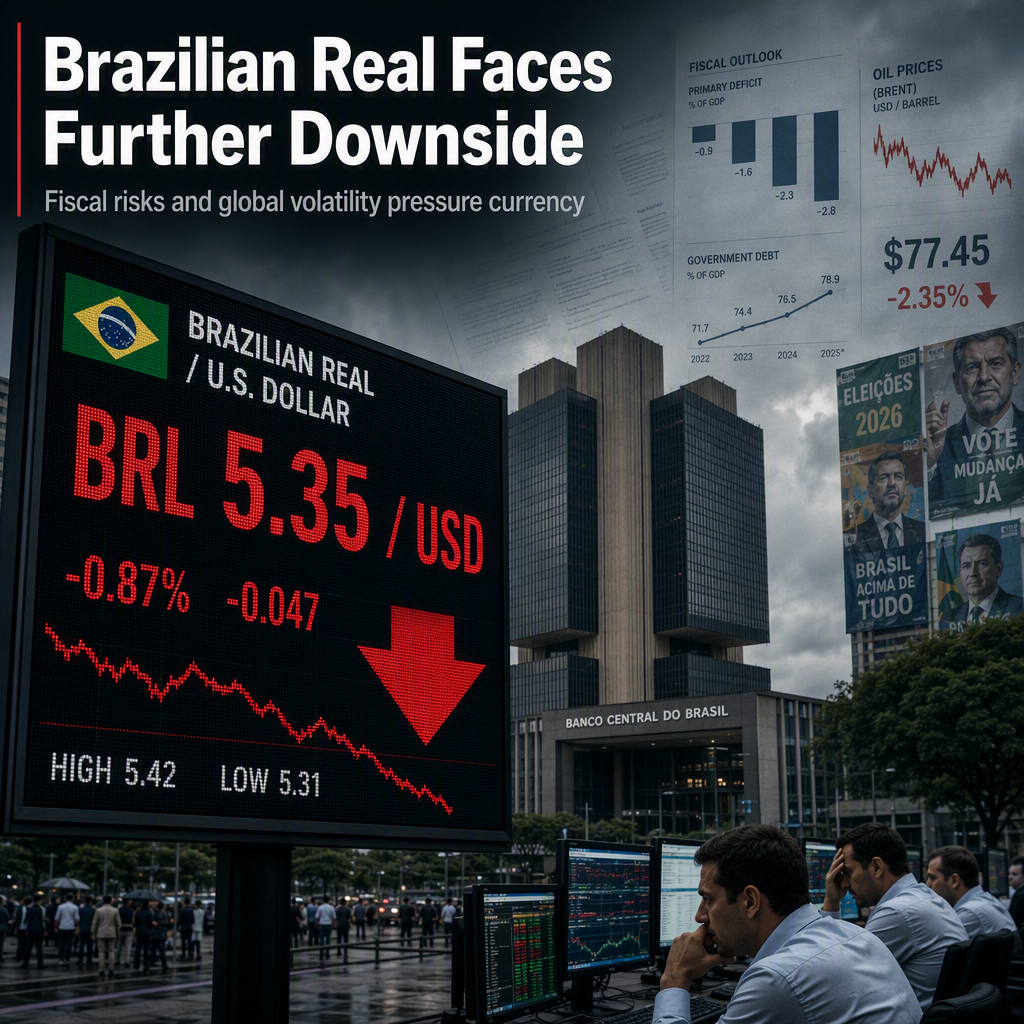
Rabobank forecasts that the BRL will weaken to BRL 5.35 per U.S. dollar by year-end. The analysts also mention that Brent crude oil prices remain volatile, stabilizing near US$90 per barrel, and that geopolitical risks, such as the conflict between the United States and Iran, continue to add to market uncertainty [1].
CONCLUSION
Rabobank expects the Brazilian Real to face continued depreciation pressures due to fiscal vulnerabilities, unanchored inflation expectations, and narrowing rate differentials. The currency is forecast to weaken to BRL 5.35 per U.S. dollar by year-end, with market sentiment remaining cautious amid ongoing domestic and global uncertainties.