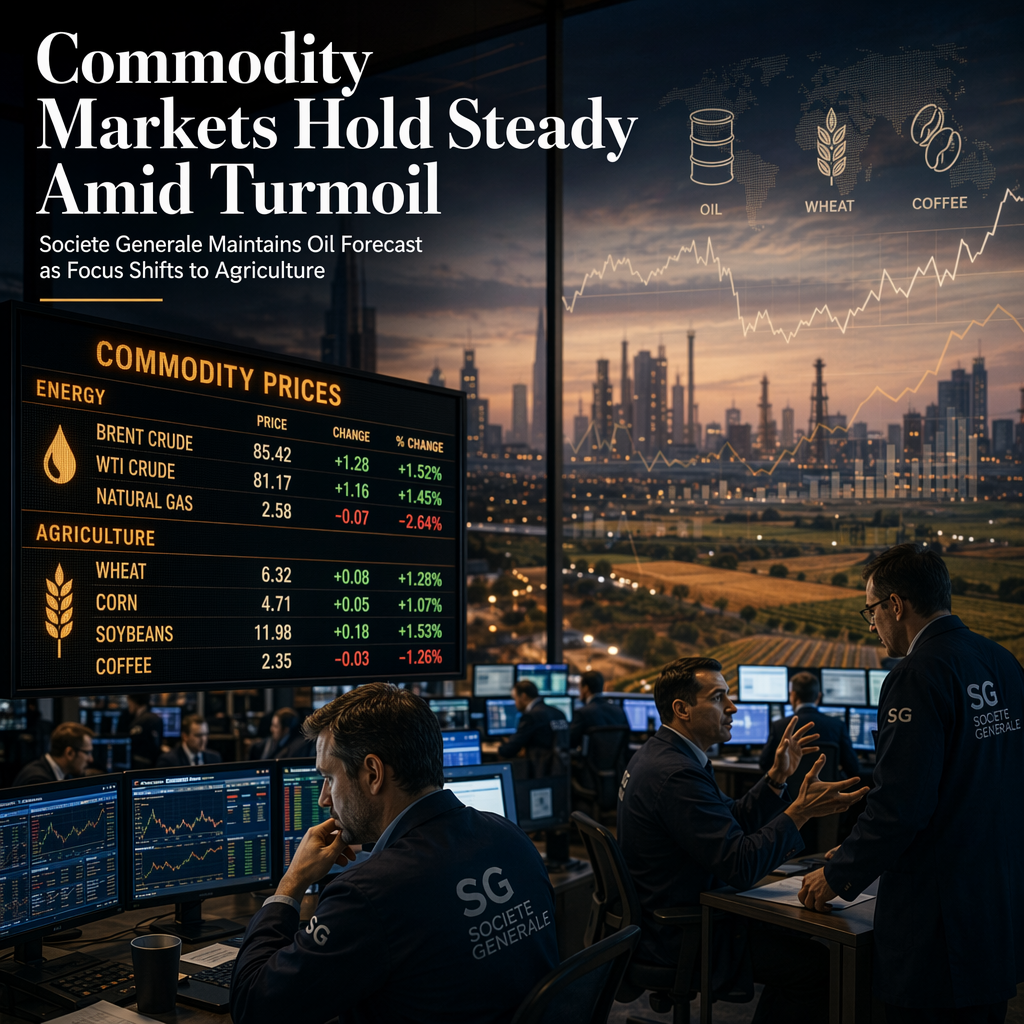
Societe Generale analysts Michael Haigh and Jeremy Sellem report that the commodity complex has demonstrated resilience in the face of ongoing Middle East tensions, with only limited market movement observed. The Bloomberg Commodity Index (BCOM) gained 2% over the week, which is described as less than a standard weekly move for the year. Oil prices were the primary driver, experiencing a sharp rise of approximately 10% from $72 to $78 per barrel within three days, before retreating later in the week. Despite this volatility, Societe Generale's oil price forecast remains unchanged at $70 per barrel by year end [1].
The report notes that prices firmed briefly midweek following the end of a ceasefire and the resumption of strikes by both sides in the Middle East. However, the rally in oil prices appears to be capped for now, and attention is gradually shifting toward agricultural markets. Agricultural commodities have increased by 7% this month, with the 'softs' segment up 8% in the past week alone [1].
Societe Generale introduces a new cross-commodity term-structure model designed to build continuous forward curves, fill contract gaps, and support pricing, hedging, basket construction, and de-seasonalised carry signals across BCOM and GSCI markets. This framework generates consistent monthly forward prices out to two years for 27 commodity markets, addressing gaps where contracts are only listed quarterly or seasonally and extending maturities beyond the final observable contract when necessary [1].
The analysts highlight that their model will facilitate easier relative value carry trades by combining economic intuition from commodity term structure theory with a practical interpolation framework [1].
CONCLUSION
Commodity markets have shown limited reaction to Middle East tensions, with oil price gains capped and Societe Generale maintaining its year-end forecast. The introduction of a new term-structure model aims to enhance pricing and hedging strategies across commodity markets. Agricultural commodities are gaining attention as market focus shifts away from energy.