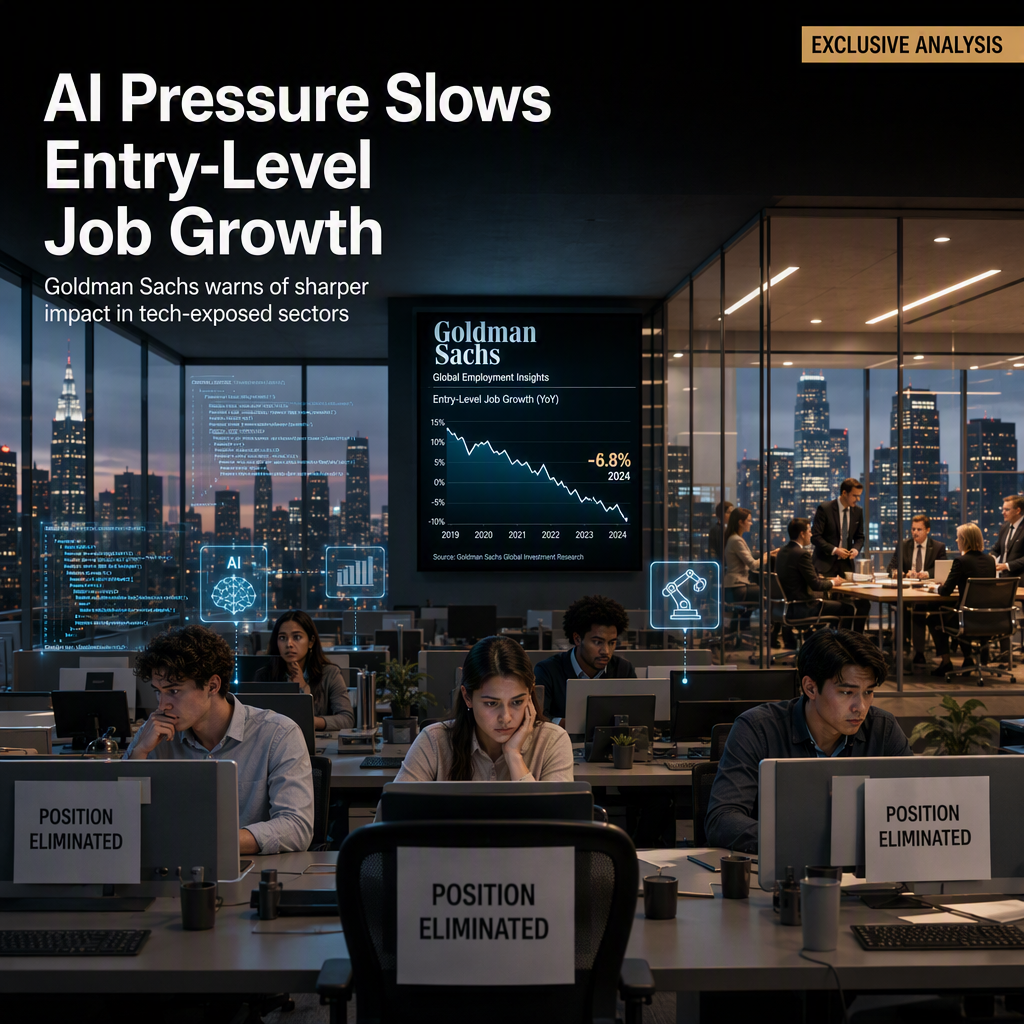
Goldman Sachs has released research indicating that artificial intelligence (AI) is already exerting downward pressure on labor markets in major developed economies, with the effects varying by industry and job seniority level [1]. The report highlights that industries with higher exposure to AI automation have generally experienced slower growth in job openings since the second half of 2022, with this trend being particularly notable in Germany, Australia, and the United States [1].
Employment in information and communication services—sectors identified as highly exposed to AI—has slowed across nearly all major developed economies since 2022, though employment levels in these industries remain near or above their long-run trends outside the U.S. [1]. More specifically, employment in call centers, software publishing, management consulting, and advertising has fallen sharply below historical trends, with call center employment now 39% below trend in the U.S., 33% lower in Canada, and 27% below trend in Germany [1].
The negative impact of AI on employment is most pronounced among entry-level workers. Goldman Sachs analyzed over 800 occupations and found that AI-related headwinds were strongest for those starting their careers, with entry-level job growth seeing a drag of more than 0.6 percentage points in Australia and over 0.2 percentage points in the U.S. [1]. In contrast, across the broader labor market, a 10% occupational exposure to AI was associated with only a 0.1 percentage point reduction in annual headcount growth in France, Canada, and the U.S. [1].
The report also notes that AI adoption rates in major developed markets are roughly 15% to 20%, with France, the U.S., the Netherlands, and the U.K. leading in adoption, while Italy, Japan, and New Zealand lag behind [1]. Overall, Goldman Sachs concludes that while AI-related hiring pressures are clearly visible in global employment data, they remain limited to a relatively narrow set of industries and workers at this stage [1].
CONCLUSION
Goldman Sachs' research underscores that AI is already impacting job growth, especially for entry-level workers and in industries with high automation exposure. While the effects are significant in certain sectors and countries, the overall labor market impact remains relatively contained for now. Continued AI adoption could further shape employment trends in the future.