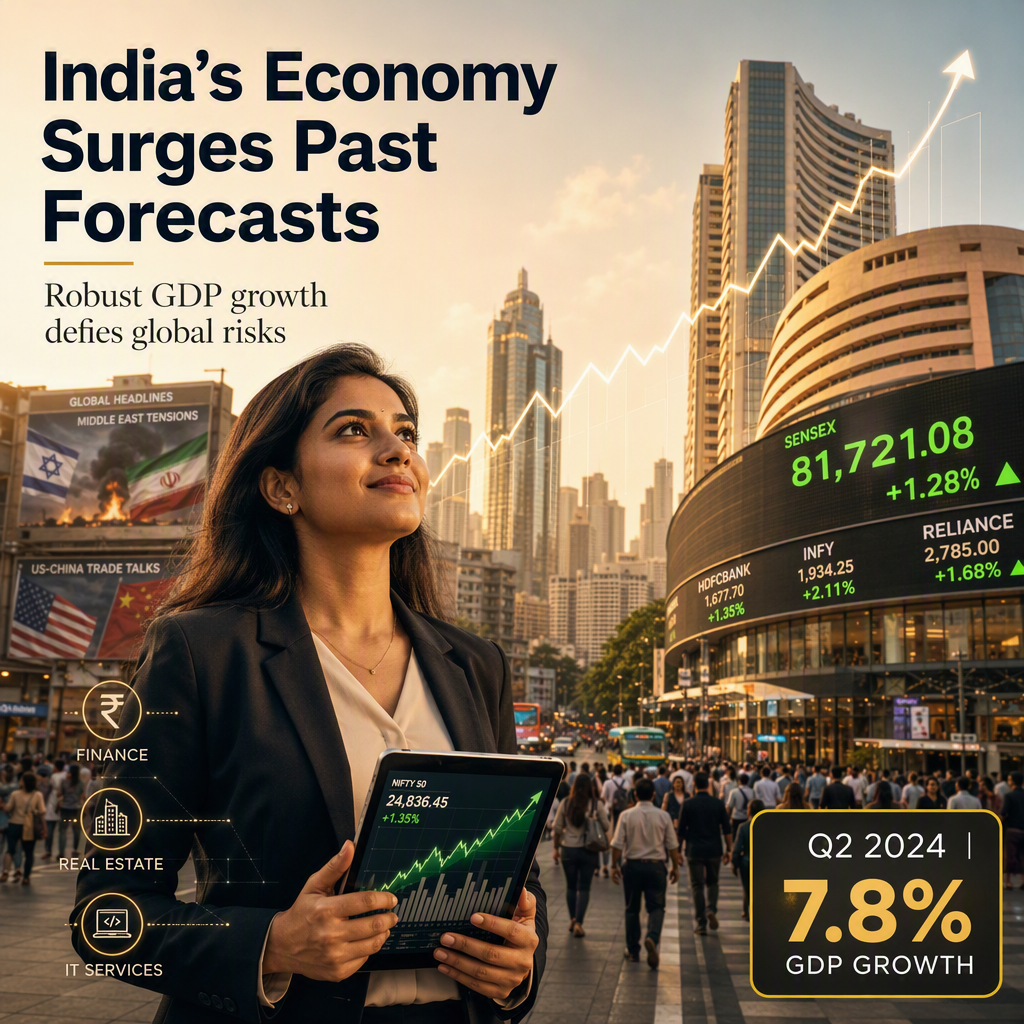
India's economy posted a robust 7.8% GDP growth in the quarter through June, surpassing most analyst forecasts, according to data released by the country's statistics ministry on Monday [1]. This strong performance comes despite ongoing geopolitical tensions stemming from the U.S.-Israel war with Iran, which began at the end of February [1]. The finance, real estate, and IT sectors led the expansion during the April-June period, outpacing manufacturing and agriculture, which recorded more moderate gains [1].
The government implemented a series of economic measures since the onset of the U.S.-Israeli war on Iran, building on consumption tax cuts introduced in September of the previous year [1]. Market analysts attributed the surprise growth to robust domestic demand, increased government spending, and a rise in private capital expenditure, particularly in data centers and renewables [1].
The data suggest that India has successfully navigated external shocks, especially those related to Middle East geopolitical tensions, with minimal disruption to its economic momentum [1]. The government's proactive fiscal policy, including targeted economic support and tax cuts, has been instrumental in sustaining growth [1]. However, analysts warn that ongoing geopolitical risks and global market volatility could present challenges in the upcoming quarters [1].
The GDP announcement was met with optimism in Indian equity markets, as several benchmark indices posted gains on expectations of continued economic resilience [1]. Technical analysts observed that key support levels for the Nifty 50 and Sensex remain intact, with the possibility of testing upside resistance levels if positive momentum continues [1].
CONCLUSION
India's stronger-than-expected GDP growth highlights the country's resilience amid global uncertainty and geopolitical tensions. While markets responded positively to the data, analysts remain cautious about potential risks in the quarters ahead.