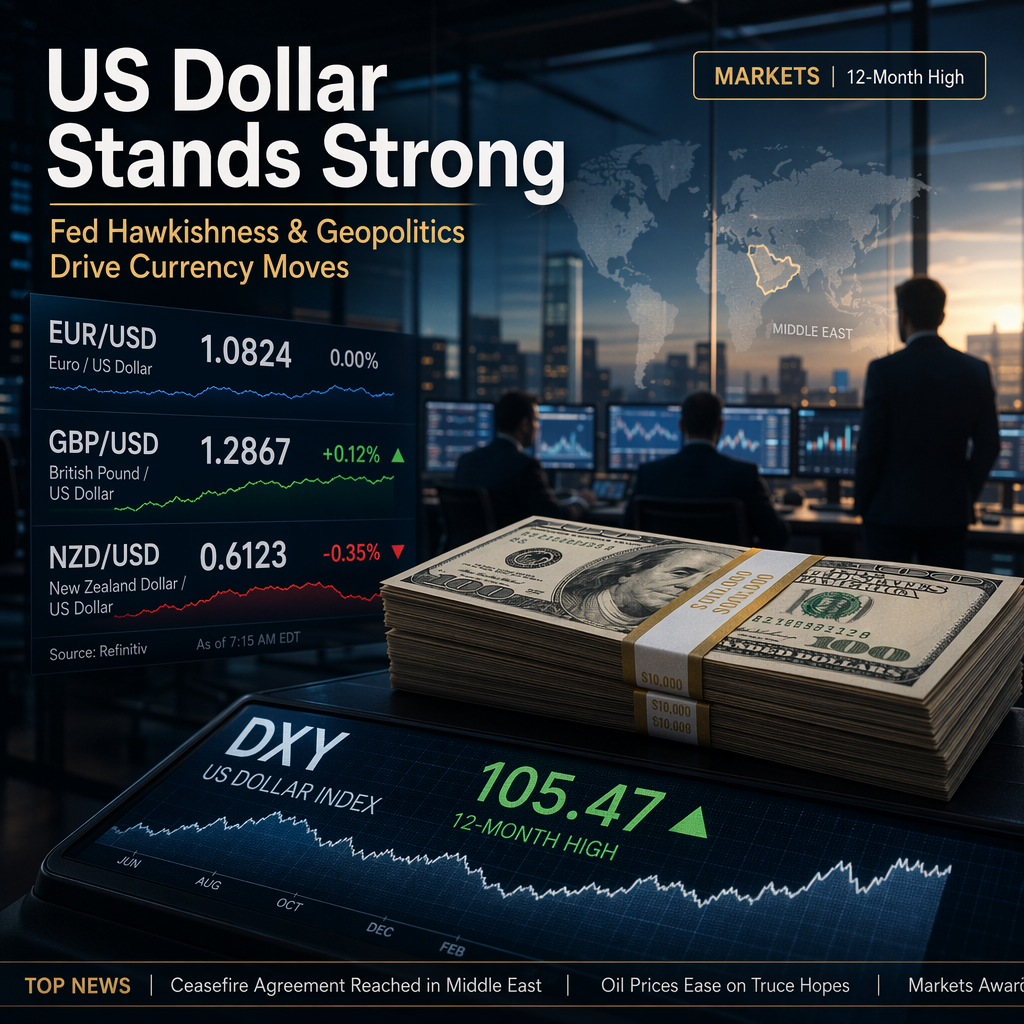
The US Dollar maintained its strength against major currencies on Friday, driven by expectations of a more restrictive monetary policy from the Federal Reserve. The Federal Open Market Committee's projections now see the Federal Funds Rate reaching 3.8% by year-end, up from 3.4% in March, reinforcing the likelihood of another rate hike in the coming months [1]. Nearly half of FOMC members anticipate a rate hike before year-end, pushing the US Dollar Index (DXY) to a 12-month high of 101.12, close to the May 16, 2025 peak at 101.26 [2][3].
Geopolitical developments also influenced market sentiment. Reuters reported a ceasefire agreement between Israel and Hezbollah, brokered with US and Qatari involvement and supported by Iran, which temporarily eased fears of regional escalation and led to a modest improvement in risk appetite [1][2][3]. However, the impact on currency markets was limited, as investors remained cautious due to ongoing uncertainties. CNN reported that US Vice President JD Vance canceled a planned meeting with Iran in Switzerland, though Iran confirmed the ceasefire agreement had been signed digitally [1].
Currency-specific moves reflected these dynamics. The New Zealand Dollar (NZD) extended its decline, with NZD/USD trading around 0.5740, down 0.28% on the day and near its lowest level since April [1]. The NZD found limited support from the Reserve Bank of New Zealand's outlook, which indicated the Official Cash Rate could reach 2.85% by year-end, suggesting potential further rate hikes [1]. The British Pound (GBP) rebounded slightly from a three-month low, with GBP/USD at 1.3226, up 0.18% in thin holiday trading, but still set for a weekly loss of 1.25% [2]. The Bank of England held rates at 3.75% with a 7-2 vote, as inflation expectations among households reached their highest since 2009 [2].
The Euro (EUR) stabilized after recent losses, with EUR/USD trading around 1.1470, rebounding from a three-month low of 1.1417 [3]. The Euro's upside was limited by the Federal Reserve's hawkish stance and relatively weaker Eurozone growth. The European Central Bank (ECB) recently raised rates by 25 basis points, and policymaker Pierre Wunsch indicated openness to another hike in July if inflation data worsens, but also noted the possibility of rate cuts if conditions improve [3]. Nordea analysts and research highlighted that the ECB is likely closer to the end of its hiking cycle than the Fed, and that EUR/USD is expected to trade sideways in the near term, with a gradual recovery only as US economic outperformance fades and the Fed eventually cuts rates ahead of the ECB [3][4].
Looking ahead, markets will focus on upcoming economic data, including Flash PMIs and speeches from central bank officials in both the US and UK, as well as the US Core Personal Consumption Expenditures (PCE) Price Index, the Fed's preferred inflation gauge [2][3].
CONCLUSION
The US Dollar remains supported by expectations of further Fed tightening and ongoing geopolitical caution, limiting gains for other major currencies. While temporary relief from Middle East tensions improved risk sentiment, the market's focus remains on central bank policy divergence and upcoming economic data. Analysts expect sideways trading for EUR/USD and continued Greenback strength in the near term.