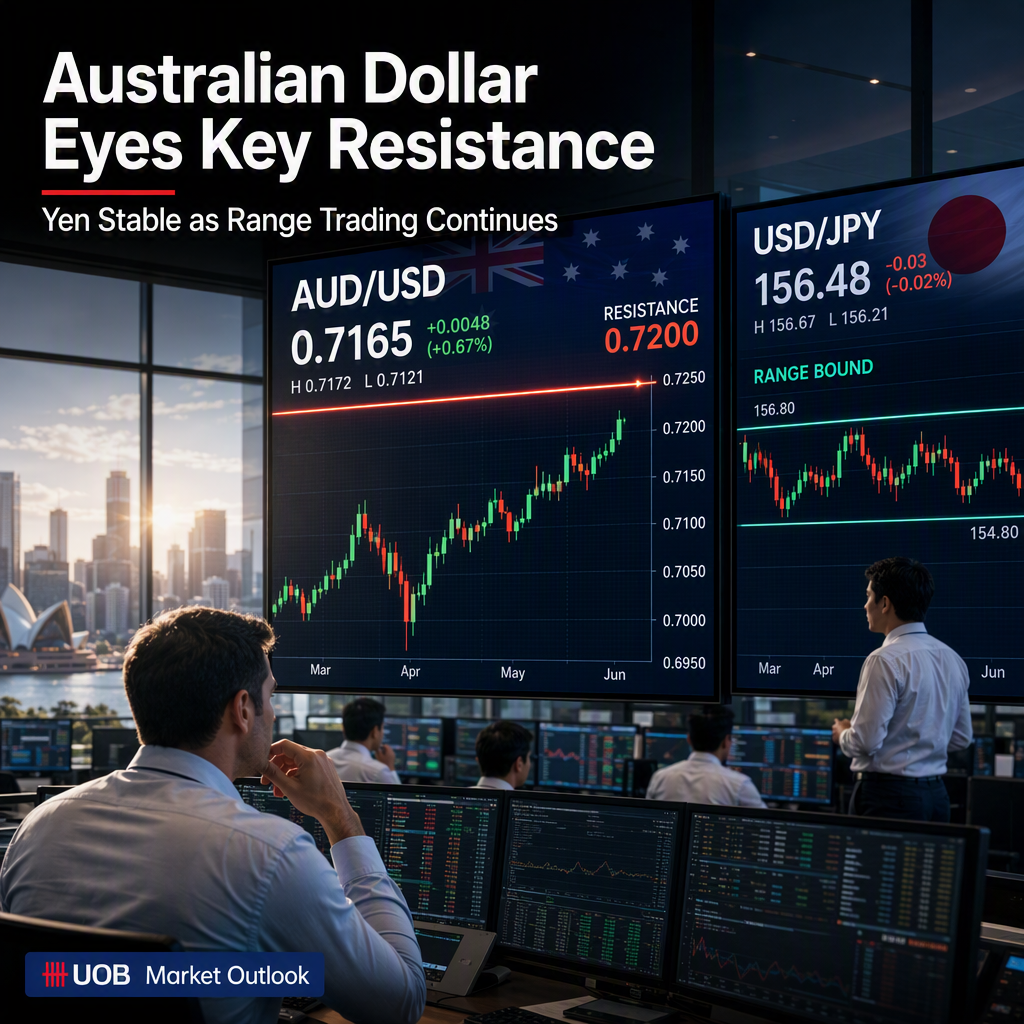
United Overseas Bank (UOB) analysts Quek Ser Leang and Lee Sue Ann provided updated outlooks for both the Australian Dollar (AUD) and Japanese Yen (JPY) against the US Dollar (USD). For the AUD/USD pair, UOB noted that the Australian Dollar extended its consolidation slightly higher, closing at 0.7165, up 0.21% as short-term momentum improved. The analysts highlighted 0.7200 as a major resistance level to watch in the coming weeks, with the bullish outlook contingent on the pair holding above a strong support zone at 0.7120. In the short term, UOB expects the AUD to trade within a 0.7145/0.7180 range, and even if it breaks above 0.7180, further advances are unlikely to reach 0.7200 immediately. The analysts reiterated that as long as the 0.7120 support is not breached, the AUD strength remains intact [1].
For the USD/JPY pair, UOB described the market as being in a range-trading phase. On Monday, the USD/JPY traded between 158.59 and 159.28, closing little changed at 159.08 (+0.09%). The following day, the pair traded between 158.99 and 159.48, again closing little changed at 159.16 (+0.05%). UOB expects the USD/JPY to continue fluctuating within a narrow range of 158.95 to 159.50 in the short term, and between 157.90 and 159.80 over a 1–3 week horizon. The analysts indicated that the price action provides no fresh clues and that the pair is likely to remain range-bound unless key support levels are breached [2].
No significant market-moving reactions or volatility were reported for either currency pair in the short term. Both analyses suggest a cautious outlook, with the AUD showing a slight upside bias as long as support holds, and the JPY expected to remain stable within established trading bands [1][2].
CONCLUSION
UOB analysts see the Australian Dollar maintaining a bullish bias as long as it stays above key support, with 0.7200 as the next resistance to watch. Meanwhile, the Japanese Yen is expected to remain range-bound against the US Dollar, with no immediate breakout signals. Overall, both currency pairs are likely to see limited volatility in the near term.