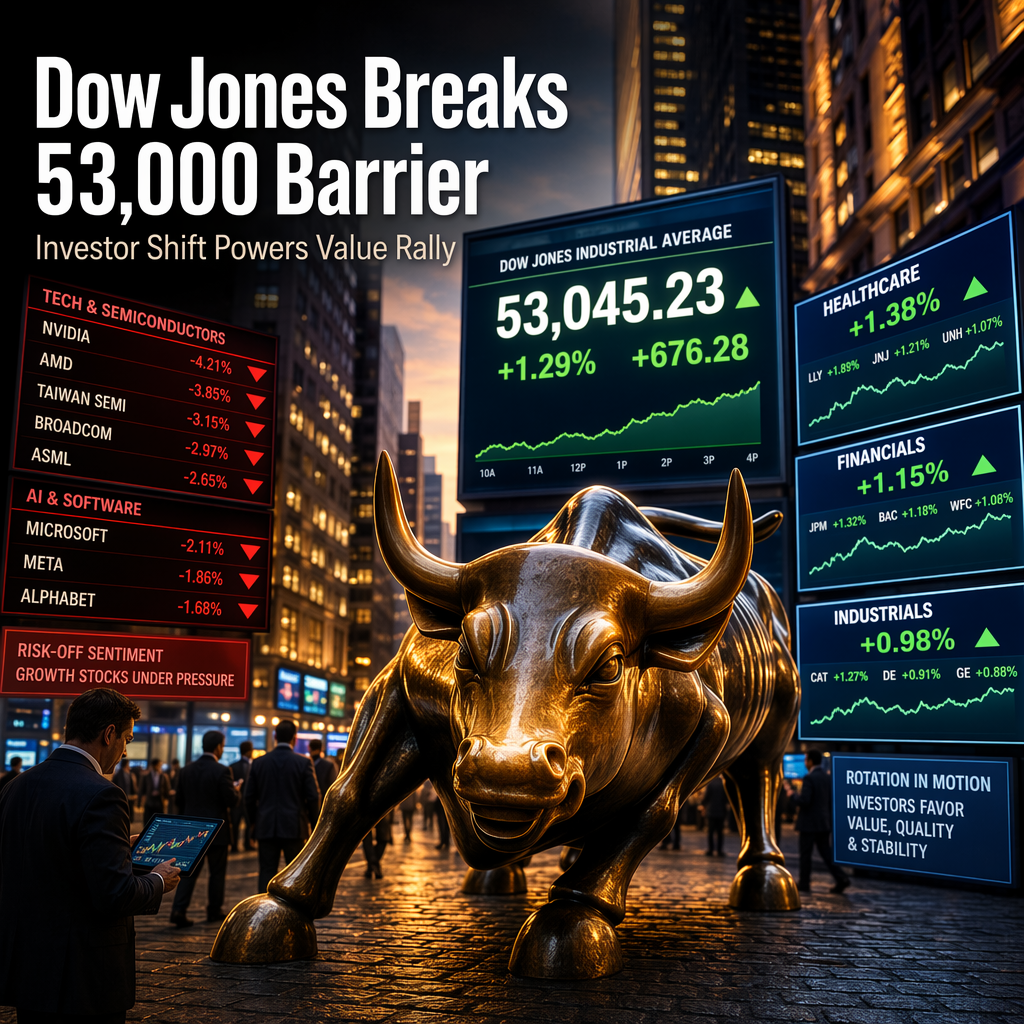
The Dow Jones Industrial Average closed above the historic 53,000 milestone for the first time on Monday, gaining 0.29% during the regular US session, while the S&P 500 rose 0.72% and the Nasdaq Composite advanced 1.12% [1]. However, US stock futures showed mixed results on Tuesday, with Dow Jones futures up 0.15% to around 53,450, S&P 500 futures down 0.20% near 7,580, and Nasdaq 100 futures falling 0.90% to approximately 29,670 [1].
This divergence comes as investors rotate capital out of volatile technology stocks, particularly in the semiconductor and AI sectors, and into more stable value sectors such as healthcare, financials, and industrials, which are heavily represented in the Dow Jones [1]. The rotation follows a sharp sell-off in major semiconductor stocks during Asian trading hours, with Samsung Electronics dropping nearly 7% despite reporting strong profit growth from AI data center memory chips, and SK Hynix sliding over 6% as it began marketing its anticipated US listing [1].
Market sentiment has turned cautious amid this tech sector volatility, with investors taking profits from high-flying stocks and seeking safety in value-oriented sectors [1]. On the macroeconomic front, expectations for Federal Reserve rate hikes in the coming months have been scaled back after a cooling labor market report showed job growth in April, May, and June fell short of Wall Street’s expectations [1]. Additionally, a recent decline in crude oil prices has helped ease inflationary pressures, reducing the urgency for the Fed to maintain an aggressive monetary policy stance [1].
CONCLUSION
The Dow Jones' record close above 53,000 reflects a significant rotation from tech to value sectors as investors respond to volatility in semiconductor stocks and shifting macroeconomic signals. Cautious sentiment prevails, with market participants reassessing Fed rate hike expectations and seeking stability in defensive sectors. This rotation could continue to shape market dynamics in the near term.