
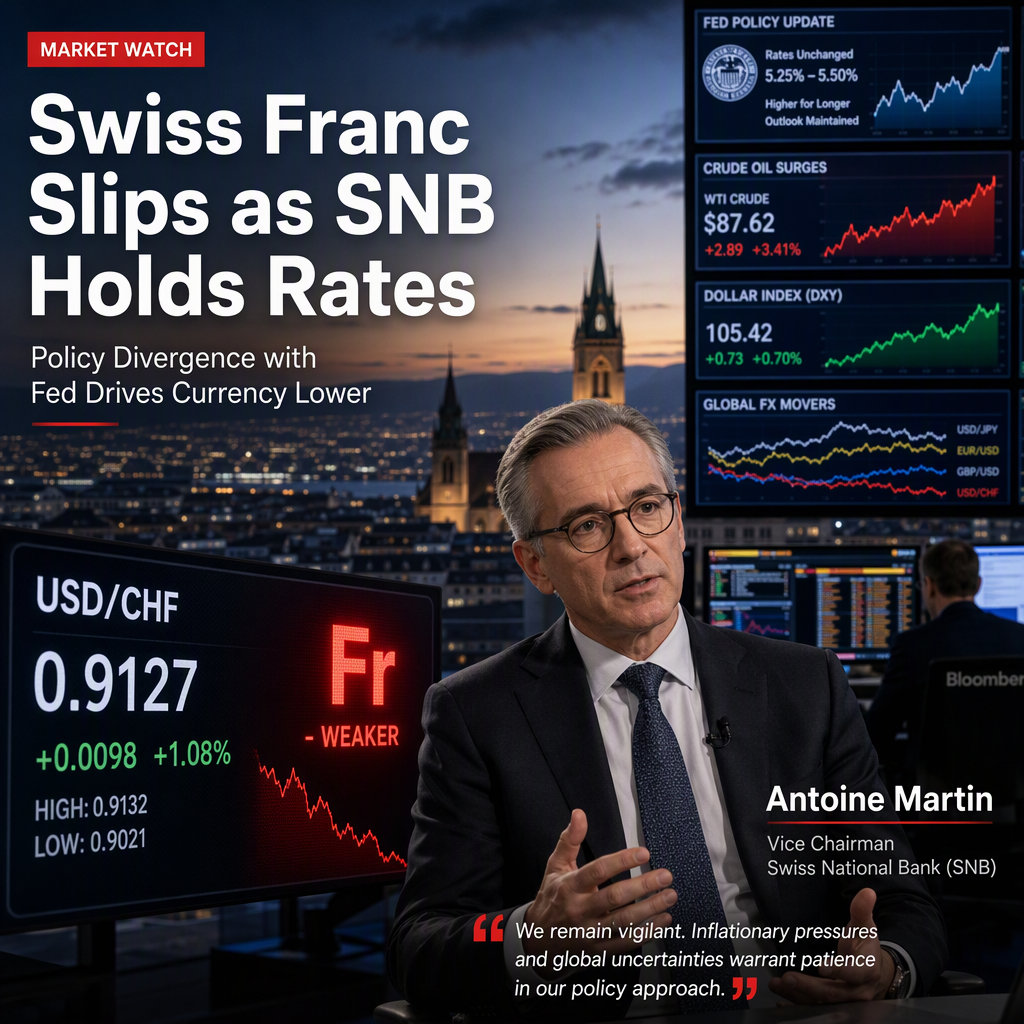
The Swiss Franc (CHF) continued its decline against the US Dollar (USD) for the fourth consecutive day on Thursday, following comments from Swiss National Bank (SNB) Vice Chairman Antoine Martin. Martin stated that the SNB sees no need to change its monetary policy stance, despite rising risks from the War in Iran, and dismissed the possibility of interest rate hikes in the near term. He emphasized that Switzerland remains 'comfortably within the price stability range of 0% to 2%' [1].
As a result, the USD/CHF currency pair reached weekly highs near 0.8350, approaching the 17-month high at the 0.8380 level [1]. The SNB's dovish stance has increased the monetary policy divergence with the US Federal Reserve (Fed), which is expected to raise rates by at least 50 basis points over the next six months [1]. In contrast, the Fed's September FOMC minutes reinforced expectations of a wait-and-see approach in October, but also highlighted inflation risks, leading markets to anticipate another rate hike in December [1].
The rally in oil prices is contributing to higher US yields, as markets expect the Fed to maintain a restrictive policy to combat inflation. Analyst Lloyd Chan from MUFG/BTMU noted that if long-end yields rise further, market focus could shift to tightening US financial conditions and potential policy responses. In such a scenario, Switzerland's strong fiscal position could provide the CHF with a competitive advantage [1].
Overall, the SNB's commitment to its current policy and the growing divergence with the Fed have kept the CHF on the defensive, with market participants closely monitoring both central banks' next moves and global inflation trends [1].
CONCLUSION
The Swiss Franc's recent weakness is driven by the SNB's signal of lower-for-longer rates, contrasting with expectations of further tightening by the US Federal Reserve. This policy divergence has pushed USD/CHF to multi-month highs, and markets are watching for any shifts in central bank stances or global inflation pressures.