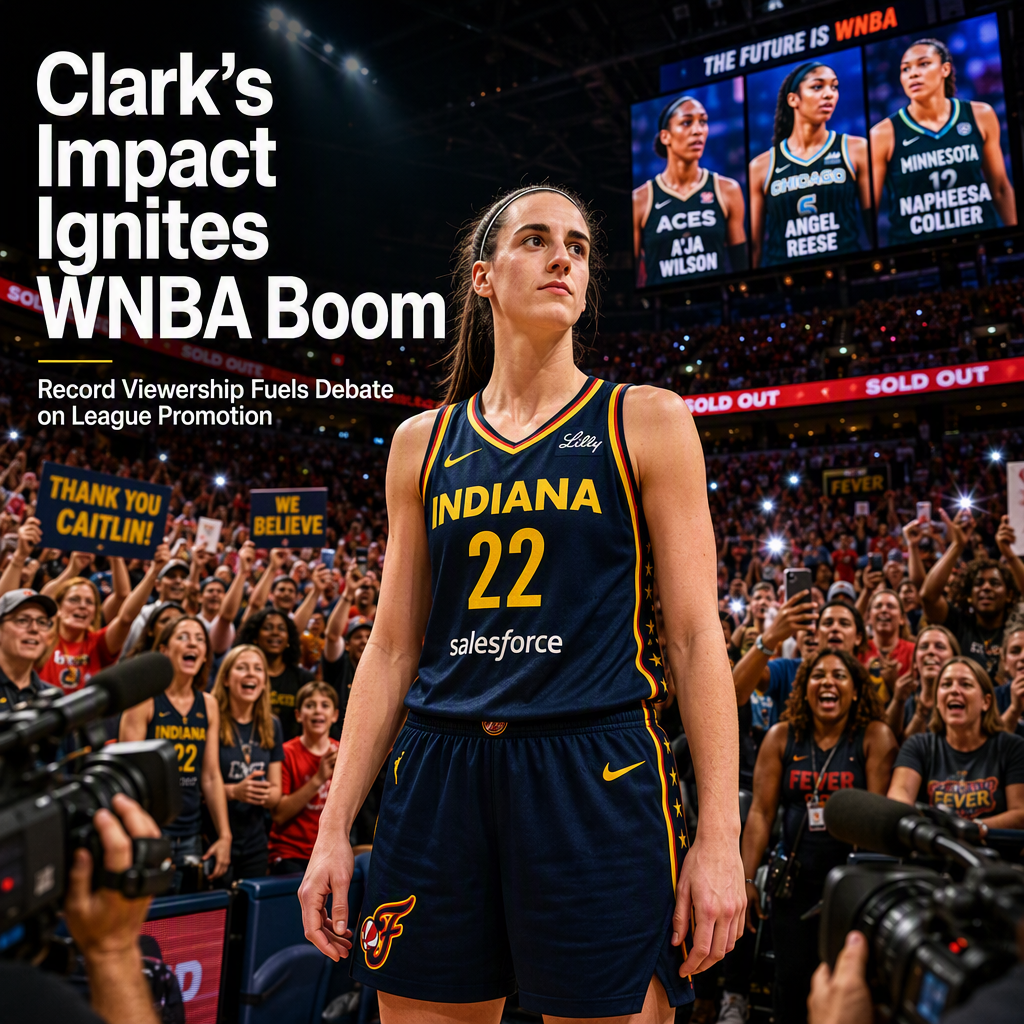
Chantell Preston, co-founder and owner of the incoming San Francisco Signal, a League One Volleyball (LOVB) franchise, and stakeholder in LOVB, defended the WNBA's handling of Caitlin Clark's impact on the league. Preston described the visibility Clark has brought to the WNBA as 'invaluable,' not only for the league but for all women's sports, citing record ratings, sold-out arenas, and a rapidly growing fan base that the WNBA had sought for nearly three decades [1]. Preston acknowledged that while the league's response was not perfect, she believes the WNBA managed the moment well and sees further opportunities for improvement [1].
The article highlights that the WNBA has sometimes chosen not to feature Clark prominently in its promotional materials. For example, a May social media graphic promoting a Fever game on NBC and Peacock included A’ja Wilson, Angel Reese, Zia Cooke, and Raven Johnson, but omitted Clark. Similarly, a July ESPN six-part documentary on the WNBA's growth focused on Wilson, Napheesa Collier, and DeWanna Bonner, with Clark only appearing in game and All-Star footage and not being interviewed or featured in storylines [1]. Preston emphasized the importance of focusing on the league's diverse talent rather than centering solely on one player, suggesting that the WNBA should highlight multiple individuals and their contributions to their teams [1].
Despite these promotional choices, Clark's influence on viewership is clear. The Fever-Sky game on August 23 averaged 3.31 million viewers on NBC and Peacock, making it the most-watched WNBA regular-season game since the league's opening weekend in 1997, with a peak of 3.82 million viewers. Additionally, the Fever-Aces game in July averaged 2.64 million viewers, the second-largest WNBA regular-season audience of the season [1]. Preston noted that while the WNBA does not need to feature Clark in every graphic, it cannot ignore her significant role in attracting viewers [1].
Preston concluded by advocating for a positive narrative around the league's players and the importance of visibility and storytelling in women's sports. She views the current moment as an investment opportunity for women's sports, driven by the increased attention and engagement that players like Clark have generated [1].
CONCLUSION
Caitlin Clark's arrival has propelled WNBA viewership to record highs, underscoring her pivotal role in the league's recent popularity surge. While the WNBA's promotional strategy has sparked debate, the market takeaway is clear: Clark's presence is a major driver of audience growth and investor interest in women's sports.