
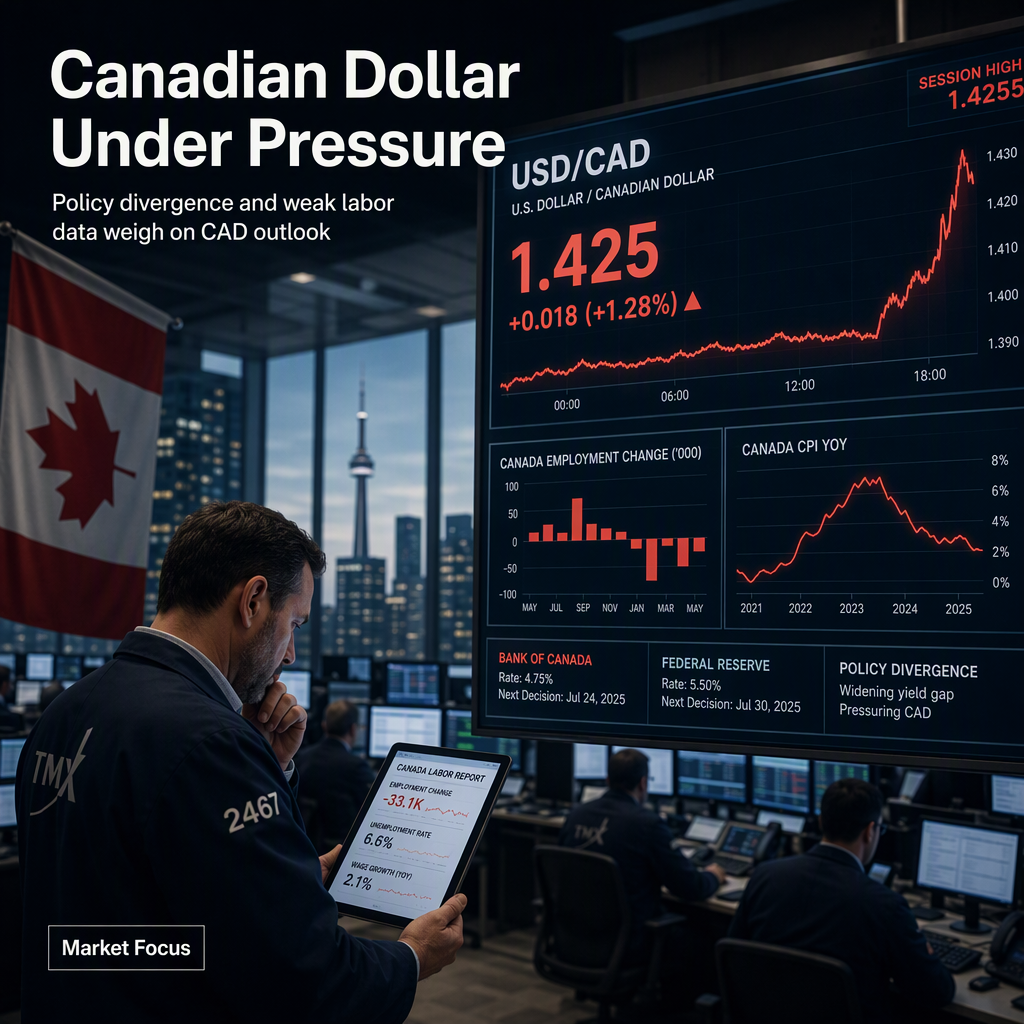
The Canadian Dollar (CAD) is under pressure as both Brown Brothers Harriman (BBH) and Rabobank highlight significant developments in the USD/CAD currency pair. BBH notes that USD/CAD is consolidating just above 1.4200 after reaching fresh cyclical highs near 1.4300 earlier in the week, with the Canadian September labor force survey identified as a key market event. Expectations are for a modest job gain of +10.0k following a loss of -41.7k jobs in August, and for the unemployment rate to rise by 0.1 percentage points to 6.5%, with the participation rate steady at 65.0%. BBH argues that nearly 100 basis points of Bank of Canada (BoC) rate hikes priced in over the next year appears too aggressive, especially as core inflation is near the BoC’s 2% target and indicators suggest continued excess supply in the economy. This leaves the CAD vulnerable to a dovish repricing of BoC expectations [1].
Rabobank strategists Molly Schwartz and Christian Lawrence attribute the recent USD/CAD rally primarily to broad US Dollar strength rather than specific CAD weakness. They observe that USD/CAD is consolidating near 1.425 after failing to break above 1.43 on October 5, representing a significant move from September’s low of 1.373. Rabobank forecasts a widening US-Canada rate differential from 175 basis points currently to 200 basis points by year-end, expecting this divergence to push USD/CAD toward 1.45 over the next three months before easing back toward 1.40 over a 12-month horizon. The strategists also note that, despite weak Canadian economic activity and a deteriorating trade dynamic with the US, the Canadian OIS curve is implying almost four more BoC rate hikes by September of next year [2].
Both sources highlight the vulnerability of the Canadian Dollar to shifts in monetary policy expectations. BBH emphasizes the risk of a dovish repricing if labor data disappoints and inflation remains subdued, while Rabobank points to policy divergence and higher US yields as drivers for further USD/CAD upside in the near term [1][2].
CONCLUSION
The Canadian Dollar is facing downward pressure due to a combination of weak domestic labor data, subdued inflation, and a widening policy gap with the US. Market participants are closely watching upcoming economic releases and central bank signals, with both sources suggesting that the CAD remains vulnerable to further declines if current expectations for aggressive BoC tightening are revised lower.