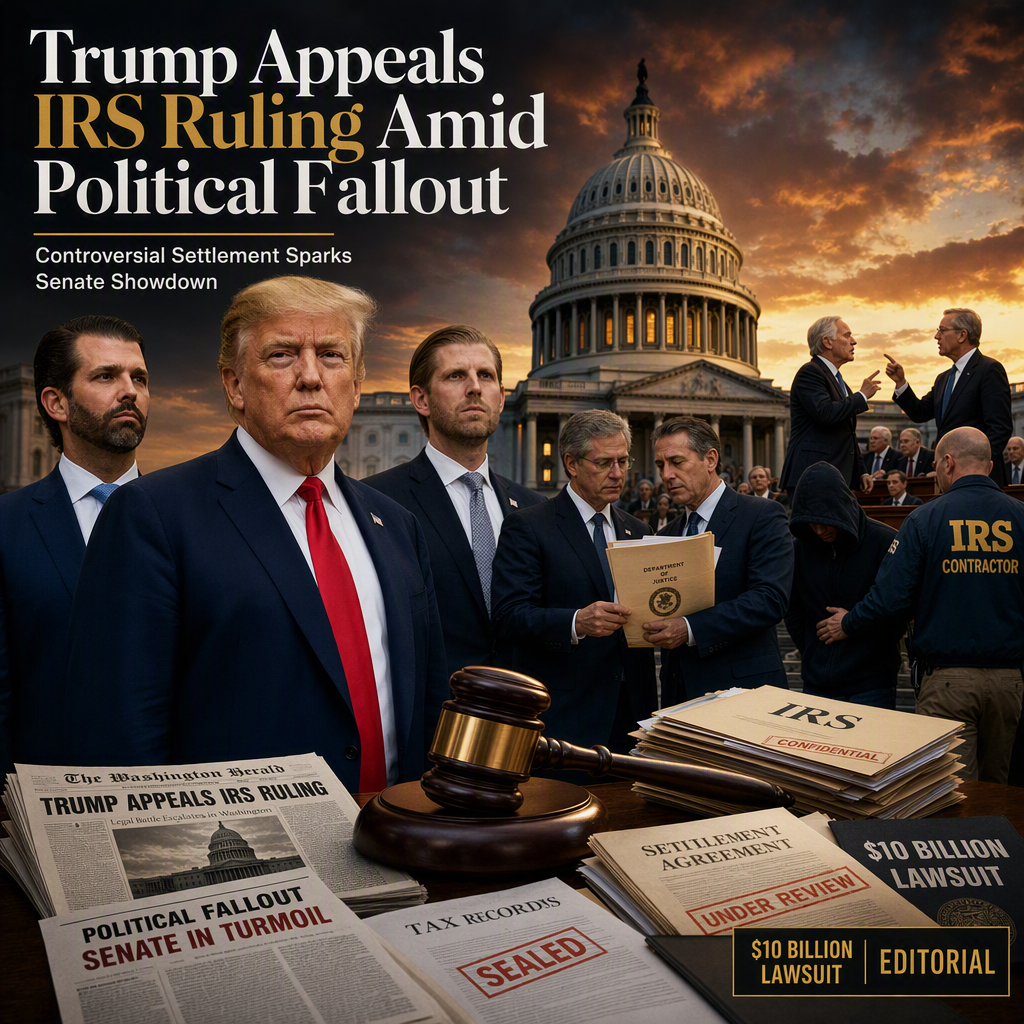
President Donald Trump has initiated an appeal against a federal judge’s July 13 ruling that found his $10 billion lawsuit against the IRS was filed for an “improper purpose” and aimed to “manipulate the judicial process” rather than to “vindicate rights” [1]. The lawsuit, brought by Trump, two of his sons, and the Trump Organization, accused the IRS and the Treasury Department of being responsible for the unauthorized release of Trump’s tax documents, which led to a New York Times report stating he paid only $750 in federal income taxes in 2016 and 2017 [1].
The case resulted in the Justice Department creating a $1.8 billion “anti-weaponization” fund as part of a settlement, which also included an agreement that the government would not investigate or seek payment from Trump, his family, or his companies on pending tax claims [1]. However, the judge ruled that the Justice Department could not portray the settlement as a judicial agreement and imposed sanctions against acting Attorney General Todd Blanche and Associate Attorney General Stanley Woodward. The judge also referred one of Trump’s attorneys, Alejandro Brito, to the Florida Bar Association for possible disciplinary action [1].
The settlement has sparked a standoff between Republican Senators John Cornyn and Thom Tillis and the Justice Department, stalling a vote on Blanche’s nomination for attorney general. The senators have demanded that the DOJ permanently shut down the “anti-weaponization” fund and narrow the audit protection deal before advancing the nomination [1]. Trump acknowledged that the fund is “dead” but expressed regret, stating, “I wish it weren’t” [1].
A former IRS contractor pleaded guilty in 2023 to stealing Trump’s tax records and thousands of others in 2019 and 2020 before leaking them, and is currently serving a five-year prison term [1]. The IRS did not immediately respond to requests for comment on the appeal [1].
CONCLUSION
Trump’s appeal of the federal ruling and the controversial settlement with the Justice Department have intensified political tensions, particularly regarding the stalled attorney general nomination. The case highlights ongoing scrutiny over the handling of Trump’s tax records and the broader implications for government accountability and legal processes.