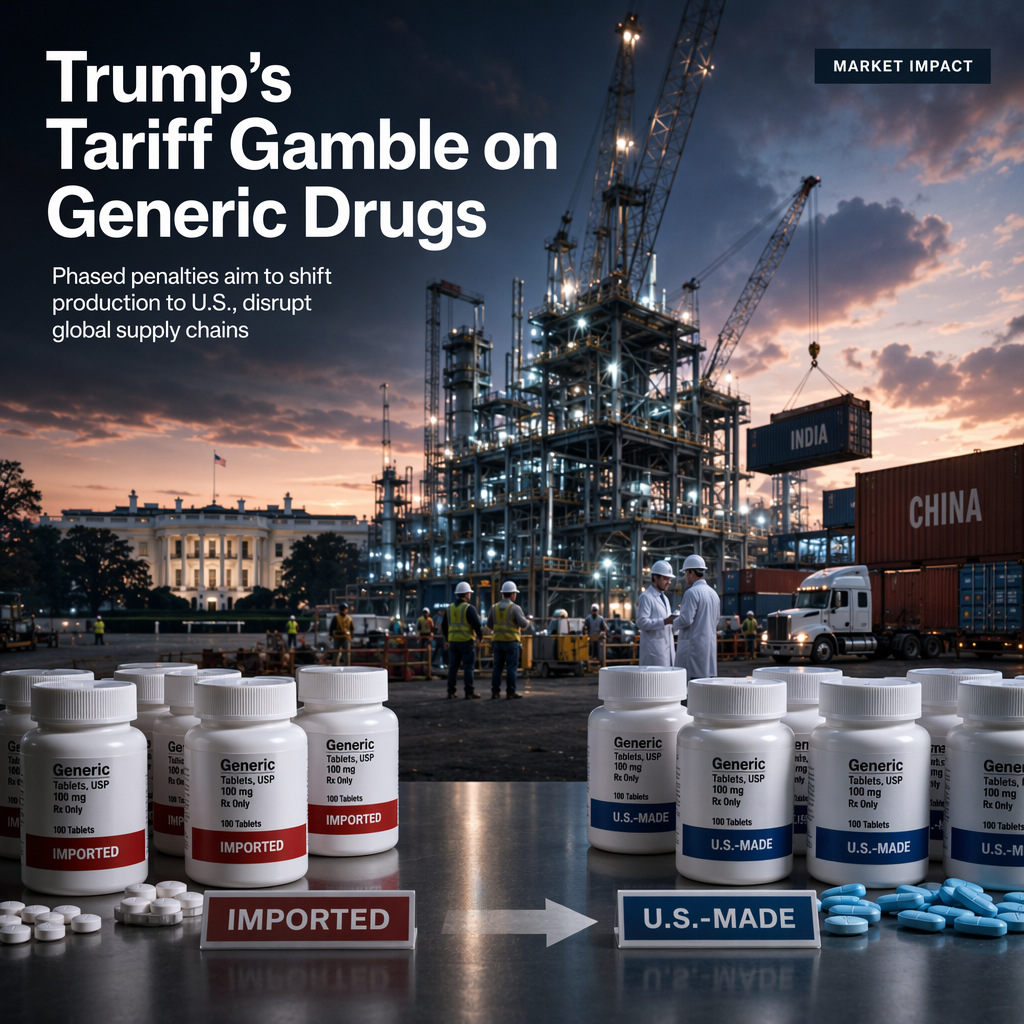
President Donald Trump has announced a new tariff policy targeting imported generic drugs, aiming to encourage pharmaceutical companies to shift production to the United States. According to the announcement, all imported generic drugs will remain tariff-free for a two-year transition period starting August 1, 2026. After this period, a 100% tariff will be imposed for one year, followed by a 200% tariff thereafter [1][2]. Trump described the phased approach as a 'penalty' for companies that do not build manufacturing plants and facilities in the U.S. within the grace period [1][2].
The policy does not affect patented, branded, or innovative drugs, whose tariff regime will remain unchanged. Trump previously imposed a 100% tariff on patented pharmaceutical products and ingredients under Section 232 on April 2, exempting generic drugs, biosimilars, and related ingredients [2]. Larger drugmakers were given 120 days before the 100% tariff rate took effect, while smaller drugmakers relying on contract manufacturers had 180 days [2].
The Association for Accessible Medicines, representing generic drug manufacturers, stated it is seeking more details on the proposal but supports policies that strengthen domestic manufacturing. President and CEO John Murphy III noted that while the industry has expanded U.S. manufacturing investments over the past two years, structural issues in purchasing and reimbursement continue to hinder further growth [1].
The market implications are significant, especially for India, which supplies nearly 50% of all generic medicines consumed in the U.S. The U.S. represents about a third of India's pharmaceutical exports, primarily consisting of lower-cost generic drugs. Chinese firms also play a major role in supplying active pharmaceutical ingredients such as amoxicillin and heparin [2]. Trump highlighted a surge in domestic investment by drugmakers, stating that pharmaceutical facilities are being built at unprecedented levels across the U.S. [1].
Additionally, more than a dozen major drugmakers, including Eli Lilly, Pfizer, and Novo Nordisk, have reached agreements with Trump to lower the prices of new and existing medicines. These deals are part of the 'most favored nation' policy, which ties U.S. drug prices to those in other high-income countries and exempts participating companies from tariffs for three years [2].
CONCLUSION
Trump's phased tariff plan on imported generic drugs is designed to incentivize domestic production and reduce U.S. reliance on foreign suppliers, particularly from India and China. The policy is expected to have a high market impact, with significant implications for global pharmaceutical supply chains and pricing strategies. Industry groups are seeking further details, while major drugmakers have already negotiated exemptions under related pricing agreements.