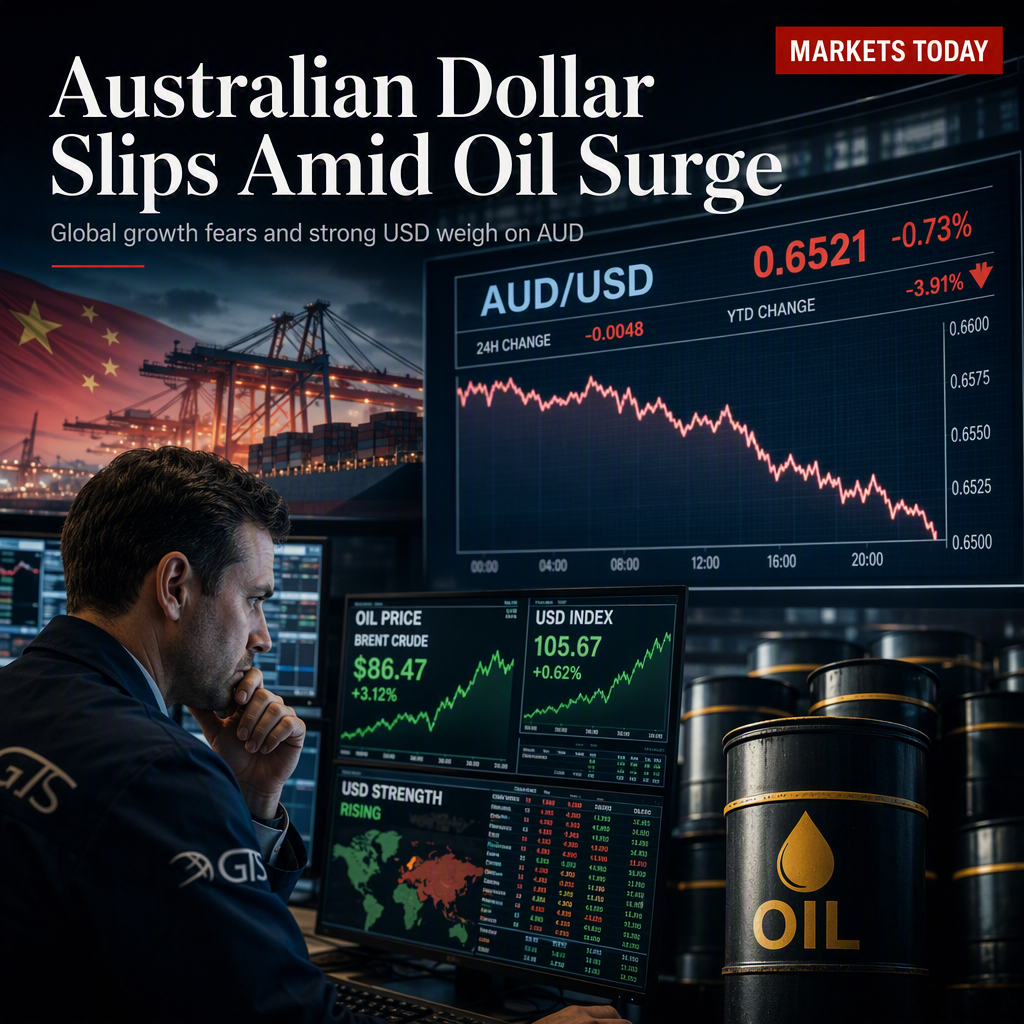
The Australian Dollar (AUD) declined by 0.36% against the US Dollar (USD) for the day, remaining above the 0.7000 level but surrendering gains made on Wednesday. This movement occurred as the US Dollar Index (DXY) rose by 0.28%, approaching the key 100.00 mark, indicating broad-based USD strength [1]. Notably, the AUD's weakness came despite a rally in crude oil prices, which climbed over 3% to $77.67 following reports that vessels linked to the US, Israel, and other countries considered hostile by Tehran could be barred from the Strait of Hormuz under a proposed deal. Typically, commodity-linked currencies like the AUD would benefit from such a move, but the current risk to global growth from potential disruptions to a fifth of the world's oil flows appears to be weighing on sentiment [1].
Chinese trade data also factored into the AUD's performance. Exports from China are expected to have grown 22.2% year-on-year in July, down from 27%, while imports are projected to slow to 27.9% from 36%. The trade surplus is anticipated to narrow to $107 billion from $125.62 billion. Although these figures remain robust, the deceleration is significant for the AUD, which often trades as a proxy for Chinese demand [1].
Looking ahead, the US Nonfarm Payrolls (NFP) report is due on Friday. A strong result could further bolster the USD and put additional pressure on the AUD, potentially squeezing it from both sides [1].
From a technical perspective, AUD/USD is trading at 0.7031 in a neutral near-term tone, with price action consolidating between the 100-period Simple Moving Average (SMA) at 0.7001 (support) and the 20-period SMA at 0.7035 (resistance). Immediate resistance is clustered around 0.7033–0.7034, with further hurdles at 0.7044 and 0.7049. On the downside, support is seen at 0.7023 and more firmly at 0.7001, which would need to break to signal a more bearish phase. The Relative Strength Index (RSI) near 50 suggests consolidative momentum rather than a clear directional move [1].
CONCLUSION
The Australian Dollar's decline, despite a rally in oil prices, reflects concerns over global growth risks and a stronger US Dollar. With Chinese trade data showing a slowdown and the upcoming US Nonfarm Payrolls report, the AUD remains vulnerable to further downside pressure. Technical indicators point to a consolidative phase, with key support and resistance levels in focus.