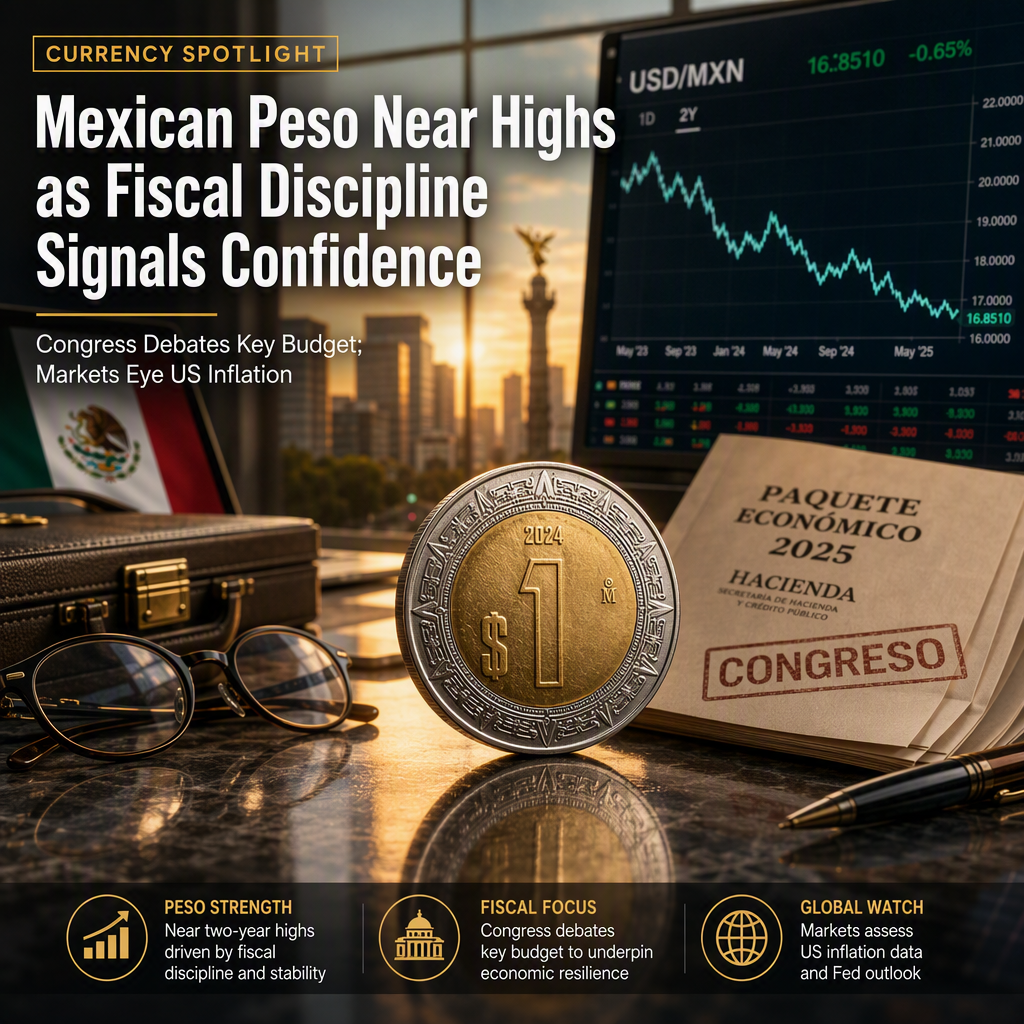
The Mexican Peso maintained its strength against the US Dollar on Wednesday, with the USD/MXN pair trading at 16.89, down 0.09% and hovering near yearly lows, following the presentation of Mexico’s government fiscal package in Congress [1]. The fiscal plan projects a narrowing of the budget deficit to 3.9% of GDP by 2027, compared to this year's estimated deficit of 4.1% of GDP, and includes a significant reduction in government support for Petroleos Mexicanos (PEMEX), with debt payment support expected to fall to about $4.8 billion, nearly 70% lower than the current year's allocation [1]. The government also forecasts economic growth between 1% and 2%, and anticipates a primary fiscal surplus of 0.6% of GDP next year, excluding debt payments [1].
The fiscal package is now set for debate in Congress, where President Claudia Sheinbaum’s ruling party, Morena, is expected to approve the bill with possible amendments [1]. On the inflation front, Mexico’s National Statistics Agency reported annual inflation for August at 3.26%, below the 3.30% estimate but up from July’s 3.12%. Core inflation reached 3.88%, also below forecasts of 3.92%, but remains above the Bank of Mexico’s target range of 3% plus or minus 1% [1].
Market participants are closely watching upcoming US inflation data, with the US Bureau of Labour Statistics set to release the Producer Price Index (PPI) and Consumer Price Index (CPI) for August in the coming days [1]. A stronger-than-expected US inflation report could trigger a rebound in USD/MXN and potentially prompt the Federal Reserve to consider a rate hike at its September 15-16 meeting [1].
From a technical perspective, USD/MXN remains in a bearish near-term trend, trading below key moving averages clustered around 17.2154, with immediate support at 16.8866. The Relative Strength Index (RSI) at 34.12 suggests ongoing, but not extreme, selling pressure [1].
CONCLUSION
The Mexican Peso's resilience is underpinned by the government's commitment to fiscal discipline and cooling inflation, though core inflation remains above target. Market attention now shifts to upcoming US inflation data, which could influence the USD/MXN trajectory and Federal Reserve policy decisions.