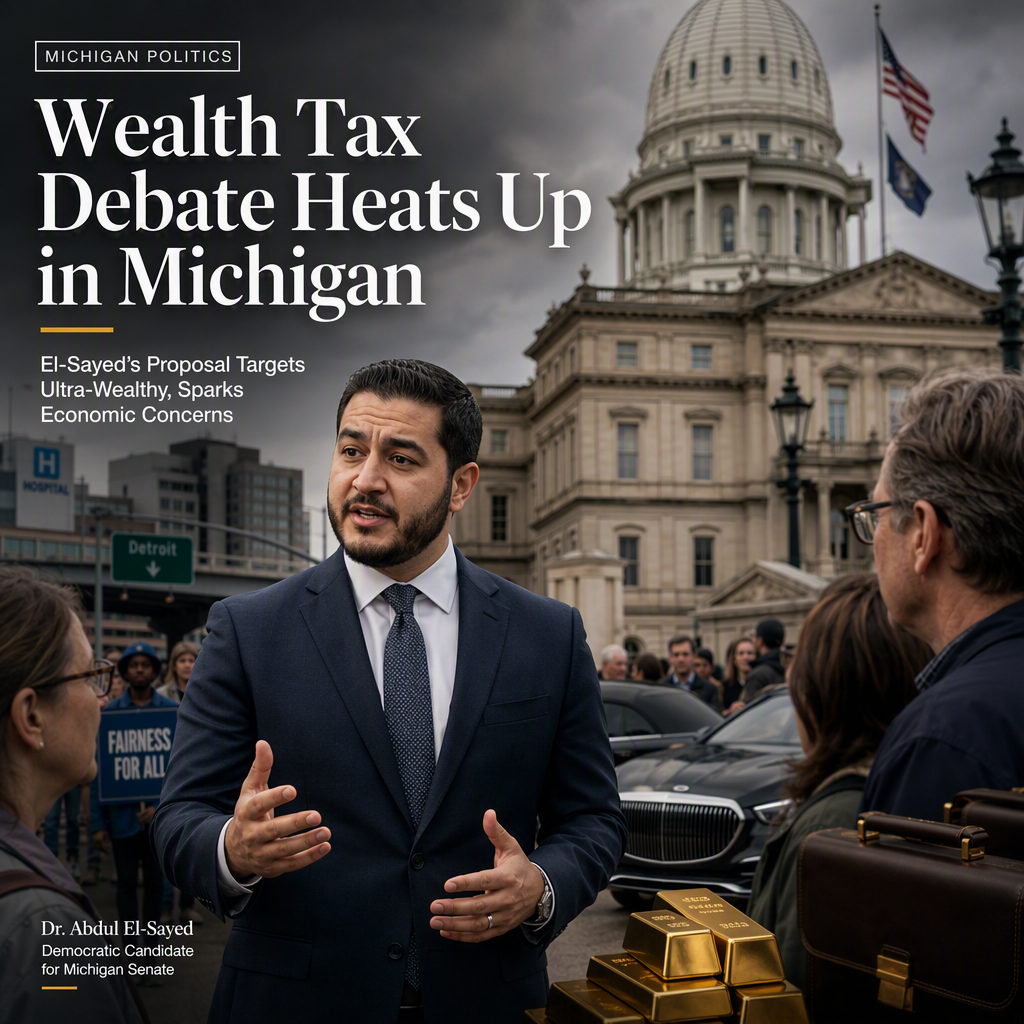
Michigan Democratic Senate candidate Dr. Abdul El-Sayed has reiterated his support for a wealth tax targeting individuals with over $100 million in property and other forms of wealth, according to his recent interview with Fox News’ Jesse Watters [1]. El-Sayed emphasized that wealthy individuals do not have much use for their excess money and argued that these funds would be better allocated to public programs such as Medicare-for-All, reparations, and infrastructure improvements for Michigan voters [1].
El-Sayed clarified that the proposed wealth tax would not affect his own reported income of $686,069 in 2025, as it is designed to apply only to those with $100 million or more in wealth [1]. During the interview, he stated, "If we tax you at 7%, you’re still going to make what? A cool $30 million off your billion dollars? I think that’s OK, they’re going to be OK, Jesse," suggesting a hypothetical scenario where a $1 billion fortune generates a 10% annual return, with a 7% wealth tax leaving $30 million in gains [1]. However, El-Sayed did not provide detailed assumptions or clarify the realism of these figures [1].
The article notes that other political figures, such as Rep. Ro Khanna, D-Calif., have also advocated for wealth taxes on millionaires, not just billionaires, indicating a broader political movement [1]. The opinion piece argues that such a tax could be unconstitutional at the federal level and potentially disastrous for Michigan’s economy if implemented at the state level [1].
Market implications discussed in the article are largely negative, with the author warning that the wealth tax could harm Michigan’s economy and referencing historical examples of divisive "eat-the-rich" politics [1]. No specific market reactions or analyst forecasts are provided in the article.
CONCLUSION
Dr. Abdul El-Sayed’s renewed call for a wealth tax on individuals with over $100 million in wealth has sparked debate about its potential economic impact on Michigan. While El-Sayed frames the tax as a means to fund public programs, critics warn of possible negative consequences for the state’s economy. No concrete market reactions or forward-looking analyst opinions are provided in the article.