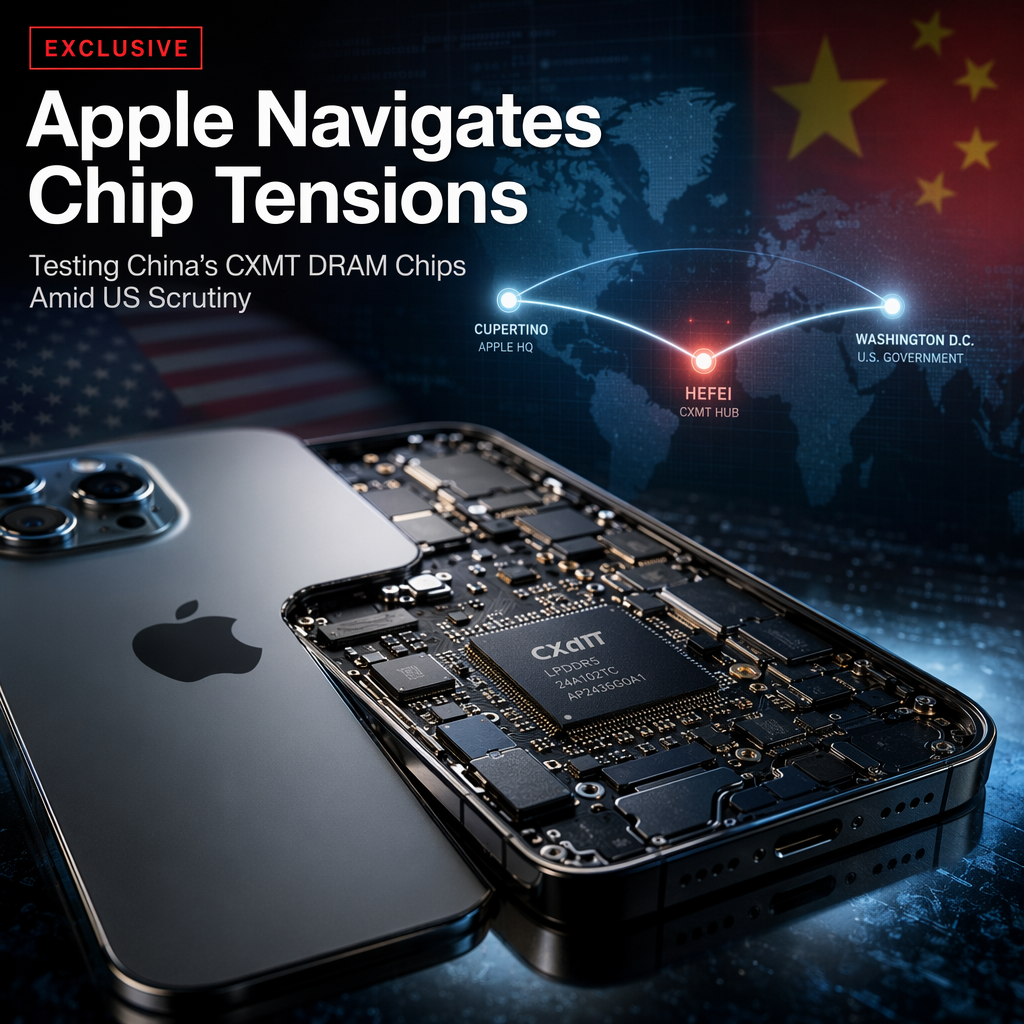
Apple has reportedly started testing DRAM chips from China's state-backed ChangXin Memory Technologies (CXMT) for use in devices sold within China, according to the Financial Times as cited by CNBC. This move comes as Apple navigates the sensitive geopolitical landscape, with its ties to Chinese suppliers under scrutiny amid increasing U.S. efforts to curb China's technological advancements [1]. Apple is also lobbying the U.S. government to allow broader use of CXMT's products [1].
CXMT is positioned to play a central role in Beijing's strategy to establish a self-sufficient AI supply chain and is expected to become one of the most profitable technology companies to list in Shanghai, with plans to raise at least 29.5 billion yuan ($4.3 billion) in an upcoming IPO [1]. The company is currently the world's fourth-largest DRAM producer, with a market share projected to rise from approximately 11% last year to 15% by 2028 as new production lines in Hefei, Shanghai, and Beijing come online, according to data from SemiAnalysis [1]. Major global competitors in the DRAM space include Samsung Electronics, SK Hynix, and Micron Technology [1].
The report notes that while CXMT's production capacity is expanding, it is unlikely to immediately flood the market with cheap chips because much of its output is already pre-committed. However, there are industry concerns about a potential long-term scenario similar to what occurred in the solar panel and electric vehicle sectors, where state-backed capacity expansion led to falling global prices and increased pressure on foreign competitors [1].
In 2022, Apple faced significant opposition from U.S. policymakers, including then-Senator Marco Rubio (now Secretary of State), after considering the use of Chinese memory suppliers [1]. At least 15 state-owned shareholders collectively hold 36% of CXMT, with additional backing from state-owned limited partners in its private funds [1]. Despite being flagged as a national security risk, the U.S. has so far refrained from adding CXMT to its trade blacklist, as the Trump administration seeks to avoid escalating tensions with Beijing [1].
Neither Apple nor CXMT responded to CNBC's requests for comment [1].
CONCLUSION
Apple's testing of CXMT DRAM chips for China devices highlights the company's efforts to navigate complex geopolitical and supply chain challenges. While CXMT's growing capacity and state backing raise concerns about long-term market impacts, immediate effects are limited due to pre-committed output. The situation remains sensitive as U.S.-China tech tensions continue to influence corporate strategies and policy decisions.