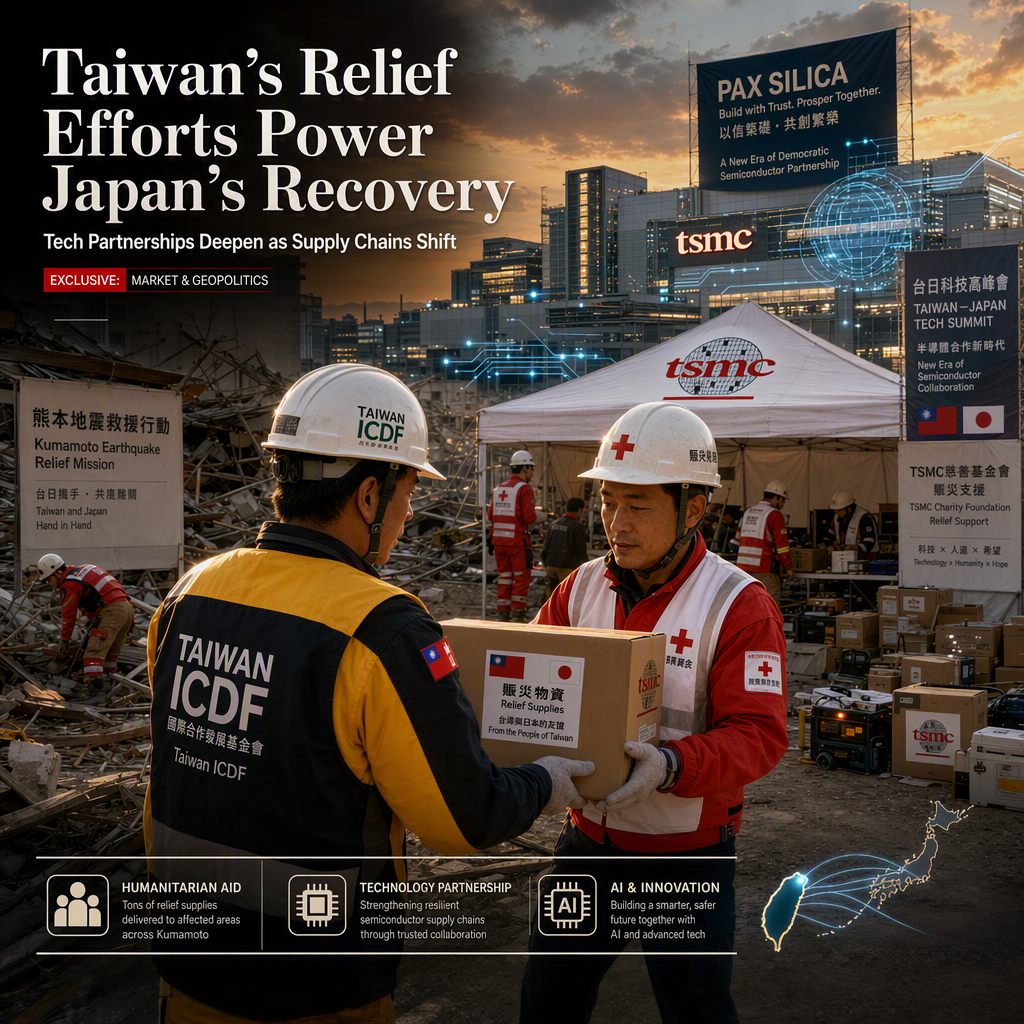
On August 27, 2026, it was reported that Taiwan has played a prominent role in supporting relief efforts following the M7.1 earthquake in Kumamoto, Japan, which resulted in 38 fatalities and impacted over 26,000 residences [1]. The International Cooperation and Development Fund (ICDF), affiliated with Taiwan's Foreign Ministry, announced that a campaign in Taiwan raised more than 300 million New Taiwan dollars ($9.4 million) for earthquake relief [1]. Additionally, Taiwan Semiconductor Manufacturing Co. (TSMC), which operates a chip factory in Kumamoto, pledged 250 million yen ($1.6 million), and its charity foundation launched an employee fundraising campaign to aid community rebuilding [1].
Taiwanese Foreign Minister Lin Chia-lung, who also chairs the ICDF, emphasized the deep friendship between Taiwan and Japan, referencing Taiwan's previous donation of 25 billion yen (over $200 million) after the 2011 Great East Japan Earthquake [1]. This ongoing generosity has fostered a strong sense of affinity between the two nations, especially in contrast to Japan's cooler relations with China under President Xi Jinping [1].
Beyond humanitarian support, Japan and Taiwan have reinforced cooperation in technology and economic security, aiming to establish a "China-free" supply chain. The fifth annual Japan-Taiwan Innovation Summit, held last week in Osaka and Tokyo, focused on driving economic growth through technological innovation and supply chain resilience [1]. The summit attracted 46 Taiwanese startups across sectors such as artificial intelligence, autonomous driving, semiconductors, space technology, digital health, and deep tech [1]. A key theme was alignment with the U.S. Pax Silica initiative, launched last December to build an international alliance for AI and tech supply chain security, with Japan as one of 25 signatories and Taiwan as a non-signatory partner [1].
John Speaks, regional technology officer for East Asia at the U.S. State Department, stated that creating a trusted tech ecosystem with partners like Japan and Taiwan is "not a slogan" and "no longer optional" [1]. While China was not directly referenced, the context suggests a strategic move away from Chinese influence, especially with the recent founding of the World Artificial Intelligence Cooperation Organization (WAICO) in Shanghai, which has 29 members [1].
CONCLUSION
Taiwan's substantial financial and humanitarian support for Japan's earthquake recovery, combined with deepening tech and supply chain collaboration, underscores a strengthening bilateral relationship. The focus on supply chain resilience and alignment with U.S. initiatives signals ongoing market and geopolitical shifts, particularly in the tech sector. These developments are likely to have medium-term implications for regional economic security and technology markets.