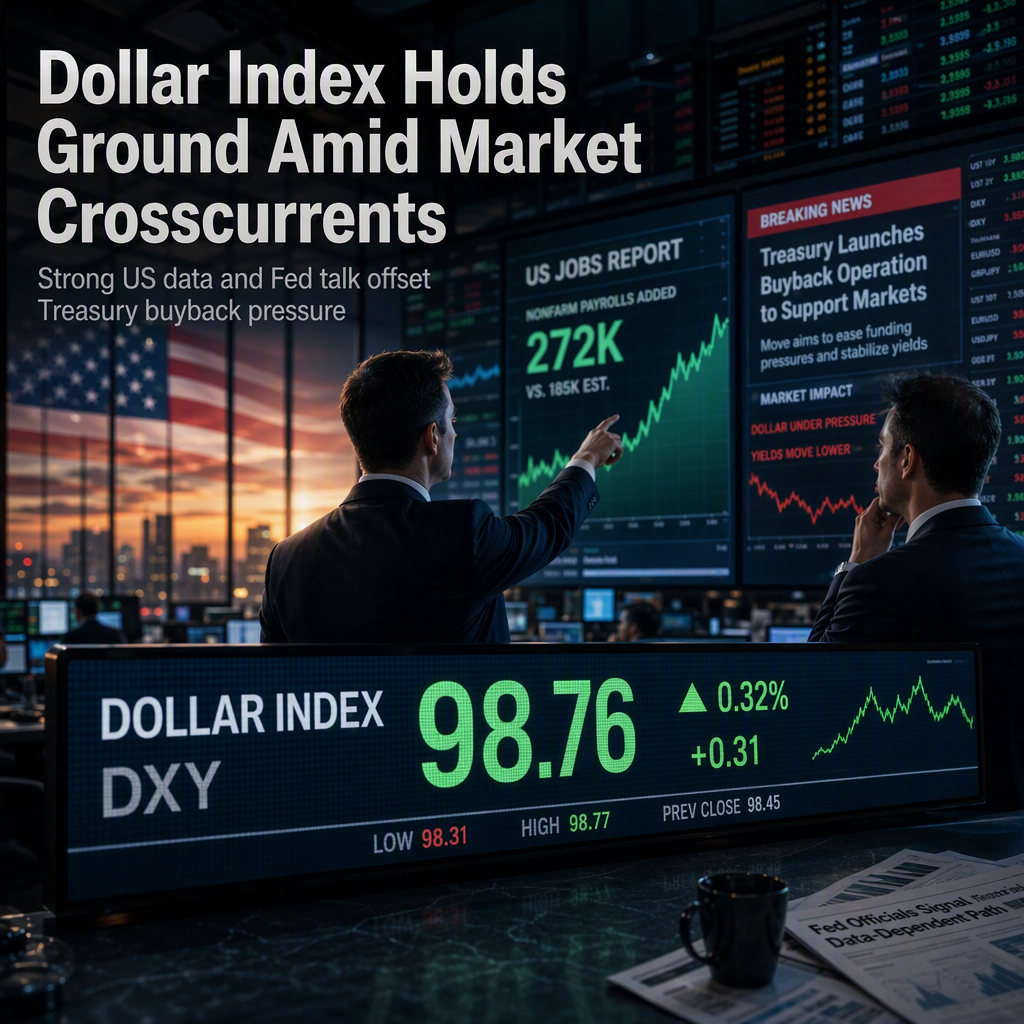
The Dollar Index spent Thursday defending a floor just above 98.50, ultimately rising 0.12% from a base last seen in mid-May, buoyed by a combination of strong US economic data and hawkish commentary from a regional Federal Reserve official, though neither Fed speaker currently holds a vote on the FOMC this year [1]. Initial jobless claims came in at 206,000, beating the consensus estimate of 210,000 and improving from the previous week's 212,000 [1]. The Philadelphia Fed's August manufacturing survey surged to 47.4, well above the consensus of 25 and the prior reading of 41.4, with the employment index climbing 18 points to its highest since April 2022 and the six-month outlook index jumping 39 points to a level last seen in 1983 [1].
Despite these positive data points, the Dollar Index remains more than a point below its 50-day Exponential Moving Average and about eight tenths of a point under the 200-day EMA, with the 50-day average trending downward [1]. The 12:30 GMT Fed appearance was interpreted as neutral, with the official stating that current policy is appropriate, the Fed's credibility is intact, and it is too early to assess the impact of Treasury debt-management decisions; the Dollar Index eased toward 98.75 during this period [1]. At 15:10 GMT, a more hawkish Fed official, who supported a rate hike in July and warned that inflation is likely to remain above target, argued for preemptive action but did not commit to a September move; this commentary helped lift the index toward its session high just below 99.00 [1].
However, the Dollar's earlier weakness this week was attributed to the US Treasury's announcement on Wednesday that it would at least double its liquidity-support buybacks in the 10-year to 30-year sector, raising the ceiling to $4 billion per operation from $2 billion, effective September 9 through November 4, after long-end yields had reached their highest levels since 2006 [1]. The Dollar Index fell roughly eight tenths of a point following this announcement [1].
CONCLUSION
The Dollar Index found support from robust US economic data and hawkish Fed commentary, but remains technically pressured below key moving averages. The Treasury's decision to expand long-end buybacks weighed on the Dollar earlier in the week, highlighting ongoing market sensitivity to policy and liquidity developments.