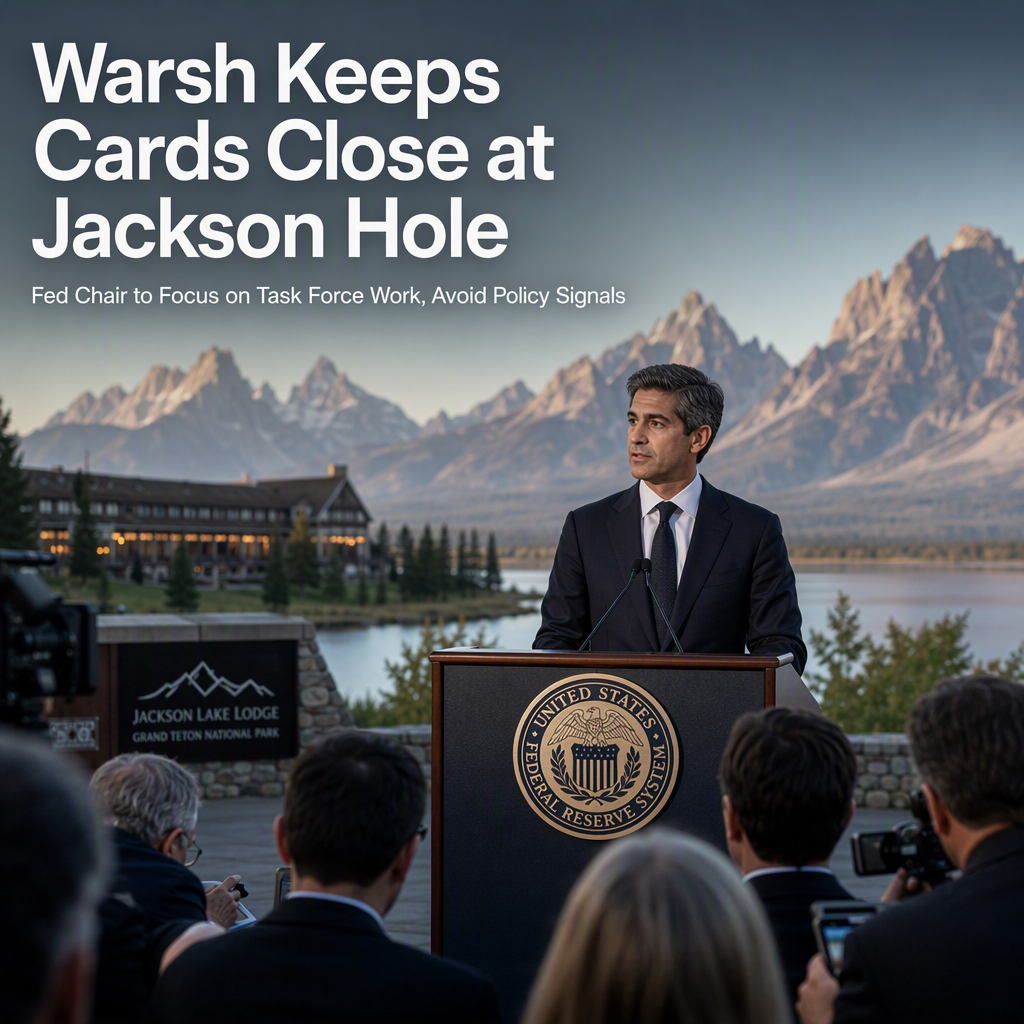
Wells Fargo Economics suggests that the Federal Reserve's Jackson Hole symposium is often given more significance than warranted, noting that only two speeches in the past 14 years—Powell's 'pain' speech in 2022 and Bernanke's hint at QE3 in 2012—have been truly consequential for near-term policy direction [1]. The expectation is that Chair Warsh will continue his strategy of withholding detailed guidance on the Fed's near-term reaction function, a tactic he has maintained since taking office, especially given the current split within the FOMC and upcoming inflation and employment data before the next FOMC meeting on September 16 [1].
Wells Fargo anticipates that Warsh will use his Jackson Hole speech to elaborate on ongoing task force work, balance sheet options, and broader policy framework issues, rather than making commitments that could constrain the FOMC's future decisions [1]. The report highlights Warsh's intention to avoid getting ahead of the task forces and to emphasize continuity at the Fed, aiming to foster positive relations with existing FOMC members and secure support for eventual recommendations [1].
The market implication, according to Wells Fargo, is that little is likely to happen at this year's Jackson Hole event in terms of immediate policy shifts, with Warsh expected to avoid signaling any changes that could influence the near-term policy path [1].
CONCLUSION
Wells Fargo Economics expects Chair Warsh to maintain a cautious approach at Jackson Hole, focusing on task force updates and avoiding near-term policy commitments. The symposium is unlikely to deliver market-moving news, with the Fed's direction remaining dependent on upcoming economic data and internal committee discussions.