
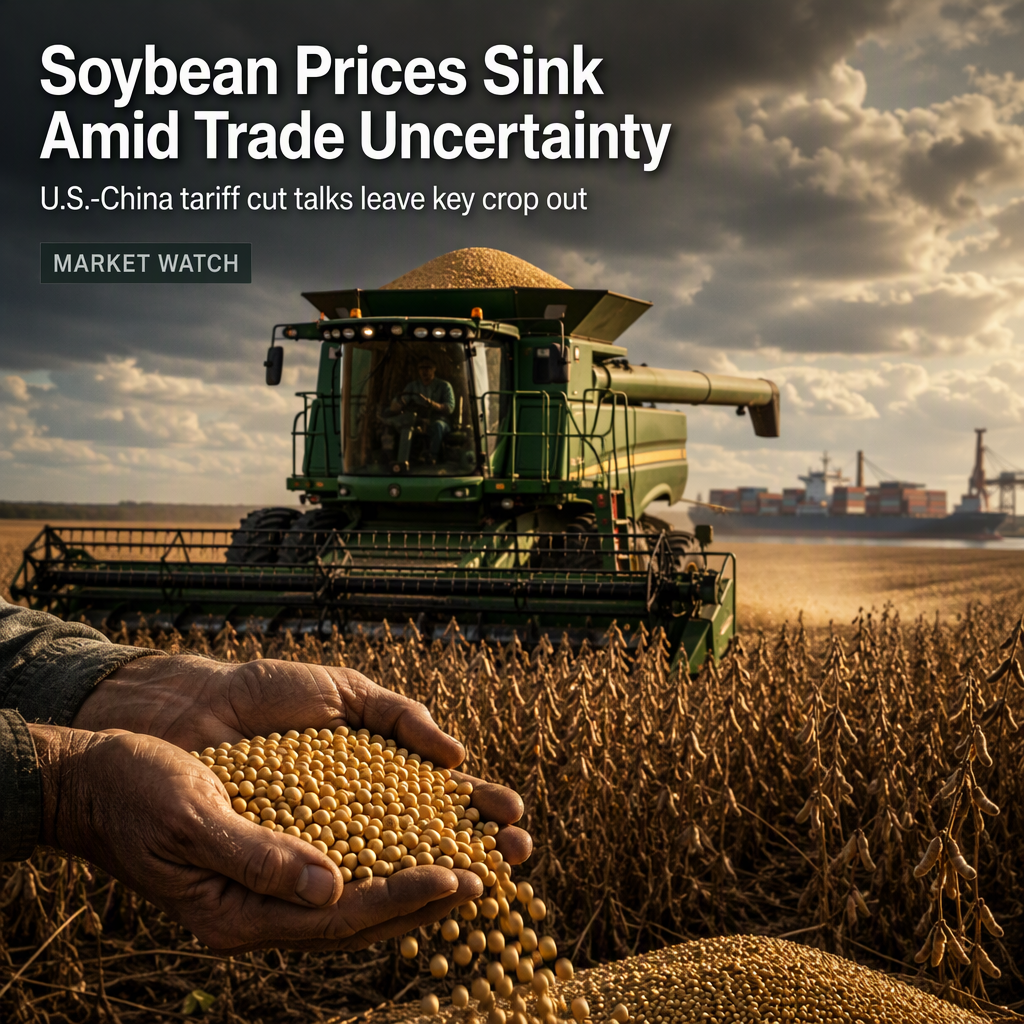
Soybean prices dropped to a roughly one-month low this week after it was revealed that soybeans were not included in the initial list of products for which the U.S. and China plan to discuss tariff cuts following recent summit talks [1]. This development came as a surprise to market participants, who had anticipated that soybeans—a major U.S. export to China—would be used as a goodwill gesture to ease ongoing trade tensions [1].
The seasonal increase in supply during the U.S. harvest period typically puts downward pressure on soybean prices, and this effect was intensified by the news of soybeans' omission from the tariff discussions [1]. Market analysts noted that the lack of progress on tariff relief has dampened trader optimism, with one analyst stating, "The market was hoping for some positive movement on the tariff front for soybeans, but so far, that has not materialized" [1].
Despite the setback, sources familiar with the negotiations indicated that soybeans have not been completely ruled out and could be added to the list of products for tariff cuts at a later stage [1]. In the meantime, with U.S. harvests ongoing and inventories building, there is little immediate price support for soybeans [1].
Technical analysis shows that the next key support level for Chicago Board of Trade (CBOT) soybeans is near $12.60 per bushel, with further downside possible if this level does not hold. Resistance is seen around $13.20 per bushel, and technical indicators such as the Relative Strength Index (RSI) have declined, reflecting weakening market momentum [1]. Traders are advised to closely monitor both U.S.-China trade developments and U.S. harvest progress, as soybean prices may remain under pressure until clearer news on tariff relief emerges [1].
CONCLUSION
Soybean prices are under pressure due to their exclusion from initial U.S.-China tariff cut talks and the ongoing U.S. harvest. Market sentiment remains cautious, with traders closely watching for any updates on trade negotiations or changes in supply dynamics.