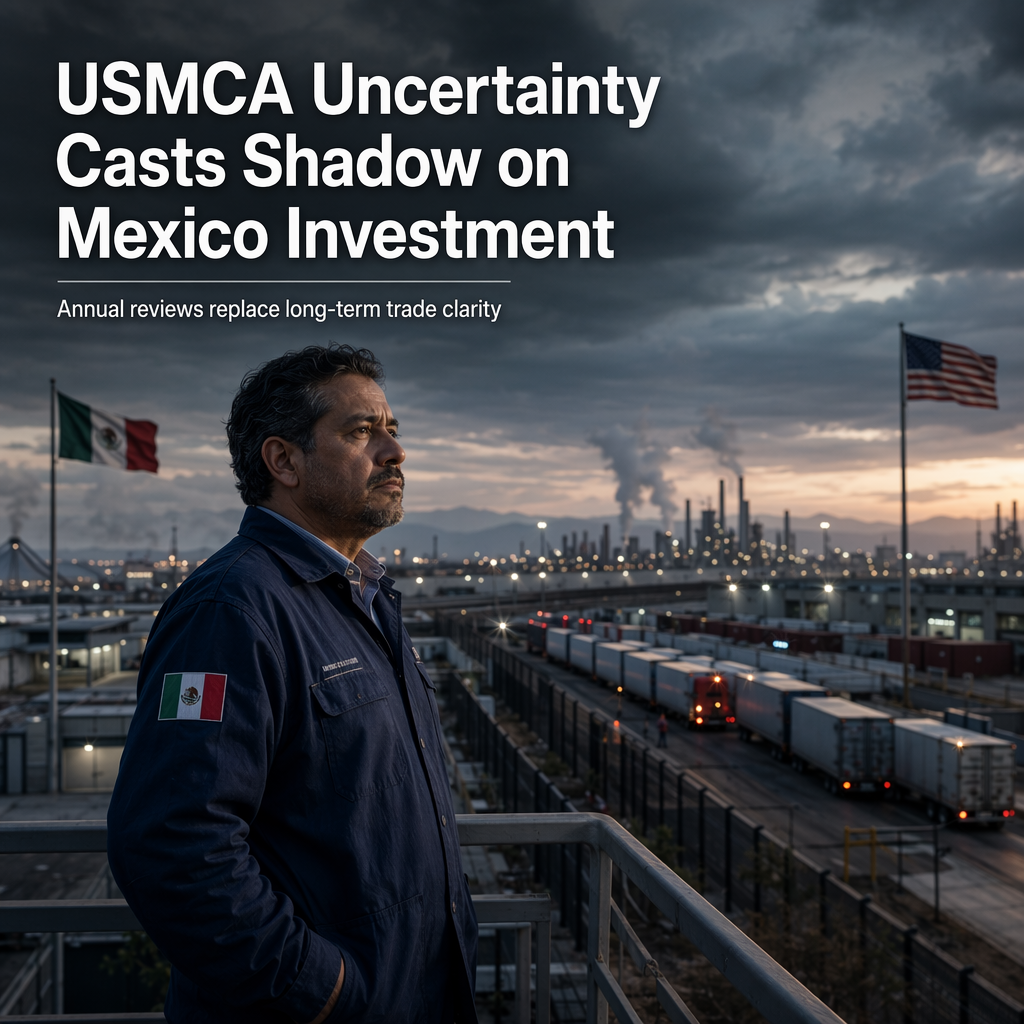
The United States has decided not to proceed with a 16-year extension of the United States-Mexico-Canada Agreement (USMCA), instead choosing to implement annual reviews of the trade agreement through 2036, according to Societe Generale’s Dev Ashish [1]. This decision extends policy uncertainty for Mexico, particularly regarding the long-term framework for regional trade, manufacturing, and supply-chain integration [1].
Despite the change, near-term trade flows are expected to remain largely unaffected, as evidenced by a muted reaction in the Mexican peso (MXN), which suggests that markets had anticipated this outcome [1]. However, the lack of longer-term policy certainty is likely to keep investor appetite for large-scale capital commitments subdued in the coming quarters [1]. Companies may continue to favor incremental, wait-and-see investment strategies rather than pursuing major expansion projects until there is greater clarity on the future of the trade agreement [1].
Societe Generale warns that the ongoing policy uncertainty could weigh on Mexican assets, raise risk premia, and moderately impact foreign direct investment (FDI) inflows [1]. These factors may potentially delay Mexico's anticipated growth recovery, as investors and firms remain cautious in the face of unresolved trade policy direction [1].
CONCLUSION
The US decision to opt for annual USMCA reviews instead of a long-term extension has extended policy uncertainty for Mexico, particularly impacting investment sentiment and FDI prospects. While immediate trade flows remain stable, the prolonged uncertainty may hinder Mexico's growth outlook as investors adopt a more cautious approach.