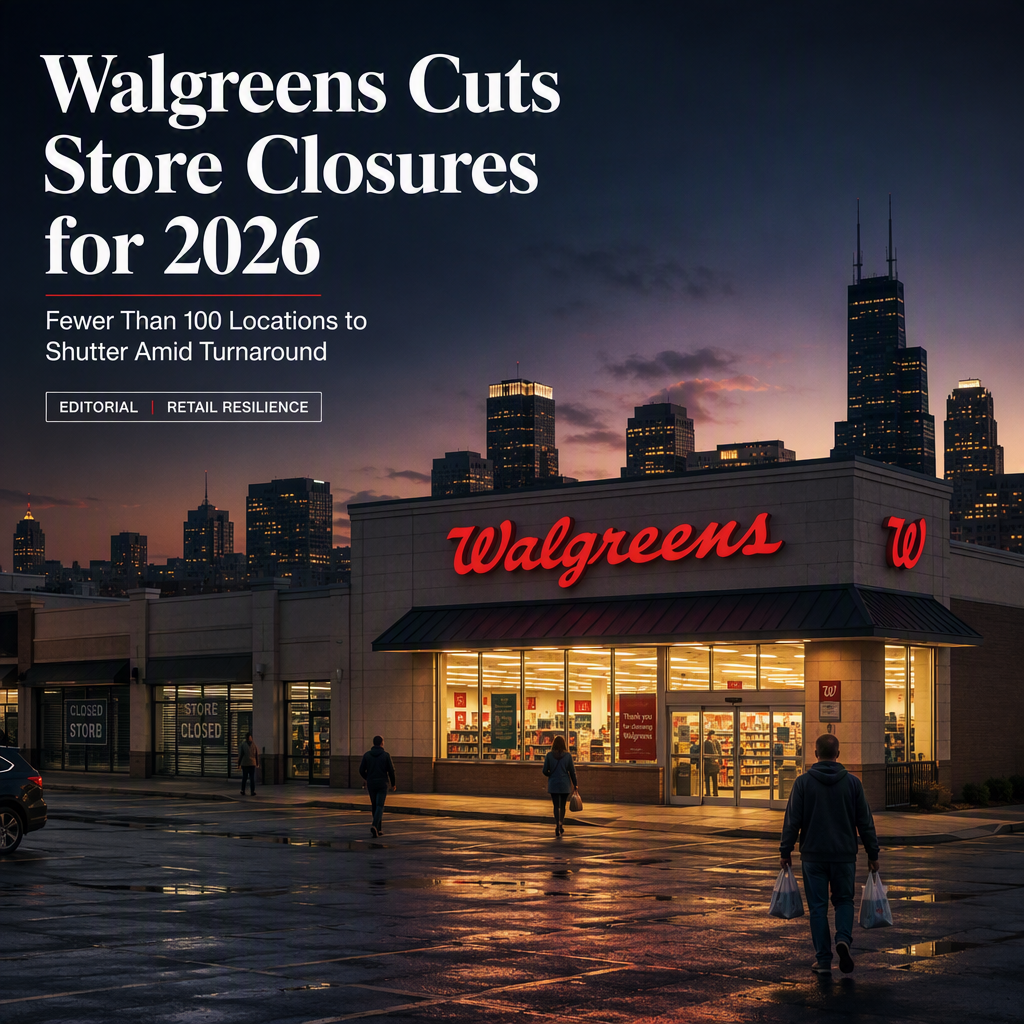
Walgreens is continuing its nationwide store closure initiative as part of a broader turnaround plan, but the company is now expected to close fewer than 100 stores in 2026, a significant reduction from earlier internal projections of roughly 700 closures for that year [1]. This adjustment follows Walgreens' October 2024 announcement to shutter approximately 1,200 underperforming stores over three years, with about 500 closures targeted for fiscal 2025, primarily focusing on locations generating negative cash flow [1]. The closure strategy was reportedly scaled back after Walgreens went private in 2025 [1].
Recent and upcoming closures include specific locations across several states: one store in Washington, D.C.; two in Chicago and one in Rockford, Illinois; one each in Bridgeton and St. Louis, Missouri; one in Bogota, New Jersey (scheduled to close August 6); one in Brooklyn, New York; one in Beaufort, South Carolina (scheduled to close August 6); a Houston, Texas distribution center; one in Arlington, Virginia; one in Seattle, Washington; and one in Milwaukee, Wisconsin [1].
The closures are attributed to financial and operational pressures, such as declining prescription sales and elevated theft, as highlighted by the closure of the Chicago location near 86th Street and Cottage Grove Avenue [1]. Walgreens regional Vice President Reginald Johnson emphasized that closing stores is a last resort, stating, "closing stores [is] not our goal. This is the last resort" [1].
Walgreens remains one of the largest pharmacy chains in the U.S., continuing to operate thousands of stores nationwide despite the ongoing closures [1].
CONCLUSION
Walgreens is reducing the scale of its store closure plan for 2026, now expecting fewer than 100 closures instead of the previously projected 700. The company continues to focus on underperforming locations as part of its turnaround strategy, while maintaining a significant national presence.