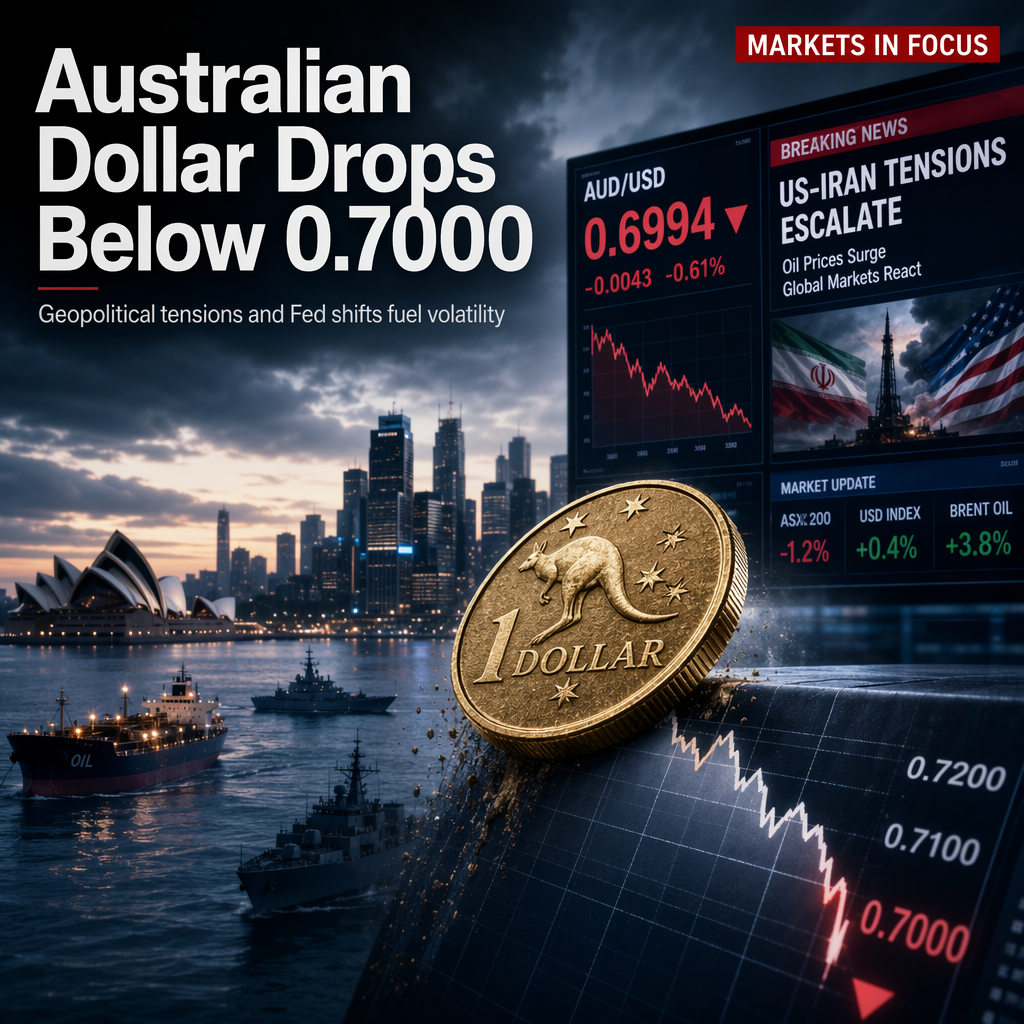
The Australian Dollar (AUD) weakened against the US Dollar (USD), with the AUD/USD pair dropping to around 0.6975 during the early Asian session on Monday, falling below the key 0.7000 psychological level. This decline was attributed to escalating tensions in the Middle East, specifically between the US and Iran. According to reports, US Central Command (CENTCOM) announced another death of a service member as the US launched additional airstrikes at Iran on Sunday in response to the killing of American troops. The US military stated that the service member was killed in Iraq on Saturday during the controlled detonation of a downed Iranian drone. Both the US and Iran have been accused of targeting critical infrastructure in recent days. Washington has reimposed its blockade of Iranian ports, while Tehran has declared the Strait of Hormuz closed and targeted US allies in the region. The ongoing conflict is seen as a factor boosting demand for safe-haven currencies like the US Dollar, thereby acting as a headwind for the AUD/USD pair [1].
In contrast, softer-than-expected US consumer and producer inflation data released last week have dampened expectations for further US Federal Reserve (Fed) rate hikes. The probability of a Fed rate hike in July stood at 14%, down from a 25% implied chance the previous week, according to the CME FedWatch tool. Traders are now pricing in 30 basis points of hikes by December. These developments could weigh on the USD against the Aussie, potentially offsetting some of the negative impact from geopolitical tensions [1].
The article also notes that the Australian Dollar is influenced by factors such as interest rates set by the Reserve Bank of Australia (RBA), commodity prices (especially iron ore), the health of the Chinese economy, and overall market sentiment. However, the immediate market reaction appears to be driven primarily by geopolitical risks and shifting US monetary policy expectations [1].
CONCLUSION
The Australian Dollar's decline below 0.7000 reflects heightened geopolitical risks from US-Iran tensions, which have increased demand for safe-haven assets like the US Dollar. While softer US inflation data and reduced Fed rate hike expectations could provide some support for the AUD, the prevailing market sentiment remains cautious amid ongoing Middle East conflicts.