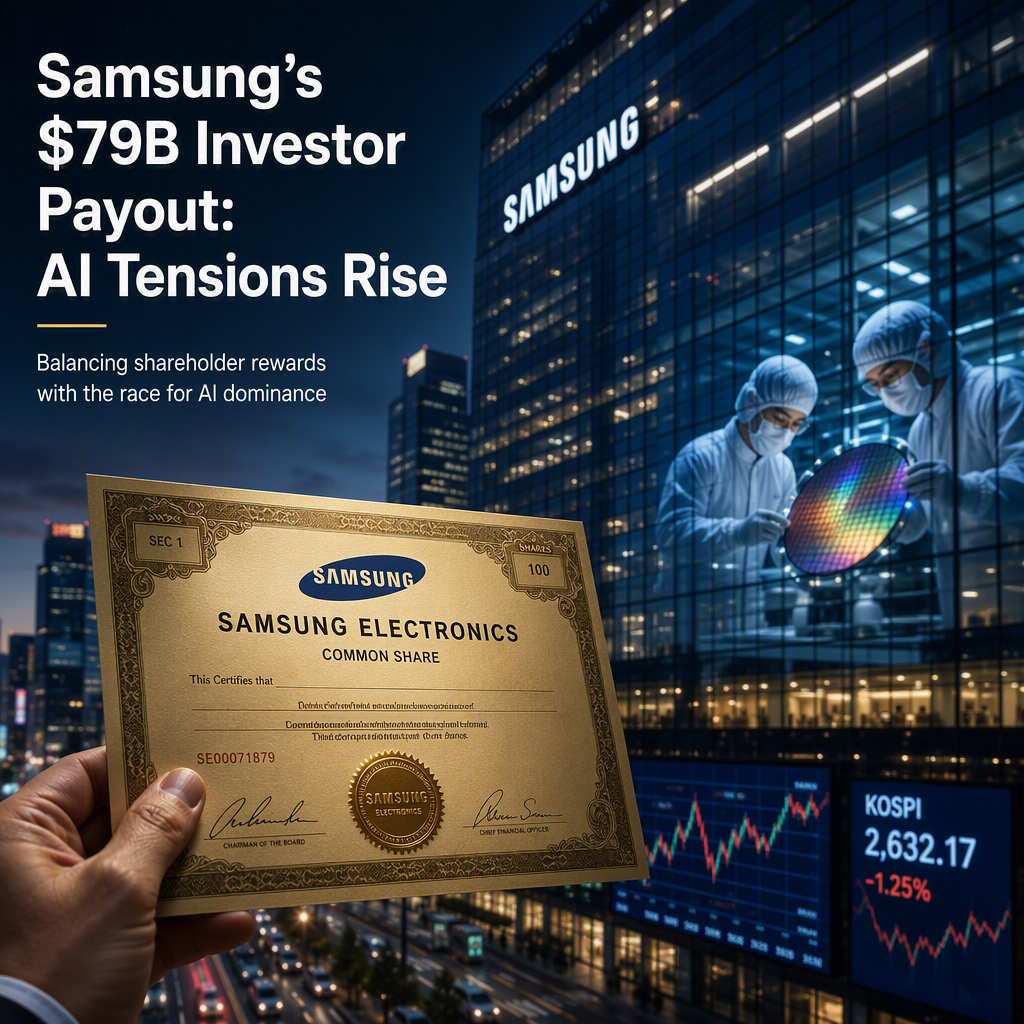
Samsung Electronics has announced a record shareholder return of up to 110 trillion won ($79 billion), reflecting the company's efforts to balance rewarding investors with the need for significant investment in artificial intelligence (AI) and semiconductor technologies [1]. This decision follows a period in which Samsung's semiconductor division achieved a record operating profit in the second quarter of 2026 [1].
The announcement comes at a time when Samsung's stock has experienced volatility, driven by concerns over a potential oversupply in the memory chip market [1]. Market analysts note that the substantial payout underscores the intense pressure on Samsung to satisfy both investor expectations and the capital demands required to remain competitive in the rapidly evolving AI sector [1].
Industry analysts have commented that Samsung must carefully balance shareholder returns with the enormous capital needed to maintain its competitive edge in AI [1]. Market participants are closely monitoring the company's capital allocation strategy, as the large payout may improve short-term sentiment among shareholders but also raises questions about Samsung's capacity for future investment in AI and semiconductor innovation [1].
No specific technical indicators or price levels were provided, but the article highlights that recent stock slides point to increased volatility and sensitivity to supply-demand dynamics in the memory chip sector [1].
CONCLUSION
Samsung's record $79 billion shareholder return signals a commitment to rewarding investors, but also highlights the challenges of balancing capital allocation amid the AI boom. While the payout may boost short-term sentiment, market participants remain cautious about the company's ability to sustain investment in future technologies.