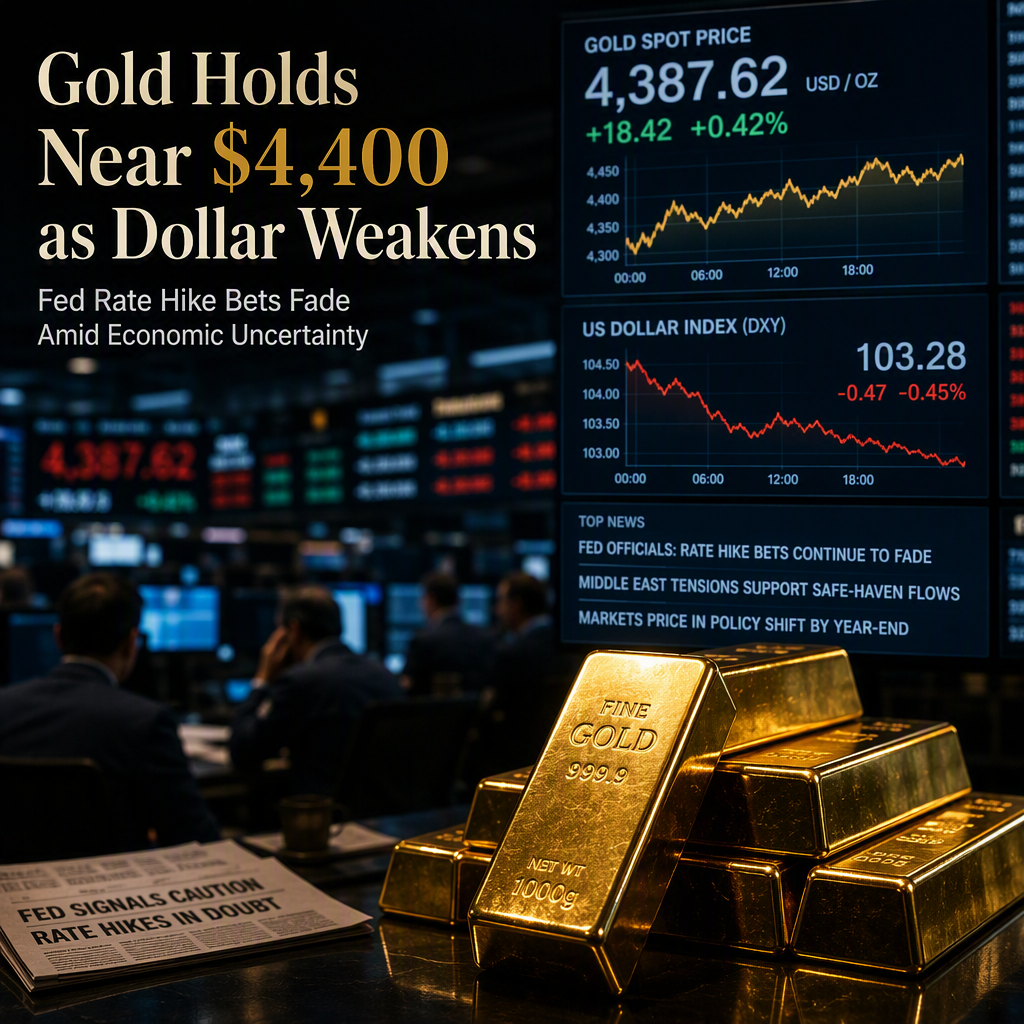
Gold (XAU/USD) maintained modest gains on Monday, trading near $4,401 after reaching an intraday high of $4,416 during Asian hours, as the US Dollar (USD) came under selling pressure due to diminishing expectations of a Federal Reserve (Fed) rate hike at the September meeting [1]. According to the CME FedWatch tool, the probability that the Fed will keep rates unchanged next month has risen to approximately 70%, up from 48% a week ago, following a series of disappointing US economic data, including declines in Nonfarm Payrolls (NFP), Retail Sales, and slower annual inflation in both the Consumer Price Index (CPI) and Producer Price Index (PPI) [1].
The weaker economic data has led to lower short-term US Treasury yields, while longer-dated yields remain near recent highs, steepening the Treasury yield curve and creating a challenging environment for the US Dollar [1]. The US Dollar Index (DXY) traded around 99.45 after touching 99.30, its lowest level since June 5 [1]. Analysts at DBS Group Research noted that the traditional relationship between US rates and the currency is under strain, citing fading Fed-hike expectations, persistent US fiscal concerns, and elevated long-term Treasury yields as factors that could weaken the link between higher US yields and a stronger USD. They warned that speculators with large short USD positions are on 'fragile ground' [1].
Gold retains a positive near-term bias, with technical indicators such as the Relative Strength Index (RSI) near 65 and the Moving Average Convergence Divergence (MACD) in positive territory, suggesting buyers remain in control without the market being overbought [1]. The spot price is holding just above the 100-day Simple Moving Average (SMA) at $4,385, with immediate support at this level and further demand at $4,200 and the 50-day SMA near $4,100 [1].
Market sentiment for gold is also influenced by geopolitical developments in the Middle East, particularly the expiration of a 60-day memorandum of understanding between the United States and Iran regarding the reopening of the Strait of Hormuz. The lack of agreement has kept oil prices elevated and the inflation outlook uncertain, which could prompt the Fed to maintain higher borrowing costs for longer, posing a potential headwind for gold [1].
CONCLUSION
Gold prices are holding steady near $4,400 as fading expectations for a Fed rate hike and a weaker US Dollar support the metal. However, ongoing geopolitical uncertainty and the potential for prolonged higher US rates could limit further gains. Market participants remain cautious, closely watching both economic data and developments in the Middle East.