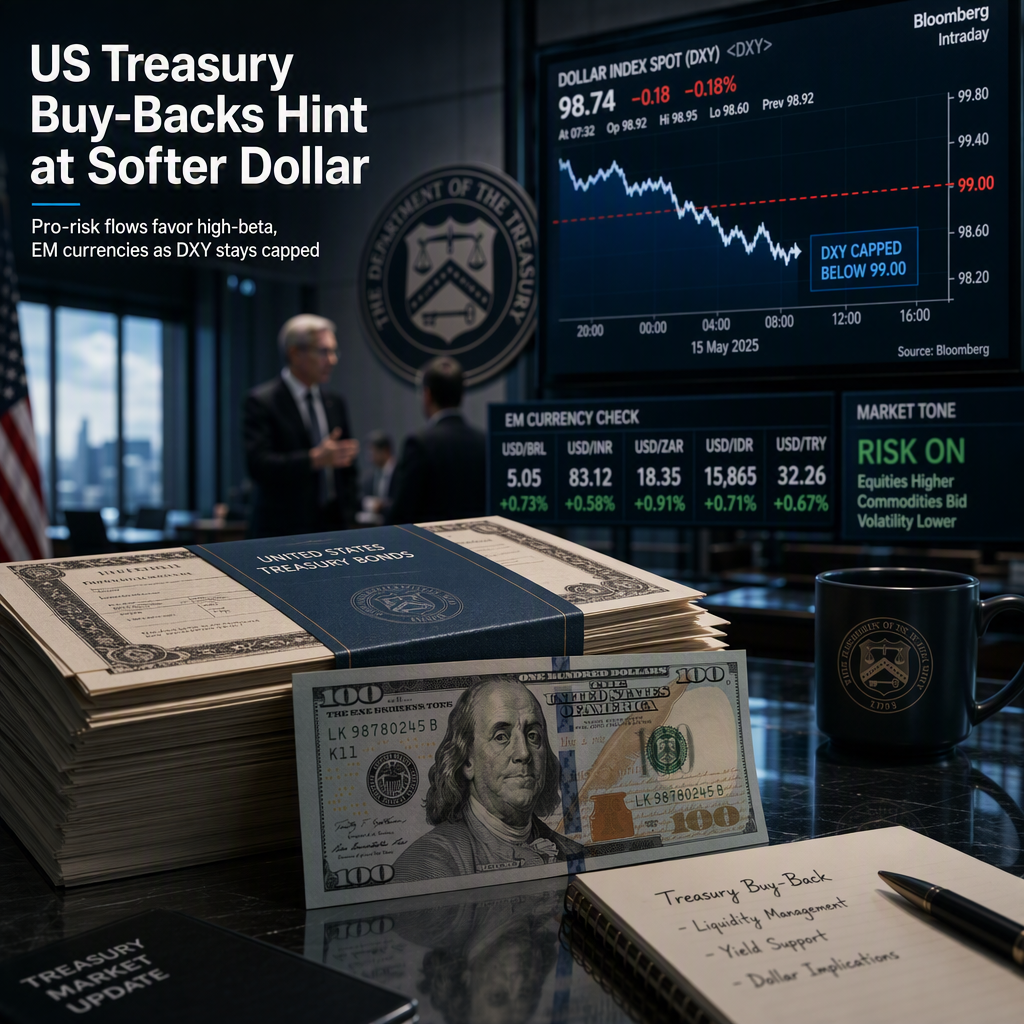
ING analysts Chris Turner, Francesco Pesole, and Frantisek Taborsky state that recent US Treasury buy-back operations are primarily a signalling tool aimed at addressing high yields in longer-dated Treasuries, rather than a direct intervention to resolve market liquidity issues [1]. The analysts note that the off-cycle nature of these buy-backs has attracted attention, but emphasize that the main message is the US Treasury's focus on elevated yields [1]. US Treasury Secretary Scott Bessent indicated that new fiscal consolidation plans may be forthcoming, potentially involving a task force to reduce fraud, drawing a parallel to previous government spending reduction efforts [1].
The ING team observes that some market participants are comparing the Treasury's actions to past events that undermined US policy credibility, such as President Donald Trump's 'Liberation Day' tariffs in April 2025, which led to a weaker dollar against the Swiss franc, euro, and yen [1]. However, ING interprets the current situation as more supportive of a softer dollar in a pro-risk environment, with high-beta commodity and emerging market currencies likely to outperform [1]. They forecast that the DXY index will remain capped below 99.00, with support in the 98.65/70 region, and suggest that a sharp sell-off in Treasuries and equities could reverse this trend, reviving safe-haven demand for the dollar and leading to lower USD/CHF, higher EUR/USD, and selling pressure on high-yield currencies as volatility rises [1].
The analysts also highlight the upcoming S&P PMI readings for August, which are expected to show continued expansion in US economic activity [1]. This data point is seen as relevant for short-term dollar movements, but the overall bias remains towards a softer dollar unless market volatility increases significantly [1].
CONCLUSION
ING analysts view the US Treasury's recent buy-back operations as a signal to address high yields, supporting a softer dollar in a risk-friendly environment. The DXY is expected to remain below 99.00, with high-beta and emerging market currencies likely to benefit unless a sharp sell-off in Treasuries and equities triggers renewed safe-haven demand for the dollar.