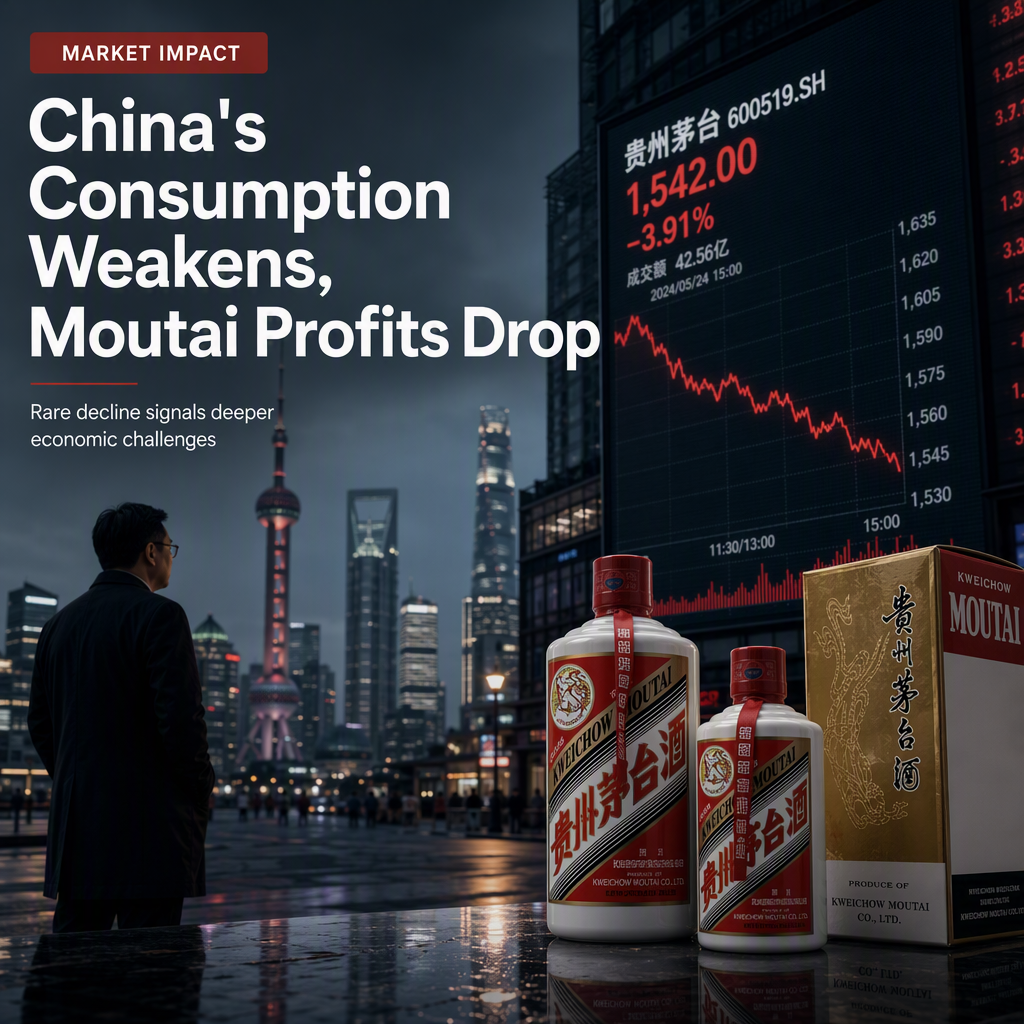
China's economy is facing mounting challenges as recent data highlights a slowdown in both consumer spending and industrial production, with significant implications for major companies such as Kweichow Moutai. In July, China's industrial production growth decelerated to 4.5% from 5.3% in June, signaling a loss of momentum in the manufacturing sector and underscoring persistent economic headwinds [1]. Consumer spending and investment also remained weak, with analysts noting that the recovery in consumer demand has not met expectations and that investment in property and infrastructure continues to lag [1].
Kweichow Moutai, once the largest company by market capitalization in mainland China, reported a rare 1.95% drop in net profit to 44.5 billion yuan ($6.6 billion) for the first half of the year, marking its first such decline for the period since 2014 and only the second since 2002, according to Wind Information data [2]. This follows a 4.5% decline in net profit for all of 2025, the first annual drop on record for the company [2]. The company's stock has fallen 5.7% year-to-date as of Tuesday and has declined annually for four consecutive years [2].
Analysts attribute Moutai's struggles to broader shifts in China's economic environment, including a slowdown in the real estate sector and a pivot toward high-end technology and artificial intelligence industries [2]. Urban fixed-asset investment, including real estate and infrastructure, declined 5.7% in the first six months of the year compared to a year earlier [2]. The anti-corruption crackdown and tighter restrictions on real estate developer borrowing have further weighed on retail sales and consumption of premium products like baijiu [2].
Despite a surge in AI-related exports providing some support to the economy, the divergence between export-driven sectors and domestic consumption is widening [1]. Market strategists recommend caution, advising investors to focus on export-heavy industries benefiting from the global AI boom while remaining wary of sectors tied to domestic consumption and real estate [1]. Market sentiment remains mixed, with optimism in technology exports but persistent concerns about the sustainability of broader economic growth [1].
CONCLUSION
China's latest economic data and Moutai's rare profit decline underscore the country's ongoing struggle with weak domestic demand and a slowing industrial sector. While technology and AI-related exports offer some relief, the broader outlook remains cautious, with analysts and investors closely watching for potential policy responses from Beijing. The market impact is significant, particularly for sectors reliant on consumer spending and real estate.