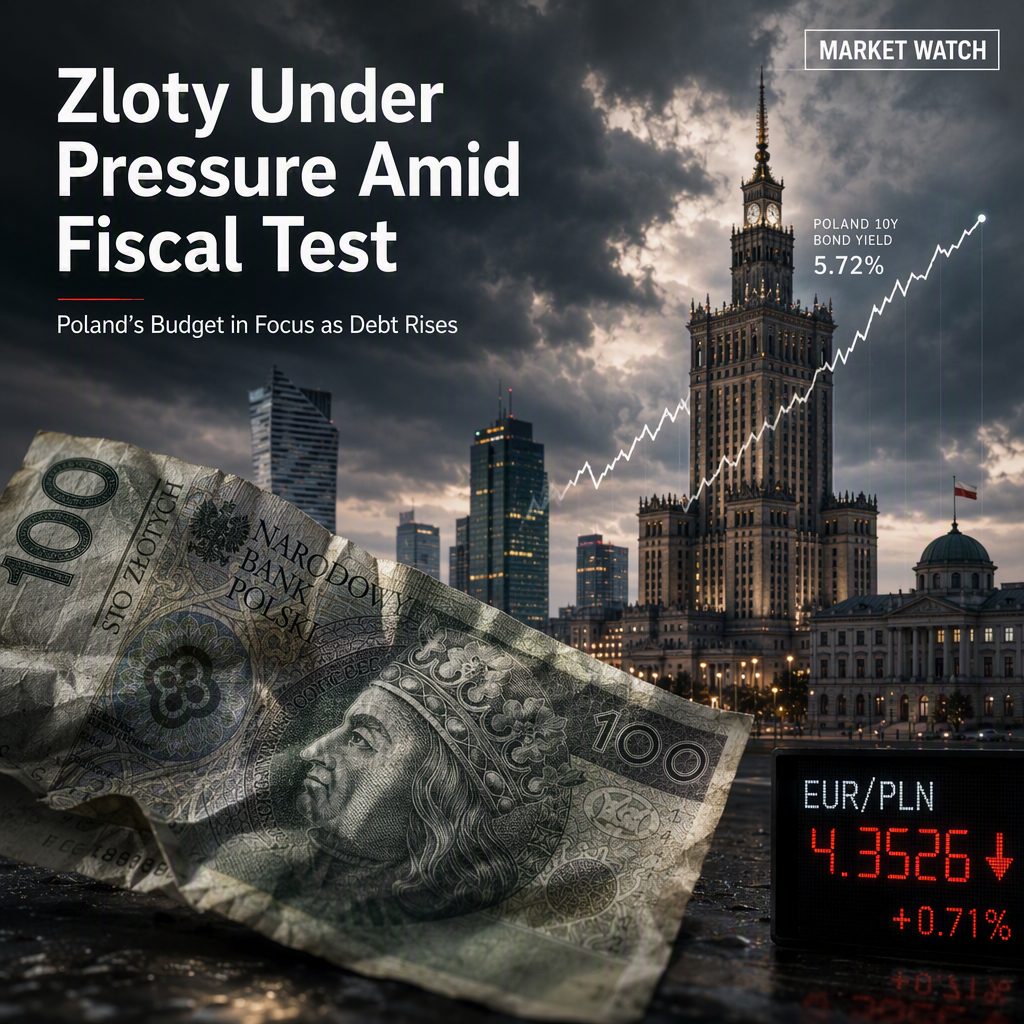
Societe Generale has highlighted that Poland's elevated fiscal deficit, currently at 7.3% of GDP, and rapidly increasing public debt are likely to keep the Polish zloty under pressure against the euro. The upcoming draft 2027 budget, set to be unveiled by Prime Minister Tusk’s government on Friday, is identified as the next critical test for investor appetite towards Polish assets [1]. Societe Generale warns that further fiscal slippage could push the yield on Poland’s 10-year government bonds (POLGB) above 6% and drive the EUR/PLN exchange rate back toward the 4.35 resistance level [1].
Fitch recently maintained Poland’s sovereign rating at A- with a negative outlook, underscoring ongoing fiscal risks despite the country’s large, diversified, and resilient economy, as well as the policy support provided by EU membership [1]. The government plans to keep the budget broadly neutral by lowering income tax for the middle class and raising taxes on large companies starting in 2027 [1].
Market participants are closely watching the release of the draft 2027 budget, as it is expected to test investor confidence in Polish assets. Societe Generale and Fitch both point to fiscal discipline as a key factor influencing the zloty’s performance and Poland’s borrowing costs [1].
CONCLUSION
Poland’s fiscal outlook remains a concern for investors, with the elevated deficit and rising debt levels putting pressure on the zloty and government bond yields. The upcoming draft 2027 budget will be a pivotal moment for market sentiment, as further fiscal slippage could lead to renewed weakness in the zloty and higher borrowing costs.