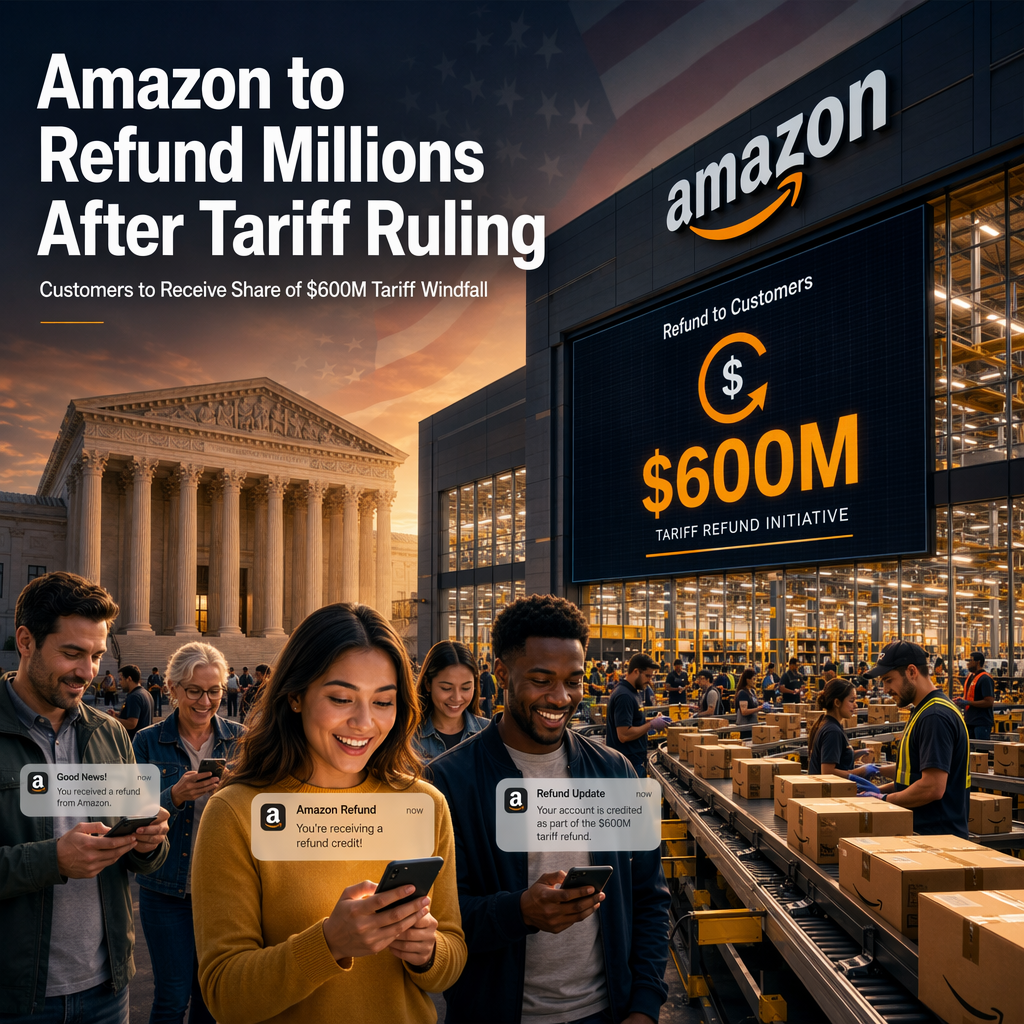
Amazon announced that it has received approximately $600 million in tariff refunds in the second quarter, following a Supreme Court decision that invalidated many of President Donald Trump's tariffs imposed under the International Emergency Economic Powers Act of 1977. The Supreme Court's February ruling required the government to pay back duties to companies that had imported goods affected by these tariffs, prompting major corporations such as Apple, Walmart, Costco, Home Depot, and General Motors to apply for refunds as well [1].
Amazon's finance chief, Brian Olsavsky, stated during the company's earnings call that the company is participating in the tariff refund process and has already received the refund. He explained that Amazon was issued a 'limited' refund amount because the company had prepositioned inventory in anticipation of the tariffs and is not the importer of record for the majority of items sold on its platform. Over 60% of goods sold on Amazon's marketplace are from third-party sellers, many of whom raised prices due to the tariffs and have since applied for their own refunds [1].
Olsavsky also revealed that Amazon will return some of the tariff refunds to customers. The company has identified specific cases where import charges were directly passed on to shoppers and will proactively contact those customers to issue automatic refunds. For other cases, Amazon plans to use the refunds to continue investing in low prices for customers, similar to the approach taken by other large retailers [1].
The Supreme Court ruling and subsequent refunds have had a notable impact on other companies as well. Apple reported that its earnings per share were boosted by 5%, or 11 cents, in the third quarter due to tariff refunds. The issue of whether companies would seek refunds became politically charged, with former President Trump stating he would 'remember' companies that did not apply for refunds. Amazon previously faced criticism and a class action lawsuit from consumers alleging the company was not seeking refunds to avoid offending Trump, and had also drawn attention from the White House for considering displaying tariff costs on its website [1].
CONCLUSION
Amazon's receipt of $600 million in tariff refunds and its plan to return some of these funds to customers mark a significant development following the Supreme Court's ruling against Trump's tariffs. The move is expected to benefit both Amazon and its shoppers, while also highlighting the broader impact of the tariff refunds on major U.S. retailers. Market sentiment appears cautiously positive, with implications for pricing strategies and consumer relations.