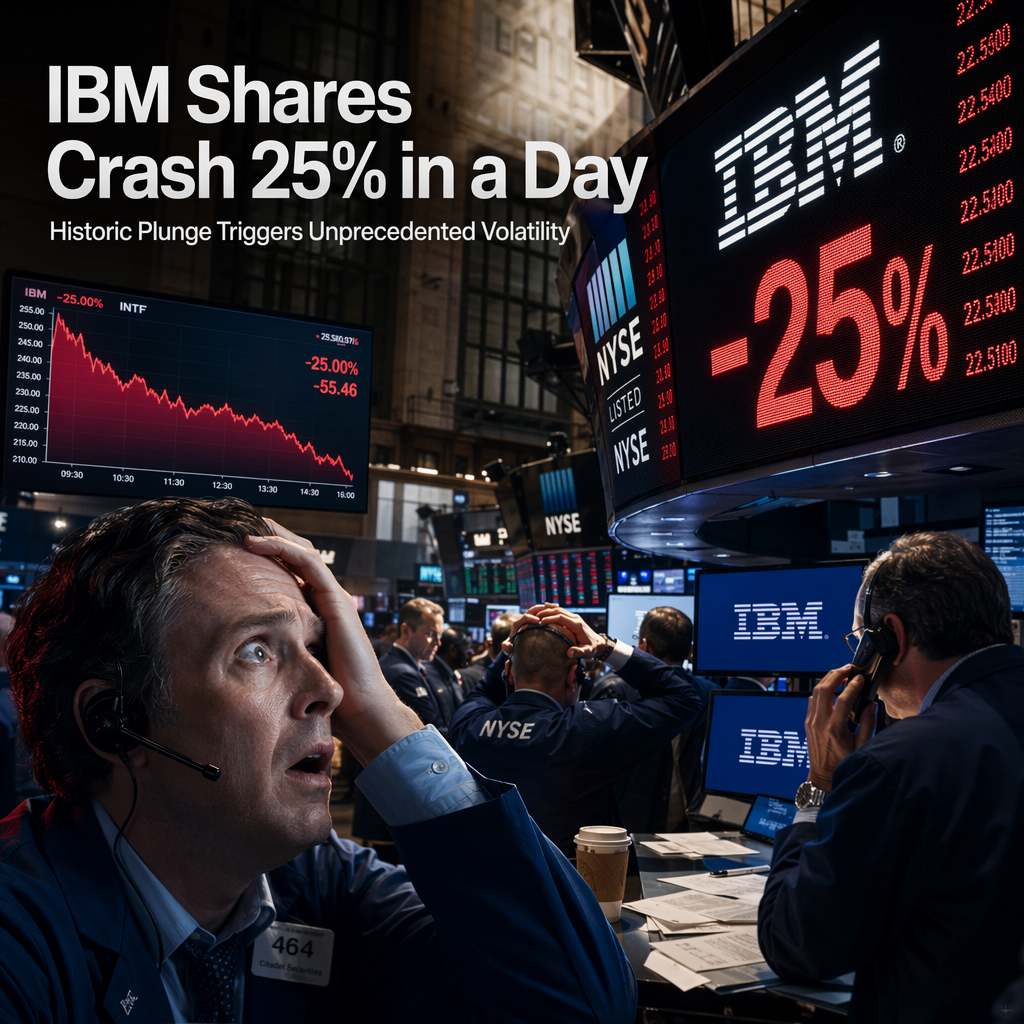
On July 14, 2026, International Business Machines (IBM) experienced a dramatic single-day stock price decline, falling just over $73 to approximately $217, which represents a 25% drop in value. This marks the steepest single-session decline in the author's lifetime and is comparable in scale only to a market event on January 3, 1968 [1]. The primary catalyst for this sell-off was IBM's preliminary Q2 revenue report, which showed sales of $17.2 billion—falling short of Wall Street's expectation of $17.9 billion. The shortfall was attributed to a 7% decline in the company's infrastructure division. CEO Arvind Krishna explained that enterprise customers shifted spending away from IBM's traditional products, opting instead to conserve cash for hardware, servers, and storage purchases, in anticipation of AI-driven supply shortages and potential price increases. However, the article notes that this explanation is Krishna's narrative and not an independently verified trend [1].
The market's reaction was swift and severe, with implied volatility in IBM options surging to the 99.6th percentile—higher than during the 2019 Taper Tantrum, the 2022 rate-hike bear market, and various tariff-related market disruptions, and exceeded only by the volatility seen during the 2020 pandemic-induced market plunge [1]. Despite the sharp sell-off, the options market has not experienced the typical post-news 'vol crush,' indicating ongoing uncertainty and fear among investors.
The article suggests that, given the magnitude of the decline, most of the downward momentum in IBM shares may be exhausted. It proposes a short strangle options strategy—selling the August 21, 2026, 190/245 strangle—to capitalize on the elevated premiums. This trade could capture approximately $11.25 per strangle, representing a 5.18% yield over 38 days, with downside and upside breakevens at $178.75 and $256.25, respectively. The strategy is based on the expectation that IBM shares will consolidate within this wide range, as further significant moves are considered unlikely in the short term [1].
No analyst opinions or additional forward-looking statements are provided beyond the options strategy recommendation.
CONCLUSION
IBM's historic 25% single-day stock plunge, triggered by a Q2 sales miss, has led to unprecedented volatility in the options market. While panic remains high, the article suggests that the worst of the sell-off may be over, presenting opportunities for options traders to capitalize on elevated premiums. The market impact is significant, with uncertainty likely to persist in the near term.