
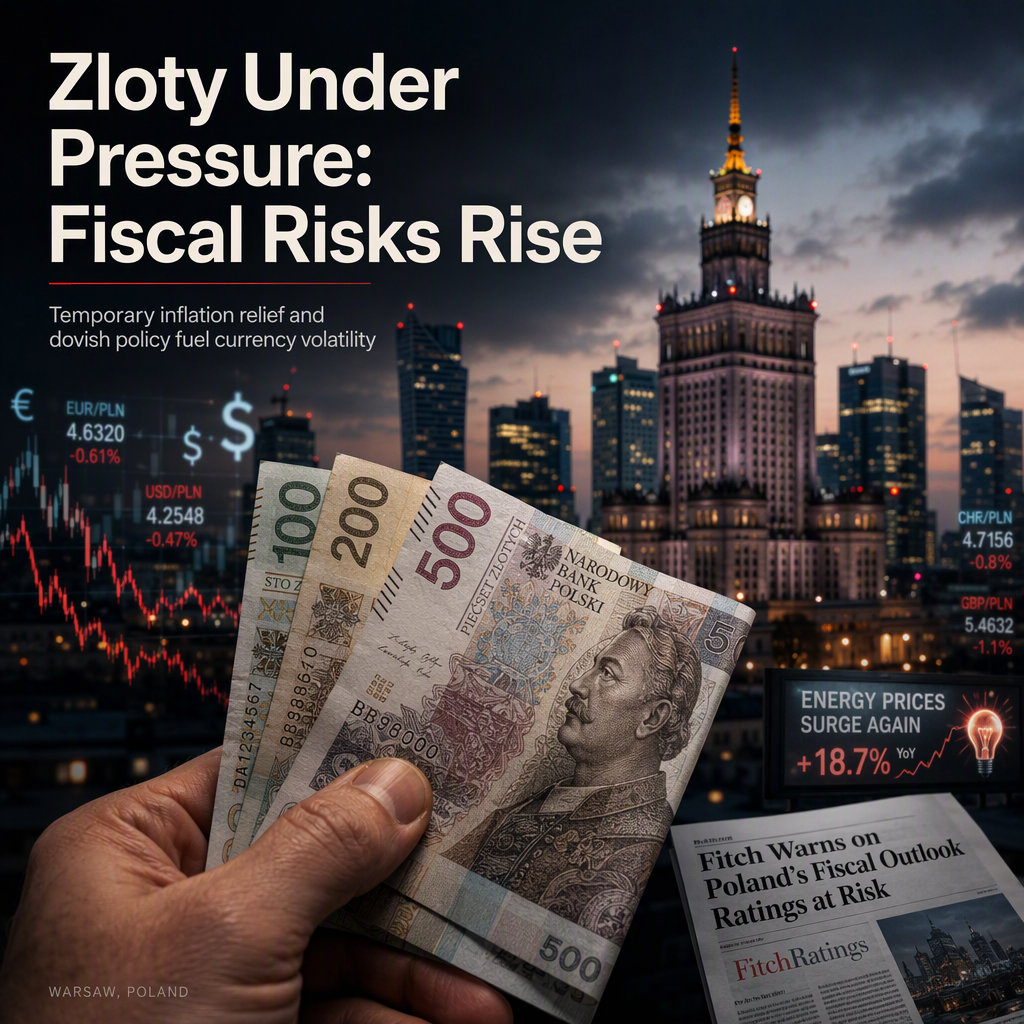
The Polish Zloty (PLN) is under significant pressure due to a combination of policy decisions and fiscal risks, according to Commerzbank’s Tatha Ghose. The government’s temporary fuel tax cuts are expected to artificially lower October CPI inflation by a full 1 percentage point, potentially bringing headline inflation down to around 3% year-on-year from the previous reading of 4% [1]. However, this reduction is seen as temporary, with fuel prices forecast to rise again as early as this week due to global energy price movements, and the tax relief is scheduled to expire on 31 December. This could result in another inflation spike early next year unless the relief is extended, which is not guaranteed [1].
Ghose notes that the National Bank of Poland (NBP) appears to be using the temporary inflation relief as justification to delay interest rate hikes, a stance that has contributed to the Zloty's depreciation against regional peers such as the Hungarian forint. The dovish signals from the Monetary Policy Council (MPC) last week led to an immediate weakening of the Zloty, and this trend is continuing [1].
In addition to monetary policy concerns, rating agency Fitch has issued warnings regarding Poland’s large fiscal deficits and rising debt levels. Fitch forecasts fiscal deficits of 7.3% of GDP in 2026 and 7.1% in 2027, with government debt projected to reach 73.4% by 2028. Fitch cautions that failure to reduce the fiscal deficit, further pre-election easing, or weaker economic growth could trigger a sovereign rating downgrade, which would further extend FX downside risks for the PLN [1].
Overall, the combination of temporary inflation relief, dovish monetary policy, and significant fiscal risks is creating a negative environment for the Polish Zloty, with both immediate and longer-term downside risks highlighted by analysts and rating agencies [1].
CONCLUSION
The Polish Zloty is facing sustained pressure due to temporary policy measures, dovish monetary signals, and warnings from Fitch about fiscal sustainability. Unless fiscal deficits are addressed and prudent monetary policy is restored, the Zloty may remain vulnerable to further depreciation and potential rating downgrades.