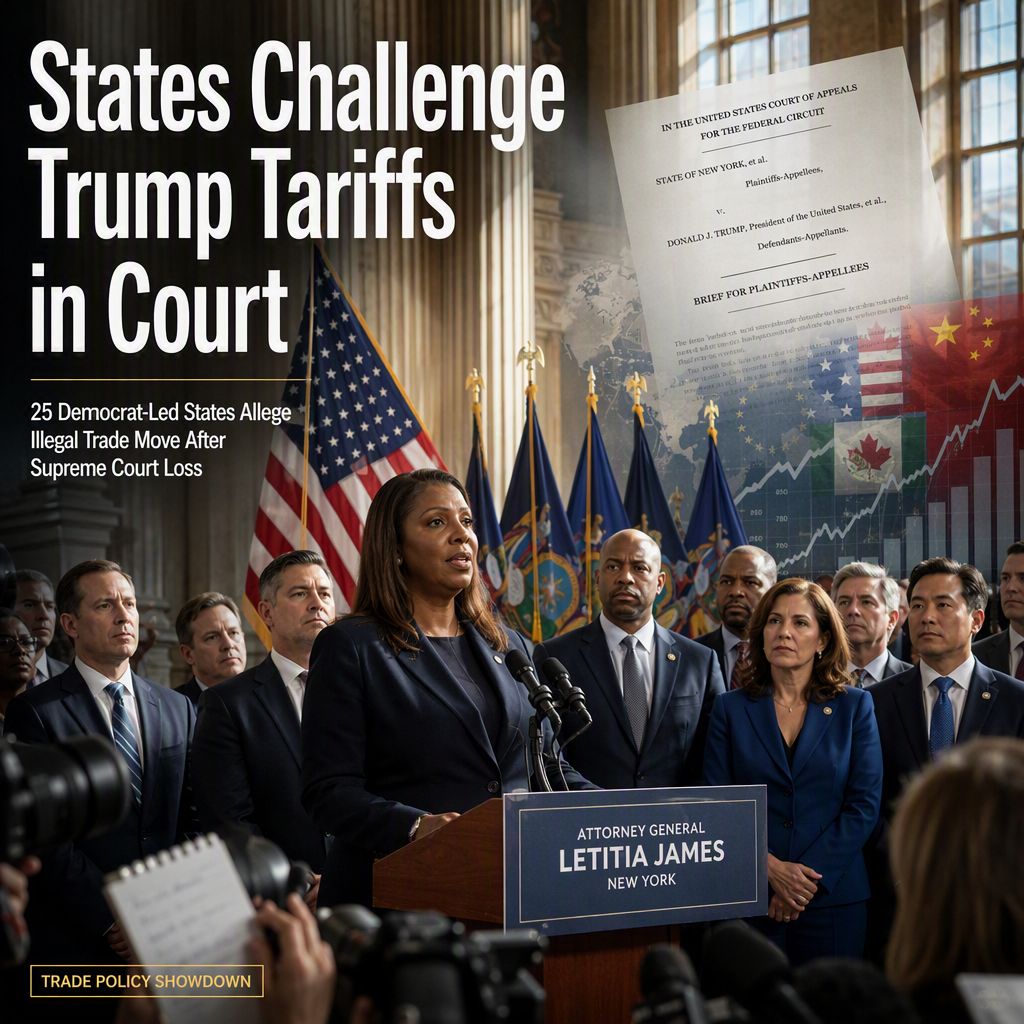
President Donald Trump's administration is facing legal action from 25 Democrat-led states over a new round of tariffs announced last month, which target 59 countries and the European Union. The lawsuit, spearheaded by New York Attorney General Letitia James, alleges that these tariffs are an illegal attempt to circumvent a recent U.S. Supreme Court ruling that limited the president's authority to impose broad tariffs under the International Emergency Economic Powers Act. James stated, 'After losing at the Supreme Court, the administration is once again trying to illegally raise taxes on families and businesses with a new round of tariffs' [1].
The Trump administration justifies the tariffs by citing 'forced labor violations,' arguing that the targeted countries and the EU have failed to adequately address imports produced by forced labor. The administration invoked Section 301 of the Trade Act of 1974, which permits the president to impose tariffs on countries found to be engaging in unfair trade practices. White House spokesman Kush Desai defended the move, stating, 'The United States is using its lawful authority to obtain the elimination of unreasonable acts, policies, and practices that burden U.S. commerce,' and emphasized that Section 301 tariffs are a 'legally durable tool' [1].
The lawsuit includes states such as Arizona, California, Colorado, Connecticut, Delaware, Hawaii, Illinois, Kentucky, Massachusetts, Maryland, Maine, Michigan, Minnesota, Nevada, New Jersey, New Mexico, North Carolina, Oregon, Pennsylvania, Rhode Island, Virginia, Vermont, Washington, and Wisconsin, in addition to New York [1]. The legal challenge follows a 6-3 Supreme Court decision that the International Emergency Economic Powers Act does not authorize the president to impose broad tariffs, a ruling that Trump has publicly criticized, claiming it has cost the U.S. 'trillions' in money and prestige [1].
Market implications are significant, as the lawsuit challenges the legal foundation of tariffs affecting a wide range of international trade partners. The outcome could impact U.S. businesses and consumers, depending on whether the tariffs are upheld or struck down. No specific analyst opinions or forward-looking statements are provided in the source [1].
CONCLUSION
The lawsuit by 25 Democrat-led states against the Trump administration's new tariffs marks a major legal and political confrontation over U.S. trade policy. With the tariffs affecting 59 countries and the EU, the case has high stakes for international commerce and domestic economic interests. The market impact is likely to be substantial, pending the legal outcome.