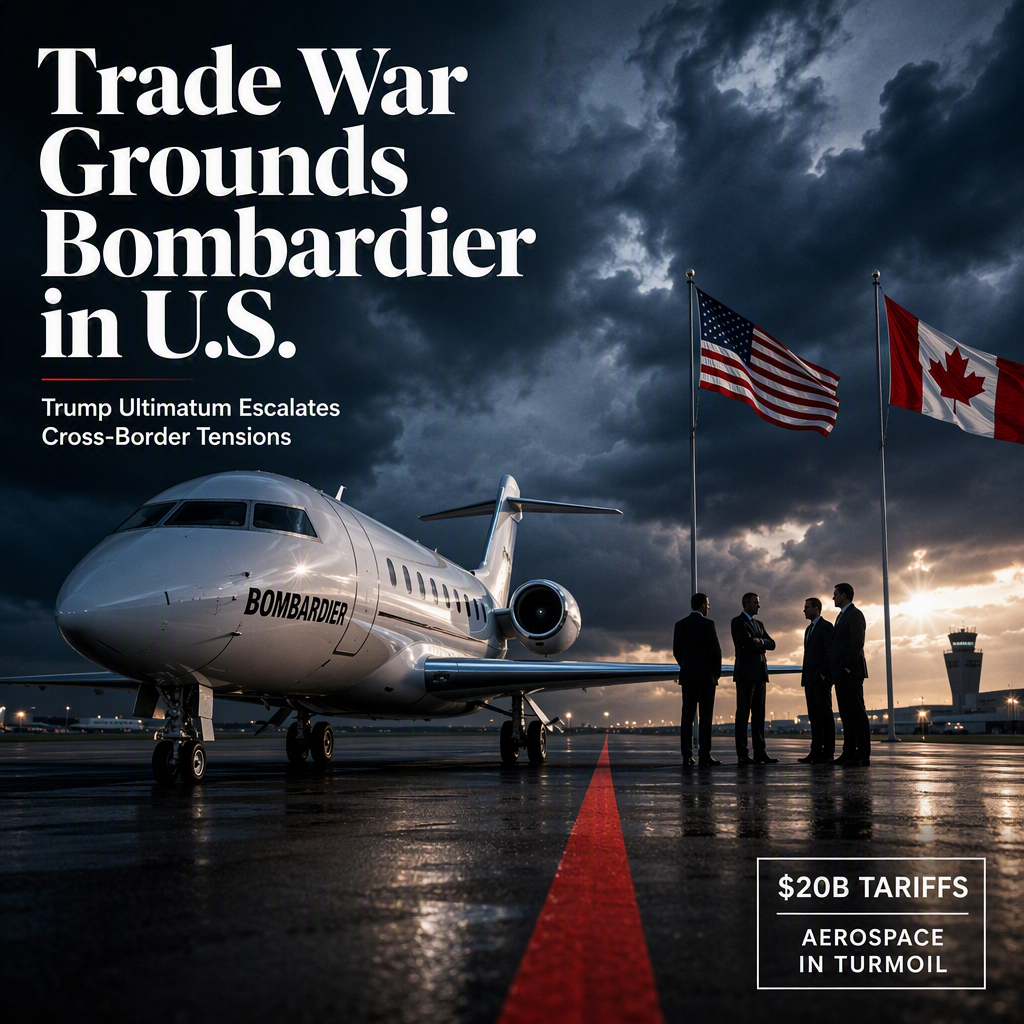
President Donald Trump announced on Monday that Canadian aerospace manufacturer Bombardier will no longer be permitted to sell its products in the United States unless it establishes production facilities within the country [1]. This directive is part of an intensifying trade conflict between the U.S. and Canada, with approximately $20 billion in Canadian retaliatory tariffs set to take effect on Tuesday, targeting over 700 U.S. goods [1].
Trump made his position clear on Truth Social, stating, "NO MORE SELLING BOMBARDIER IN THE UNITED STATES! If they want our Market, they must build here, and stop treating America like a 'piggybank'" [1]. Bombardier has not yet responded to requests for comment regarding the announcement [1].
The Canadian government, led by Prime Minister Mark Carney, announced the retaliatory tariffs on August 25, aiming to match the scale of Trump's recent 50% tariffs on Canadian products such as wine, cement, and hockey sticks, which followed a breakdown in trade negotiations [1]. U.S. Commerce Secretary Howard Lutnick attributed the collapse of the trade deal to Canadian political motives, while Carney indicated that Canada would be willing to resume talks when the U.S. is ready [1].
The developments signal a significant escalation in trade tensions, with direct implications for cross-border aerospace sales and broader U.S.-Canada economic relations [1].
CONCLUSION
President Trump's ultimatum to Bombardier marks a sharp escalation in the U.S.-Canada trade dispute, with immediate threats to aerospace trade and broader economic ties. The imposition of $20 billion in Canadian retaliatory tariffs and the breakdown in trade talks underscore the high market impact and uncertainty facing both nations' industries.